Hanoi plans to bury electrical and telecommunications cables
Hanoi sets the target to build a city without overhead wires by undergrounding electrical and telecommunications cables.
Hanoi has made plans to lay electrical and telecommunications cables underground on 300 streets in 11 districts and towns by 2025, according to the municipal Department of Construction.
Hanoi has trenched electrical and telecommunications cables on 187 out of 255 streets so far.
In the final months of 2021, the Hanoi Department of Construction continues the work on other 58 streets. However, the department said that the undergrounding work may face obstacles due to the Covid-19 pandemic.
In particular, Viettel Telecommunications Corporation (Viettel) trenched 29 of its 68 lines, Vietnam Post and Telecommunications Group (VNPT) buried 50 of 58 lines while MobiFone Telecommunications Corporation and FPT Telecom Joint Stock Company undergrounded 12 of 13 lines and 38 of 60 lines, respectively.
The landscape of streets has been improved after trenching electrical and telecommunications cables. Electricity supply has been ensured and the number of electricity incidents has reduced.
Underground electrical and telecommunications cables are buried on Le Van Luong Street in Hanoi's inner district of Thanh Xuan. Photo: Hong Ky |
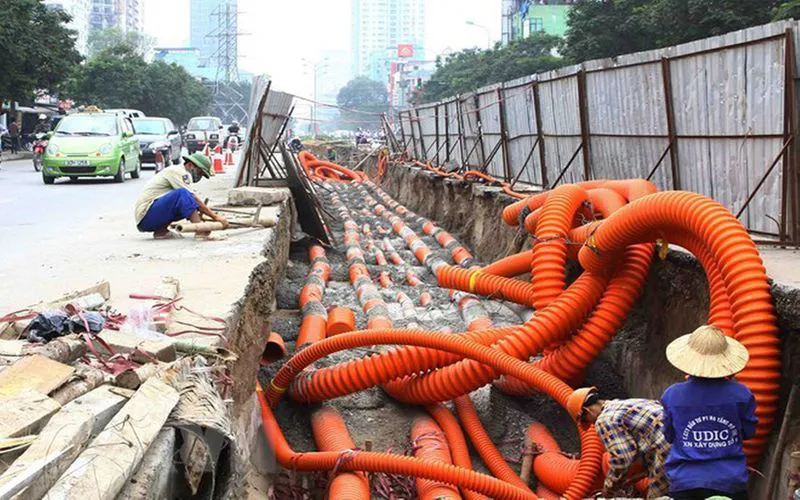
Hanoi has set a target to build a city without overhead wires by burying underground electrical and telecommunications cables.
In order to continue the urban renewal plan, the Department of Construction has coordinated with the Department of Information and Communication and People's Committees of districts to draw up a list of streets where cables would be buried.
The Hanoi authorities will focus on burying cables in the main streets of four core districts, including Ba Dinh, Hoan Kiem, Dong Da, and Hai Ba Trung. The work will be expanded to other outlying districts as soon as possible.
The urban landscape of Hanoi today is in stark contrast with years ago when streets of the capital city were plagued with bunches of tangled cables and wires of cable television, electricity and internet hung in utility poles.
To get rid of overhead lines, the local government has invested to clear and bury them. However, the funding source is not sufficient to do the undergrounding in many streets and alleys in districts.
In order to solve the difficulties, over the past time, the municipal government has reached agreements with VNPT, Viettel, and Hanoi Power Corporation (EVN Hanoi) to trench cables in streets in the city.
The undergrounding has been realized with the involvement of private resources, with the target that by the end of 2025 all the overhead lines in four downtown districts will be trenched.
The three above-mentioned telecom groups pledged to support Hanoi in deploying synchronous undergrounding of electrical and telecommunications cables, in line with the capital city's plans of socio-economic development.
EVN Hanoi will spend about VND1.5 trillion (US$64.8 million) to lay electrical wires and telecommunication cables underground along city streets this year.
Deputy General Director of the EVN Hanoi Nguyen Anh Dung said the work aims to not only improve the urban look but also increase the quality of the company’s power service.
“The power service will be better as any problem that occurs in the city’s power system will be fixed within two hours. We did a good job in responding to power-supply issues,” Dung told The Hanoi Times.