Hanoi promotes green and modern industrial clusters
These clusters are to be developed in a clean, high-tech, eco-friendly, and circular economy-oriented way.
The Government's Decision dated December 27, 2024 approving the adjustment of the Hanoi Capital Master Plan to 2045, with a vision to 2065 sets the objective of developing industrial clusters and craft villages in a green, modern, and smart way.
These areas will leverage high-tech applications and take advantage of favorable infrastructure conditions.
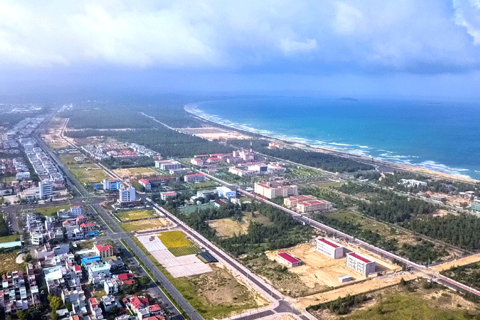
| The design of Xa Cau Industrial Cluster in Ung Hoa District. File photo |
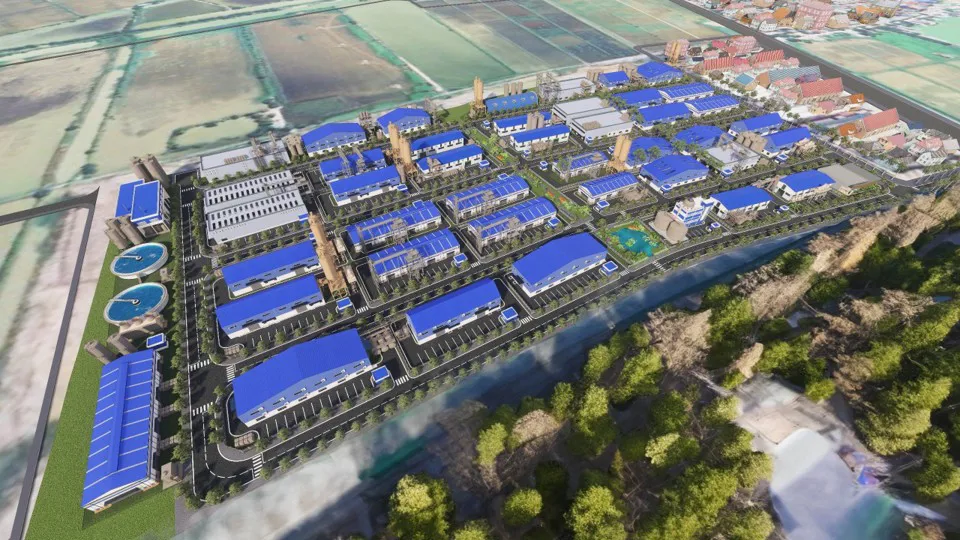
The Hanoi Capital Master Plan also outlines priorities for the development of industrial clusters integrated with craft villages, emphasizing the establishment of cultural spaces to showcase, promote, and market products while combining tourism development. These clusters are to be developed in a clean, high-tech, eco-friendly, and circular economy-oriented way.
Eco-friendly industrial clusters
Currently, three industrial clusters have been approved and are operational in Ung Hoa District, namely Bac Van Dinh, Xa Cau, and Cau Bau in Quang Phu Cau Commune. Additionally, the district is home to 21 craft villages recognized by the Hanoi People’s Committee, specializing in trades such as leather footwear, textiles, lacquerware, bamboo weaving, incense stick making, basketry, and inlay work. Production from these villages accounts for over 60% of the district’s industrial and handicraft output.
However, the co-location of production facilities in residential areas limits their expansion and poses challenges in terms of transportation, electricity, water supply, and environmental protection. Some villages face environmental pollution issues, particularly from untreated wastewater.
Deputy Head of the Urban Management Division of Ung Hoa District Bui Anh Van highlighted plans to consolidate handicraft production into industrial clusters. In Quang Phu Cau, two clusters—Cau Bau and Xa Cau—are operational and slated for expansion by 65 hectares and 75 hectares, respectively.
“The aim is to relocate businesses to these clusters to mitigate pollution and enhance fire safety. The district's development strategy also focuses on fostering green industrial zones and creative craft villages with a balanced industrial-service-agriculture structure,” Van told The Hanoi Times.
In Thanh Oai District, industrial clusters have significantly contributed to economic growth and created thousands of local jobs. These clusters are planned and built following green and environmentally friendly standards. For example, the Kim Bai Industrial Cluster covers an area of over 46 hectares with an investment of over VND1 trillion ($42.5 million). It consists of 100 industrial plots, each ranging from 2,000 to 2,500 square meters, and follows sustainable and green criteria. The cluster features a centralized wastewater treatment plant with a capacity of 1,500 cubic meters per day, designed using advanced Japanese technology with online monitoring capabilities. Green spaces account for over 11% of the cluster. Enterprises investing in the cluster are required to use modern, eco-friendly technology.
Bui Van Sang, Chairman of the Thanh Oai District People’s Committee, emphasized that the district prioritizes industrial cluster development as a means to achieve socio-economic growth and create jobs. However, all projects must meet strict environmental protection standards. Outdated, polluting production methods will not be allowed, and businesses are encouraged to transition to modern, environmentally friendly technologies, Sang said.
| The design of the upcoming Kim Bai Industrial Cluster. |

New clusters to comply with environmental regulations
The Prime Minister's approval of Hanoi's updated master plan calls for industrial clusters to support the relocation of businesses and production facilities from urban and residential areas. The plan prioritizes industrial clusters integrated with craft villages, creating cultural spaces for product promotion and combining tourism development. These clusters will follow clean, high-tech, eco-friendly, and circular economy models.
The master plan provides for the development of 71 industrial clusters—32 existing clusters to be expanded and 39 clusters carried over from the 2011–2020 period to the 2021–2030 phase. Additionally, 54 new potential clusters may be developed if they meet land use and regulatory requirements. Land resources must be utilized sustainably and efficiently, with a focus on environmental protection. All industrial parks, export processing zones, and clusters must achieve 100% compliance with wastewater treatment standards.
Beyond 2030, the development of new clusters will require careful assessment of their economic, social, and environmental impacts, as well as compliance with land use and environmental regulations. Industrial clusters located in green corridor areas will be strictly controlled to ensure alignment with Hanoi’s vision for sustainable development.