Hanoi pushes high-tech agriculture
High-tech agricultural products are expected to make up more than 70% of the city's total agricultural output by 2030.
THE HANOI TIMES — The Hanoi Department of Agriculture and Environment is set to propose policies to spur production, modernize processing and draw investment into agricultural infrastructure.
The idea was discussed at the workshop on August 12 on enhancing post-harvest values and food processing for agricultural, forestry, and fishery products.

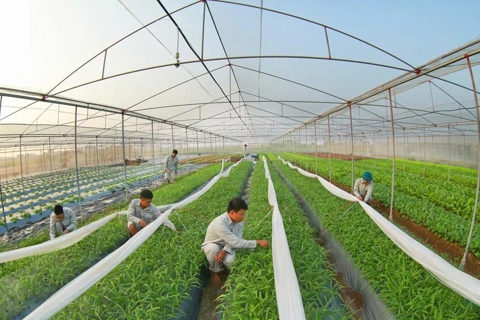
Hygienic production at Japan-Vietnam Vegetable Fruit Company. Photo: Phuong Nga/The Hanoi Times
Speaking at the workshop, Ta Van Tuong, the department’s Deputy Director, said the agency will work with research institutes and universities to transfer advanced processing technologies, expand good practices, and improve quality management.
Businesses will be encouraged to invest in modern methods, such as irradiation, hot steam treatment, modified-atmosphere packaging, and cold storage, in addition to cooperating with research bodies.
Meanwhile, the agricultural sector has adopted high-tech solutions, digital transformation, mechanization, and traceability systems, aiming for modern, clean, organic, and circular agriculture linked to processing, climate adaptation, and global value chains.
At the event, government agencies, experts, scientists, and agricultural businesses also discussed the current situation, challenges, lessons learned, and solutions to develop the food processing industry.
Nguyen Thi Thu Hang, Head of the department’s Division of Quality Processing and Market Development, said that the city’s food processing sector faces high production costs and underperformance due to technological limitations. Limited technology also results in low output, as most products are sold fresh.
Large, capable enterprises are scarce, and access to land and capital for large-scale production remains difficult.
As many as 98.5% of Hanoi's 13,700 agricultural, forestry, and fishery production facilities are small and medium-sized. The city is home to 285 high-tech agricultural production models in Hanoi, including 185 in crop production, 45 in animal husbandry, 54 in aquaculture, and one that combines crop and animal husbandry.
Processed agricultural, forestry, and fishery products account for only about 30% of the city’s consumption, with most processed goods sourced from other provinces and cities.
2030 high-tech farming goals
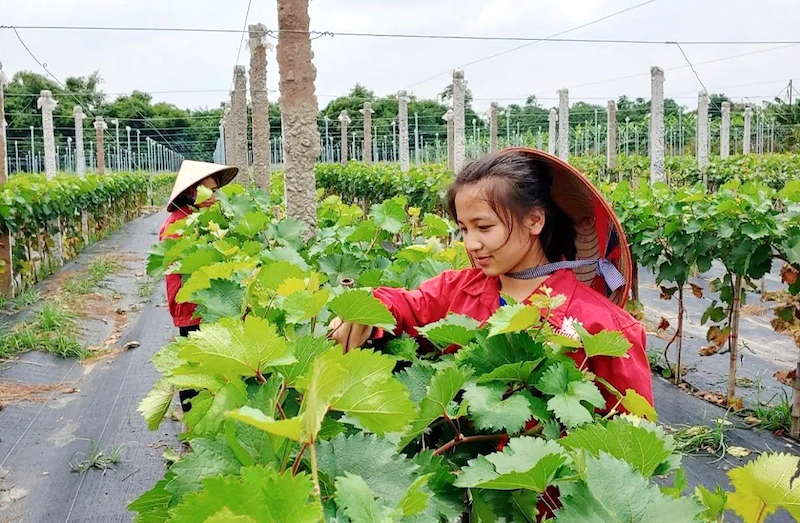
A high-tech model of black grape cultivation in Hanoi. Photo: Bao Linh/Kinh te & Do thi Newspaper
To meet the Politburo’s Resolution No. 57 on advancing science, technology, innovation, and digital transformation, Hanoi has modernized its agricultural sector.
The city targets an increase of the number of high-tech agricultural models, farms, cooperatives, and enterprises by 10%-20% annually through 2030.
Producers, businesses, and cooperatives in concentrated farming areas are encouraged to adopt smart farming practices, implement e-farm management systems, and participate in product distribution and quality control networks.
By 2030, at least 20% of the city’s agricultural projects will focus on applying high-tech and digital technology solutions.
Hanoi also targets the establishment of a dedicated high-tech agricultural center, dozens of specialized production zones, dozens of high-tech cooperatives and certified high-tech agricultural enterprises.
Products from these high-tech agricultural enterprises must meet rigorous safety and environmental standards, with an emphasis on obtaining international certifications to enhance market competitiveness.
These measures are expected to drive the growth of high-tech agriculture and secure stable incomes for farmers.
By integrating advanced technology, sustainable practices, and market-oriented production, Hanoi aims to build a modern agricultural sector capable of meeting both domestic and global demands while positioning the capital as a leader in innovative, eco-friendly farming.