Hanoi's health sector leverages high-tech for world-class standards
Hanoi’s health sector, equipped with advanced technologies, digitally transforms management and develops smart healthcare models to meet increasing demand.
THE HANOI TIMES — The use of the Artispheno robot in brain, spine, and cardiovascular surgeries has helped Thanh Nhan Hospital to optimize surgical methods, achieve high precision and avoid complications.
The hospital is one of many medical institutions in Hanoi to adopt high-tech techniques and strive for world-class standards.
Thanh Nhan Hospital is also the first health center in the country to apply high-frequency waves in the treatment of musculoskeletal pain and to transfer the technique to other hospitals.
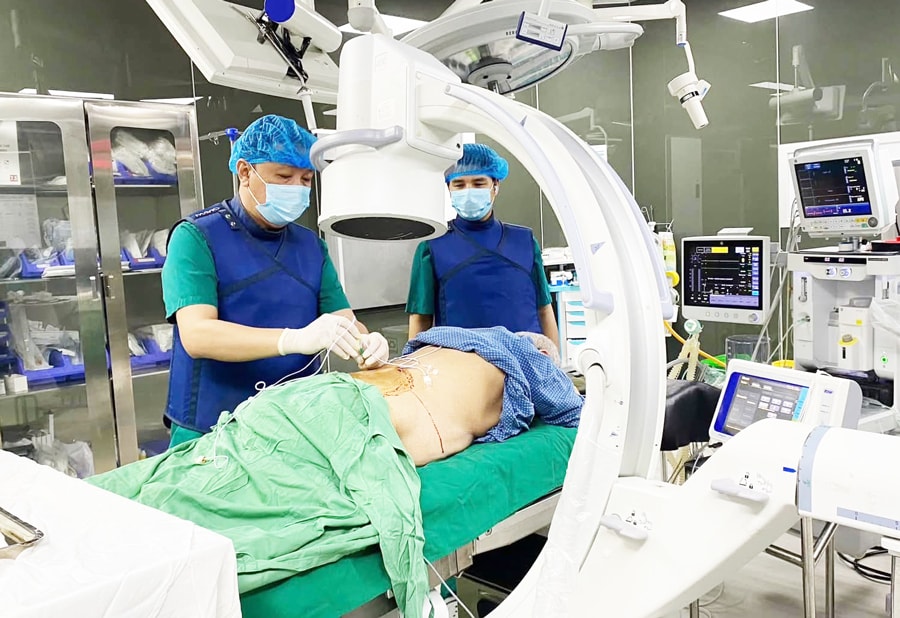
Thanh Nhan Hospital is the first in the country to use high-frequency waves to treat musculoskeletal pain. Photo: Hanoimoi
Dr. Nguyen Thi Le My, Deputy Director of Thanh Nhan Hospital, told the Hanoimoi Newspaper that the hospital focuses on leveraging information technology in management as well as medical examination and treatment.
At St. Paul General Hospital, the application of digital subtraction angiography (DSA) successfully saved a 12-year-old patient who suffered a stroke in early March.
The technique has also helped the hospital's doctors save the lives of many other patients with dangerous cerebrovascular malformations, including cerebral aneurysm, cerebral arteriovenous fistula, cerebral artery stenosis, arteriovenous malformation, and others. The number of patients undergoing DSA intervention was up to 95 cases per month.
"This is just one of the advanced techniques routinely performed at Saint Paul General Hospital. We have introduced many new difficult and complicated techniques, such as: laparoscopic surgery to completely remove the pancreatic-duodenal mass, laparoscopic liver resection to treat liver cancer, bile duct cancer, world-class pediatric surgery techniques," said Dr. Nguyen Duc Long, Director of the hospital.
In particular, the hospital is the first medical unit in Hanoi to apply the technique of harvesting and transplanting organs from brain-dead donors.
This year, the hospital will perform liver transplantation techniques while promoting radiology and interventional cardiology, coronary artery, stroke and trauma emergencies according to world standards, Long said.
Meanwhile, with the motto "For a healthy heart", after more than 20 years, the Hanoi Heart Hospital has performed operations for all cardiovascular diseases, for patients of all ages, from 1-day-old newborns to 93-year-old patients. The hospital has been taking care of an increasing number of patients. In 2024 alone, about 650,000 patients were hospitalized here (an increase of more than 10% compared to 2023); about 2,325 heart surgeries and 12,702 cardiovascular interventions were conducted, with the youngest patient weighing 900 grams.
Dr. Ha Anh Duc, Director of the Department of Medical Examination and Treatment Management under the Ministry of Health, said that as cardiovascular disease is currently the leading cause of death in the world, technology transfer and human resources training will allow patients to receive high-quality medical services right in their hometown, reducing the burden on tertiary hospitals.
Towards a smart healthcare model
Digital transformation is helping to improve treatment in Hanoi's hospitals, transform management, and develop smart healthcare models.
Smart healthcare kiosks in many hospitals really help. Instead of wasting time waiting in line at the help desk, people can conveniently register for medical examination and treatment or pay hospital fees at the smart healthcare kiosks using citizen ID cards and facial recognition.
At Saint Paul General Hospital, smart kiosks allow one staff member to attend to an average of 1,600 patients per day; the six-step reception protocol is shortened to two; the time for the reception protocol is reduced from 5-10 minutes to about 10 seconds. At Hoe Nhai Hospital, the time to perform the reception protocol for one patient is cut from five minutes to 30 seconds.
In addition, electronic medical records with data on medical examination and treatment are shared among hospitals; cashless payment is adopted; and artificial intelligence (AI) is applied to help doctors diagnose injuries and diseases more accurately.
"With electronic medical records, just open the computer, the entire medical background of the patient, including history of allergies, previous diseases, are fully provided, helping the health sector free up manpower, while examination and treatment is more convenient," said Nguyen Khuyen, Director of Van Dinh General Hospital.
Dr. Nguyen Dinh Hung, Deputy Director of Hanoi Department of Health, emphasized that in the coming period, the adoption of digital transformation in management, examination and treatment will be intensified, and all people will have electronic health records and electronic health books.