Solutions to support Hanoi's sustainable growth
Hanoi needs to attach importance to renovating old apartments, reconstructing the Old Quarter area, and developing the Red River axis.
The Hanoi Times — Hanoi needs to speed up real estate development, accelerate social housing projects, and focus on renovating old apartments to create sustainable growth, according to Hoang Van Cuong, former Vice-president of the National University of Economics.
Cuong told the Vietnam Government Portal that to create momentum for the city's rapid and sustainable growth in 2025, it is necessary to attract investment capital and focus on real estate development.
"Property growth will spill over into the services sector. Real estate that leads to services growth should be invested in," he said.
Although slower to develop, East Hanoi’s real estate market holds great advantages, in terms of improved transportation infrastructure, available land, and favorable policies aimed at promoting growth. “After Ha Tay province was merged with Hanoi in 2008, the capital’s western region experienced a real estate boom, while the east remained largely inactive. But now, East Hanoi is emerging as a promising market with the potential to attract a large number of investors,” he said.
Cuong affirmed that East Hanoi is becoming an ideal investment destination in the capital's real estate market.
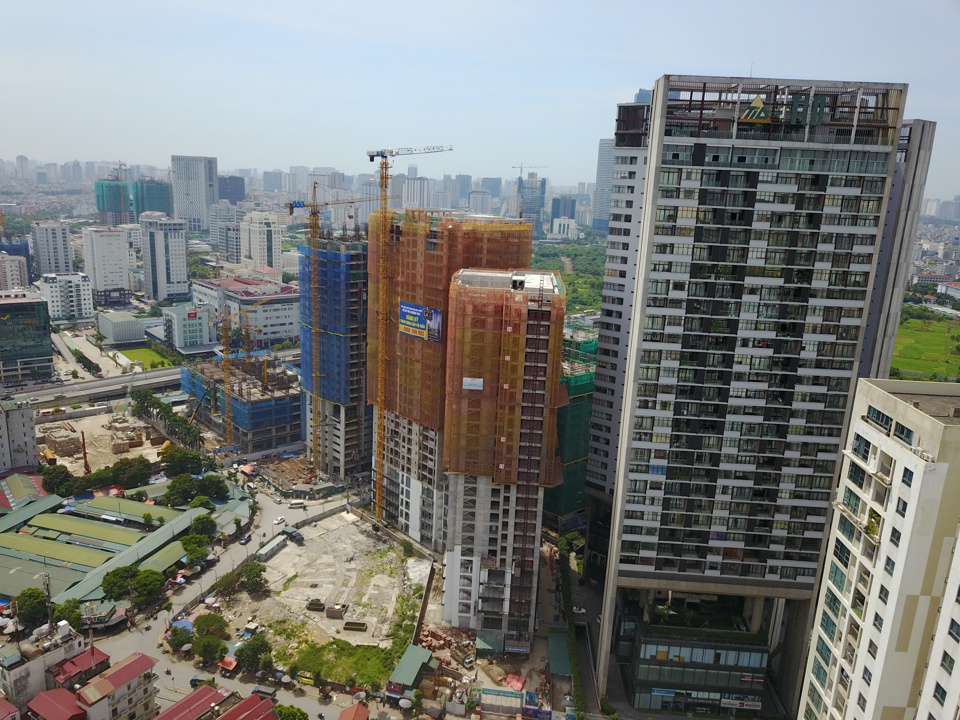
Some apartment buildings under construction in Hanoi. Photo: Pham Hung/The Hanoi Times
Nguyen Van Dinh, Head of the Vietnam Association of Real Estate Sales (VARS), said eastern Hanoi will see a wave of resettlement from Hanoi's old quarter, which is cramped by high population density.
According to the Red River Urban Project, eastern properties will benefit from six new bridges to be built across the Red River, connecting the two banks of the city.
Dinh urged the city to focus on renovating old housing, restoring the Old Quarter, and developing the Red River axis. "Hanoi needs investment, it cannot afford to waste resources," he said.
The growth of tourism is also a priority, especially given the tourism potential of the Red River and other rivers in the city. This is more than just a basic development plan, but an important step in creating a clean, green, modern and prosperous capital with convenient links to other cities and provinces in the Red River Delta.
"To effectively promote smart tourism, it is imperative to attract investors to potential sites and take advantage of the natural scenery in Soc Son and Ba Vi, suburbs of Hanoi for rapid growth and long-term sustainable development," said Dinh.
Pham Thieu Hoa, Chairman of Vinhomes - a real estate subsidiary of Vingroup - Vietnam's largest private conglomerate, echoed this sentiment when he suggested that Hanoi should focus on real estate development and accelerate growth in the sector. Hanoi must resolutely redistribute its population to satellite neighborhoods in order to free up land in the city center for expanding roads and building technical and social infrastructure. "Hanoi's current traffic congestion increases costs, wastes time, money and people's efforts, and generates a lot of emissions that affect public health," he noted.
The city also needs to expedite social housing projects for more people to buy or rent, including army officers and government employees.
"To speed up the progress of social housing projects, Hanoi should resort to appointing contractors without going through a bidding process. The unit that works the fastest can get the projects. The city government decides everything from design to price. Investors only have a 10% profit margin," Hoa added.
He stressed that it is necessary to accelerate the renovation of old apartments this year after getting the people's consent. "Building social housing or renovating old apartments will bring many sources of income to Hanoi, stimulate human resources and the construction materials business," Hoa said.
Bui Tat Thang, former Director of the Institute of Development Strategy, said Hanoi is one of the first-tier cities with a lot of space for urban economic development. Accelerating the urbanization process of some rural areas in the capital can turn rural land into urban land.
Currently, Hanoi has 2,352 land acquisition projects in 2025 with a total area of 6,981 hectares; 186 projects to change land use from rice cultivation with a total area of 448 hectares. However, it is still necessary to remove obstacles to speed up progress. To attract both international and domestic investment, a buffer zone in land rental costs should be established in places that border other cities and provinces to ensure that the price difference between the two places is minimal, Thang suggested.
Echoing other experts, Thang expressed his expectation that Hanoi will soon transform the Red River into a central and green landscape axis of the capital. According to his analysis, it should be integrated into a larger initiative to improve the ecosystem of the Red River landscape.