Hanoi schools honor teachers and preserve tradition during Vietnamese Teacher's Day celebrations
Schools across Hanoi marked the 43rd Vietnamese Teachers' Day with ceremonies, tributes and activities that celebrated the teaching profession while honoring past generations and highlighting the enduring role of educators in the city’s cultural and academic life.
THE HANOI TIMES — Schools across Hanoi marked the 43rd the Vietnamese Teacher’s Day (November 20) with heartfelt ceremonies and tributes celebrating the teaching profession and honoring generations of educators who shaped the capital’s academic culture.
At Tran Duy Hung High School in Yen Hoa Ward, teachers, staff and students joined a special gathering featuring members of the family of the late Doctor Tran Duy Hung, the first Chairman of Hanoi and a respected figure in the city’s history.
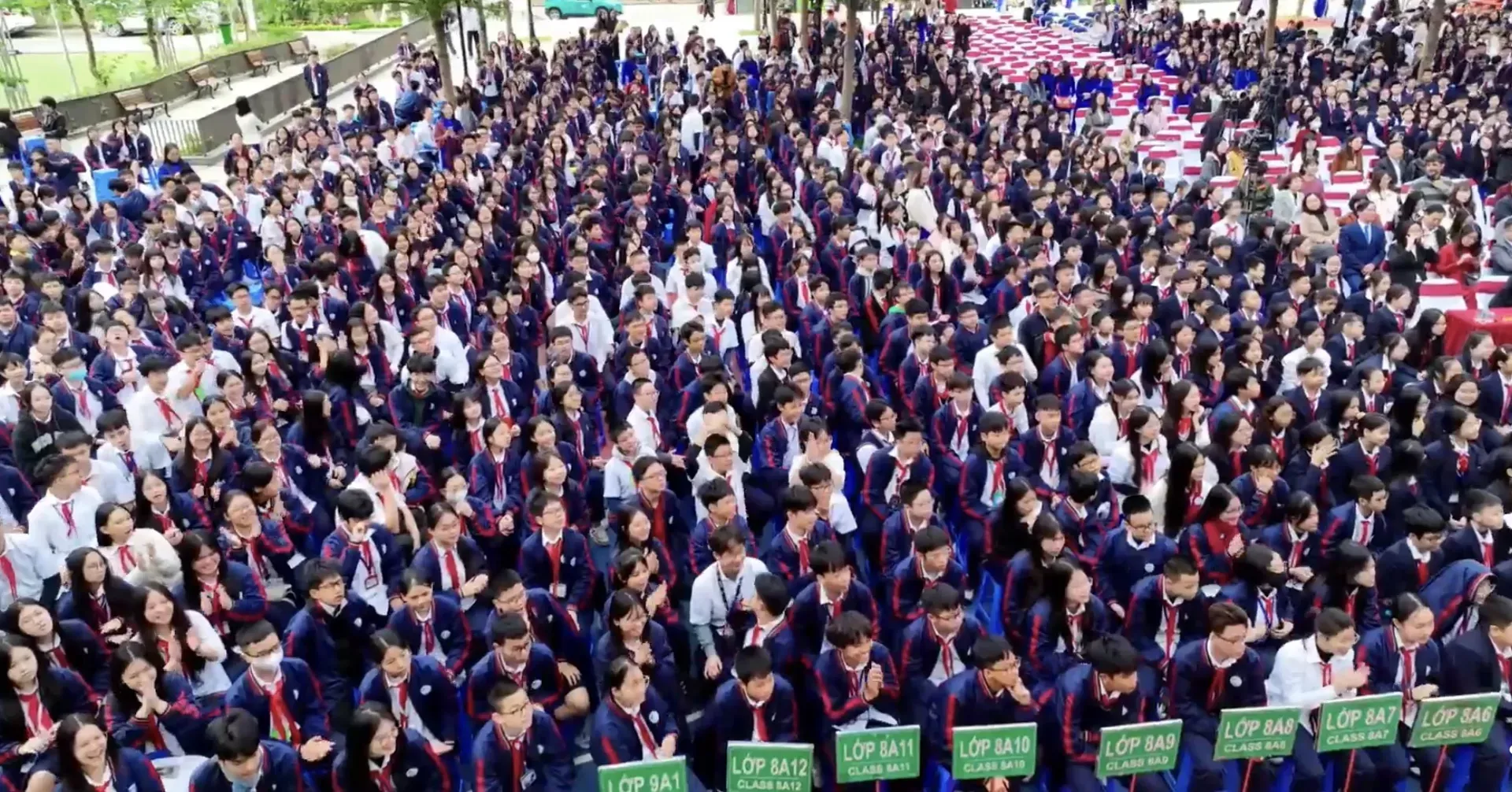
Students at Tran Duy Hung High School in Yen Hoa Ward attend the event with the two sons of the late Mayor of Hanoi Tran Duy Hung. Photo: Nam Du/The Hanoi Times
The exchange offered the school community a chance to learn more about the life, values and leadership of a man often remembered as a model public servant and a proud son of the capital.
His sons, Tran Tien Duc and Tran Duy Nghia, recalled his lifelong commitment to education.
They said that as Mayor of Hanoi, Doctor Tran Duy Hung always prioritized teachers and students. Even in 1966, when Hanoi and the northern region endured heavy air raids, he visited schools and met with teachers to encourage them through the hardship.
Despite wartime challenges, literacy classes for workers and farmers continued to operate, helping improve public knowledge across the city.
Reflecting on today’s rapidly changing world, Duc and Nghia said young people face a dual challenge: preserving tradition while adapting to new values and new ways of living.
“We have a responsibility to protect our cultural foundation while enriching it,” Duc told the students. “The most important thing for young people is to hold on to their dreams, keep them alive and maintain faith in any circumstance.”
At Vinh Tuy Primary School in Vinh Tuy Ward, teachers and students presented vibrant performances honoring the homeland, celebrating the teaching profession and inspiring the spirit of “good teaching, good learning”.
Emotional scenes recreated wartime classrooms, early literacy campaigns and the subsidy-era school environment, reminding attendees of the country’s long struggle for education.
During the ceremony, teachers and students expressed gratitude to earlier generations of educators. Principal Nguyen Phuong Hoa said the school’s achievements today come from the dedication and persistence of teachers who laid its foundation.
“We honor those quiet but profound contributions by people who devoted their energy and hearts to the young generation,” she said, adding that teachers, with their love for the profession, strong ethics and affection for students, continue to shape a caring and compassionate school environment.
One of the most touching moments came when retired teacher Vu Thi Vinh, now 74, returned to the school to be welcomed by former colleagues and students.
“I retired in 2006, but every year the school invites me back. It shows the appreciation and affection Vinh Tuy Primary School gives to teachers like us,” she said.
At Chu Van An High School for the Gifted in Tay Ho Ward, the incense-offering ceremony at the statue of Chu Van An – the revered 14th-century scholar whose legacy inspired the school’s founding – created a solemn and emotional atmosphere. The school, now in its 117th year, continues to honor the scholar’s spirit of integrity and lifelong learning.
Principal Nguyen Thi Nhiep said a teacher’s happiness comes from simple things, especially watching students grow each day and become responsible citizens rather than focusing only on academic results.
She said many generations of teachers and students remain grateful for the foundation built by their predecessors and expressed hope that the school will continue to nurture intellect and passion with confidence.
“The journey of a teacher requires devotion and resilience. Based on the legacy of Chu Van An, we will continue this new chapter with higher standards, more creativity and worthiness of our students’ trust,” she said.
A culture passed down through generations
The Vietnamese Teacher’s Day originated from an international movement recognizing the teaching profession initiated in 1946 by the World Federation of Teachers Unions.
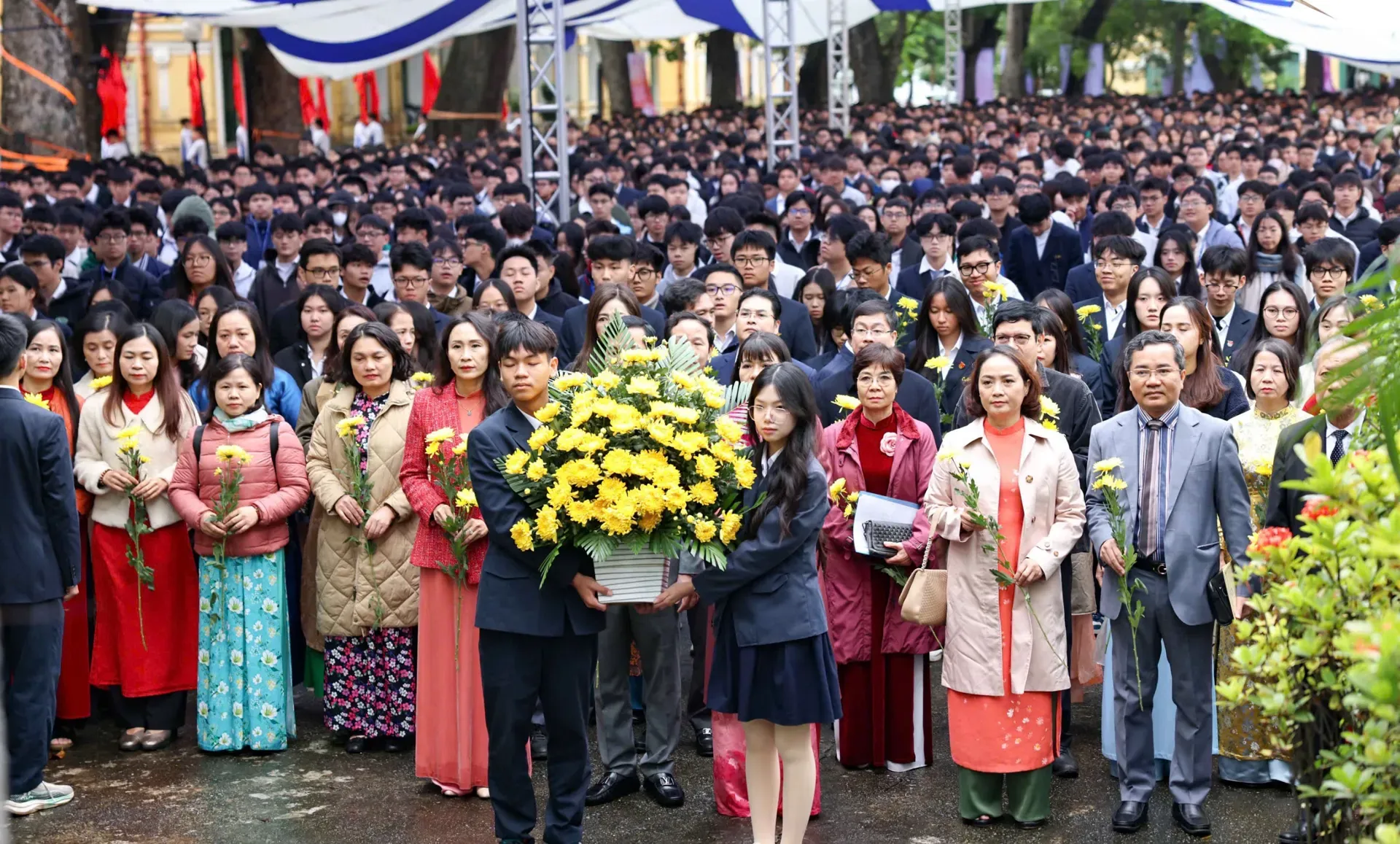
Teachers and students at Chu Van An High School for the Gifted offer incense and flowers to revered teacher Chu Van An. Photo: Nam Du/The Hanoi Times
After joining the federation in 1957, Vietnam officially designated November 20 as the Vietnamese Teacher’s Day in 1982. Since then, the celebration has become a meaningful cultural tradition that honors teachers and upholds the value of learning.
In Vietnamese and broader Asian culture, teachers have long been regarded as second parents. Proverbs such as “Honor the teacher, respect the way” and “A single word makes one a teacher, half a word makes one a teacher” reflect this deep-rooted respect.
Teaching also played a critical role in shaping modern Vietnam. In 1945, after the August Revolution, about 95% of the population could not read or write. The new government made eliminating illiteracy a national priority through the Mass Education Campaign.
From makeshift classrooms on sidewalks and lessons under tree shade, using bricks as chairs and ground as notebooks, 80% of Vietnamese eventually learned to read and write, enabling them to vote in the first general election on January 6, 1946.
For 80 years, teachers have remained committed to their profession. They continue learning, innovating and updating new trends and technologies to accompany students in an increasingly modern, digital environment.
One example is Dau Thi Van Nga, a Natural Science teacher at Xuan La Secondary School and recipient of the “Dedicated and Creative Hanoi Teacher” title in 2025. She blends digital simulations, hands-on experiments, group work and interdisciplinary projects to turn abstract concepts into relatable experiences.
“The goal is not only to help students understand the lesson. It is to help them think, question and observe the world with curiosity,” she said.
She hopes teachers will have more time for creativity and student support instead of being overwhelmed by administrative pressure. For her, the greatest joy comes from watching students grow, act kindly and pursue their dreams.
Expectations for renewal and reform
To support teachers during this period of transition, the State has introduced several important policies. The Teachers Law, the Politburo’s Resolution 71 on breakthroughs in education and proposals to raise benefits all aim to improve working conditions for educators.
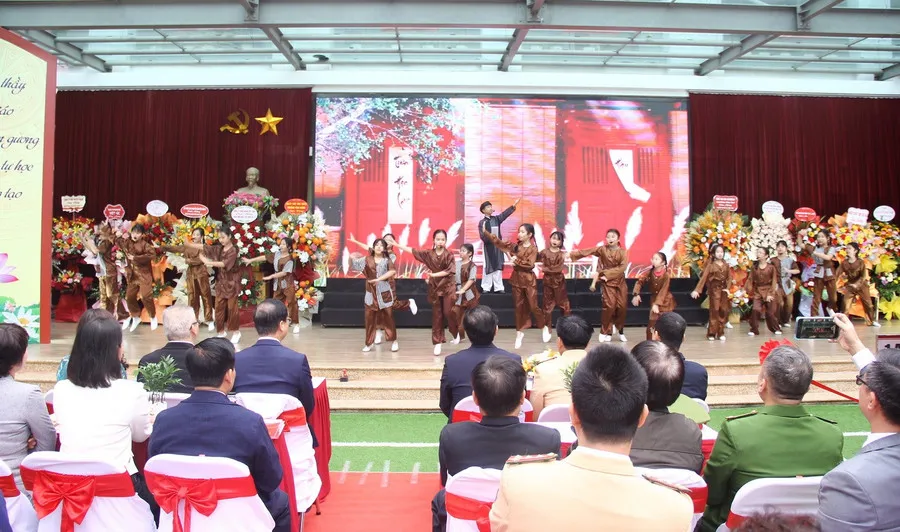
A performance by Vinh Tuy Primary School students recreates the learning campaign in 1945. Photo: Giao duc & Thoi dai Newspaper
Vu Thi Thu Thuy, a teacher at Nghia Do Primary School, said the new policies give teachers more peace of mind and motivation to innovate daily.
“Primary-level teaching requires immense dedication in every hour and every lesson. We hope support policies continue to be implemented effectively so teachers can have more time for their students,” she said.
At Thuong Cat High School, teacher Nguyen Thi Hanh hopes for better facilities and equipment to meet new goals, including the gradual introduction of English as a second language in line with national direction.
“Students need a solid foundation to enter a modern, integrated environment. Teachers, therefore, need a supportive environment to innovate,” she said.
According to the Hanoi Department of Education and Training, the city’s education sector in 2024–2025 saw clear progress.
Hanoi now has more than 3,300 educational institutions serving over 2.3 million students and more than 80% of public schools meet national standards. Students continue to achieve strong results in national and international competitions, including a champion in the 2025 Road to Mount Olympia contest.
The city also leads in digital transformation, applying AI in school management and online admissions while ensuring safe and transparent examinations. Moral education, cultural programs and bilingual and dual-curriculum models continue to expand.
Minister of Education and Training Nguyen Kim Son recognized Hanoi’s achievements and said the capital should continue leading the country in educational reform.
He emphasized the goal of building a refined, exemplary and modern education system and said teachers “must be role models of refinement and modernity.”
“A teacher honored by society must protect professional integrity and continually learn and grow to set an example for students,” he said.