

Hanoi seeks sustainable international solutions to expand and strengthen safe school zones
HealthBridge expert Dinh Dang Hai shares global experience and key recommendations for Hanoi as the city expands its safe school zone model, focusing on speed control, infrastructure, planning standards and community coordination.
THE HANOI TIMES — As Hanoi expands its “safe school gate” model and looks for more sustainable ways to implement it, Dinh Dang Hai, Senior Project Officer at HealthBridge, the organization implementing the Safe School Gate project, spoke with The Hanoi Times about international experience and recommendations tailored to the capital.
How do cities around the world implement Safe School Gate models in a sustainable way?
Many cities start with pilot sites as a launch point for long-term progress. Through pilot projects, they create sample models, collect field data and gather evidence to evaluate impact and effectiveness.
When reliable data becomes available, cities plan expansion step by step from small areas to wards, school clusters and eventually citywide coverage. This approach helps them identify the right solutions and avoid decisions based on assumptions or limited early observations.

Traffic police officers provide legal-education guidance to students. Photo: Pham Cong/The Hanoi Times
Cities also prepare clear short-term, medium-term and long-term plans. Some follow a roadmap of three to five years, then move into a 10-year plan. This aligns with the long-term approach of many international traffic safety programs, including those Vietnam and Hanoi have joined.
Hanoi can begin building annual action plans, five-year plans and a 10-year vision now. With a defined roadmap, the city will find it easier to mobilize resources from government agencies, civil society, businesses, schools, parents and students. Everyone must commit to reducing deaths and injuries caused by traffic crashes, especially for vulnerable groups such as children.
Based on international experience, what is the most important factor for Hanoi to scale up the model?
The most important factor, supported by domestic studies and international recommendations, is speed control. Speed is a major risk factor that directly affects injury severity and fatality when collisions occur, especially between motor vehicles and pedestrians and cyclists.
We have advised speed limits of around 30 km/h in school areas. This level is widely recognized as suitable and safer in places with many children. A slight increase in speed in urban areas can cause fatality risks to rise very quickly. When some urban roads still allow speeds of 60 km/h, the danger for pedestrians, cyclists and students becomes extremely high.
To reduce severe injuries and deaths, Hanoi must treat speed management as the top priority. When speeds around schools are safely controlled, child-related crashes will drop significantly, moving toward the goal of “zero fatalities”.
Some people argue that speed-limit signs near schools are not effective. What is your view?
Speed-limit signs are necessary but not enough because traffic safety depends on awareness and voluntary compliance. People’s awareness varies, so relying on signs alone is ineffective.

Dinh Dang Hai, Senior Project Officer at HealthBridge, the organization implementing the Safe School Gate project. Photo: Pham Hung/The Hanoi Times
We need multiple speed-management measures. Besides installing speed-limit signs 100, 200 or 300 meters from school gates, the city must apply infrastructure solutions that force drivers to slow down in practice.
Physical measures may include painted speed strips, rumble strips, speed cushions and especially raised pedestrian crossings. The goal is not to “announce” a speed of 30 km/h but to achieve actual safe speeds in school zones.
We must also strengthen public communication so people understand why they must slow down. When awareness improves, so does compliance. In international programs, communication always plays a critical role in building community support.
For Hanoi, an effective approach is to survey each school, choose appropriate solution combinations and implement them in an integrated way. Signs, design and management must go together.
In many places, school-gate safety involves urban planning. What lessons should Hanoi apply regarding school-gate locations and standards?
One thing we have observed is the lack of detailed standards about which roads school gates should face. International experience and local reality show that safety improves when school gates open onto internal roads, low-speed streets or easily controlled traffic routes. Many cities in Europe and Asia follow this approach to keep fast-moving traffic away from schools.
When school gates open directly onto high-speed roads or even interprovincial routes, the risks become severe. Hanoi needs new standards, guidelines and planning rules so newly built schools follow safer layouts from the start.
For existing schools with gates facing large roads, multi-layered “remedial” solutions are necessary. Speed management must come first. If speed remains uncontrolled, the city can reorganize traffic flows or create bypass routes so high-speed vehicles avoid school gates. Where feasible, the main gate can be relocated to an internal street to reduce conflict between students and motor vehicles.
Hanoi has complex traffic conditions with many motorcycles, mixed use of sidewalks and widespread on-street parking. How can the city adapt the Safe School Gate model to its specific context?
Hanoi has clear challenges: high motorcycle density, motorcycles parked on sidewalks, cars stopping along streets and sidewalks used for varied purposes. Cities in Africa, India and South America have faced similar conditions. The key is to change thinking and prioritize the safety of pedestrians and students.
Regarding sidewalks, I must emphasize that Hanoi’s sidewalks are not of poor quality. The challenge lies in design and organization to ensure pedestrians have a continuous, convenient path.
The city should arrange space for shops, trees, light poles and street furniture, while still ensuring a clear walkway that meets standards, for example, 1.8 meters wide or more in crowded areas. International evidence shows that good pedestrian infrastructure reduces motor vehicle traffic at school gates.
When pedestrian infrastructure works well, parents and students feel more comfortable walking or cycling. This reduces the number of motor vehicles at school gates, decreases conflict points and lowers the risk of crashes.
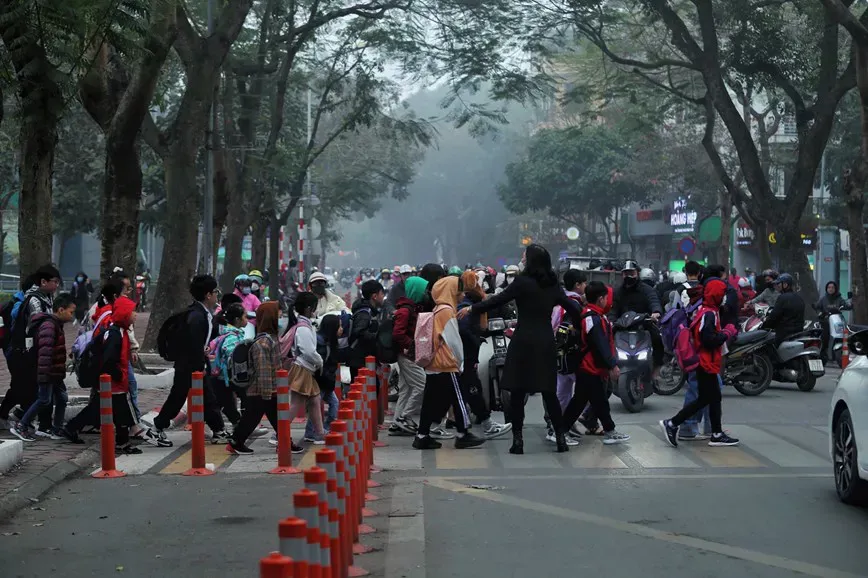
Nguyen Du Primary School in Ha Dong Ward adopts the Safe School Gate model to enhance safety for its students. Photo: Kinh te & Do thi Newspaper
The projects we have implemented apply basic measures such as widening sidewalks, creating marked crossings, improving crossing points and using raised speed-control features. Many countries use these same methods to protect children.
To overcome challenges related to habits and awareness, communication must be stronger, especially around speed management and the right of students to walk safely. When communities understand why solutions are needed, they will support and adopt them.
Finally, the model will only be sustainable when schools, parents, students, enforcement agencies and local authorities cooperate closely toward the shared goal of creating a safe zone in front of every school.
Thank you for your time!







