Hanoi seizes opportunity to develop TOD-oriented urban areas
The model not only reduces infrastructure investment costs but also boosts demand, efficiency, and revenue for public transportation.
The transit-oriented development (TOD) model is a way to address existing challenges in urban transportation, according to Nguyen Ba Son, Deputy Head of the Hanoi Metropolitan Railway Management Board (MRB).
"This is an advanced urban planning model that makes the most of the current and future public transport network and accommodates the larger number of passengers," he told The Hanoi Times.
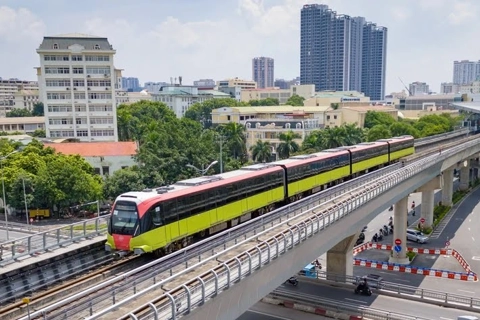
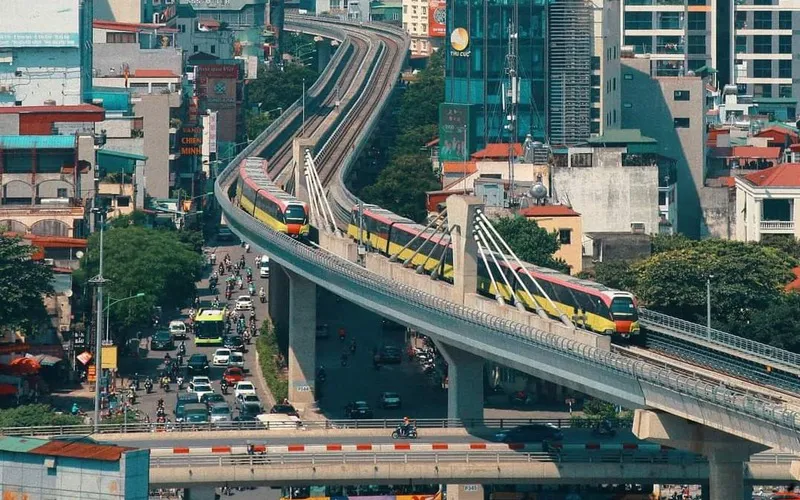
The elevated section of the Nhon-Ha Noi Station metro line, the second urban railway in Hanoi, is helping to transform urban transportation. Photo: Anh Kiet/The Hanoi Times |
Son went on to say that TOD has proven its effectiveness around the world as a stable link between public transit and neighborhoods.
The TOD model relies primarily on rail transportation and can also be implemented in conjunction with bus rapid transit systems, the official said. "Revamping the current investment strategies for urban rail networks is critical, and the TOD model offers a viable solution to the multifaceted urban transport issues facing Hanoi."
Hanoi plans to build 10 metro lines with a total length of 417 kilometers and a total investment of US$40 billion by 2035. The projects will be financed from the state budget and ODA loans.
However, the execution of the metro network plan is currently proceeding at a slow pace. So far, Hanoi has only managed to open the Cat Linh-Ha Dong rail line and the 8.5-kilometer elevated section of the Nhon-Hanoi Station metro line.
"Implementing TOD is a complex and lengthy process that requires extensive research and the involvement of multiple stakeholders at multiple levels. The basic principle of TOD implementation is to integrate rail, bus rapid transit, and real estate development into a unified system," Son continued.
The TOD model is expected to bring significant progress to Hanoi as it embarks on building an urban rail network in the city. "To achieve this, TOD needs to focus on urban density and ensure a 5-10 minute walk to public transport points," Son said.
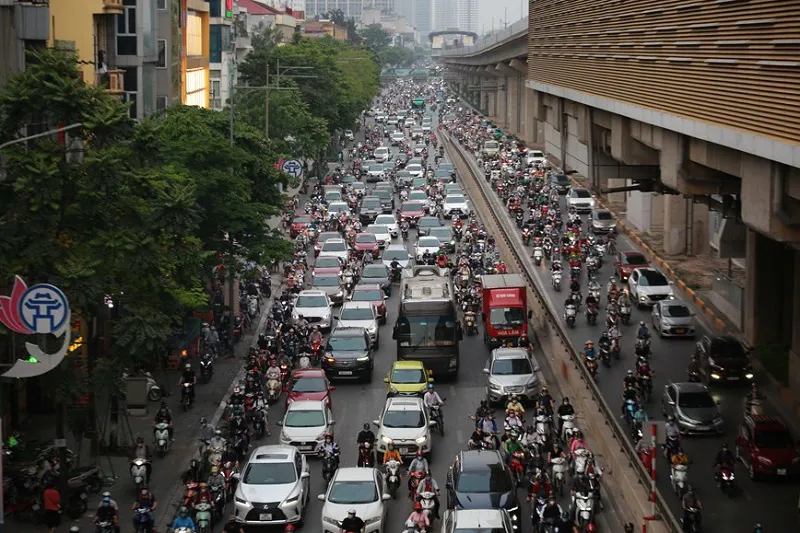
A street in Hanoi during the rush hour. Photo: Pham Cong/The Hanoi Times |
Meanwhile, Vu Minh Khuong of the National University of Singapore suggested that "the benefits are immense" if the urban rail is robustly developed with a TOD approach. Khuong told the Vietnam Government Portal that there will be significant economic and social losses if the development of urban rail systems is not prioritized.
He cited Forbes calculations that estimated the annual cost of traffic congestion at $11 billion for New York, $8.2 billion for Los Angeles, and $7.6 billion for Chicago. "For Hanoi, the loss is estimated to be at least $2-3 billion, considering the size of the population and the existing transportation infrastructure," Khuong said.
He highlighted the potential of the TOD model to boost the efficiency and sustainability of Hanoi's urban development. The model not only reduces infrastructure investment costs, particularly for roads, utilities, drainage, and future land release, but also drives demand, efficiency, and revenue for public transport.
Beyond the obvious benefits of reducing traffic congestion and air pollution, Khuong underscored a significant advantage of the TOD model in increasing social productivity.
"By reducing daily commuting costs for citizens, this approach could lead to increased employment opportunities, higher property values, improved urban landscapes, and greater efficiency in retail and service industries facilitated by the development of service centers around transit stations," Khuong added.
Deputy Director of the Hanoi Department of Planning and Investment Le Trung Hieu said that the 2024 Land Law and Capital Law, with breakthrough provisions, will create a favorable legal corridor and help Hanoi take the lead in developing urban TOD projects.
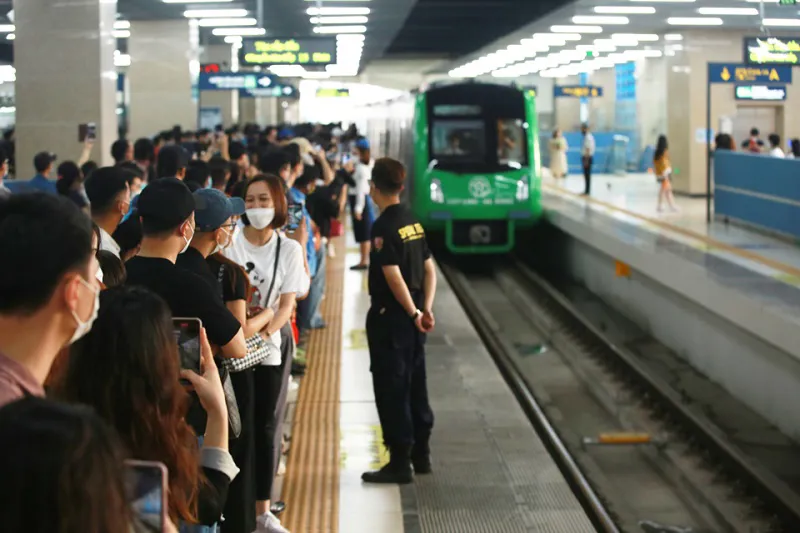
Passengers waiting on the platform to board the Cat Linh-Ha Dong train. Photo: Pham Hung/The Hanoi Times |
“These changes will help better connect districts in the city; optimize the use of land resources; build a green, smart, and sustainable city so that Hanoi can become a prosperous, integrated city with its own identity,” Hieu told The Hanoi Times.
Article 31 of the 2024 Capital Law specifically regulates the mechanism and tools for developing TOD projects in Hanoi, including the definition of the TOD area; planning of the urban railway system and TOD area; investment in urban railway development under the TOD model; management, operation and exploitation of the urban railway and TOD area.
It defines TOD urban development as a solution for planning, renovation, beautification, and development of urban areas. It also allows the Hanoi People's Committee to decide on mechanisms and tools for planning and investment.
The 2024 Land Law, with special investment incentives such as exemption and reduction of land use fees for logistics and infrastructure for urban railway projects; the mechanism of compensation, site clearance, and synchronous implementation for projects with land areas along urban railway lines and stations, will create a stronger driving force for development.
Hieu commented that the 2024 Land Law, together with the Capital Law (amended), will facilitate the formulation of policies, create specific mechanisms, and bring value for the capital to realize its ambition of having 600 km of urban rail in the future.
"The Land Law 2024 and the Capital Law (amended), with groundbreaking provisions, are favorable legal instruments to help Hanoi take the lead in developing urban TOD projects," Hieu said.