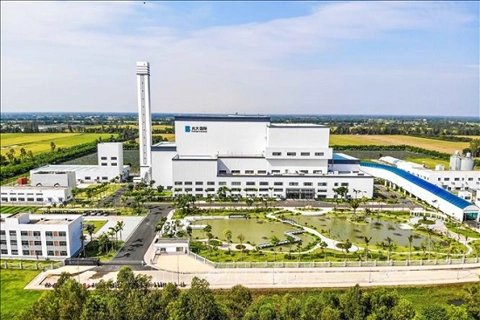
Hanoi spends US$7.5 million on upgrading its biggest landfill
The upgrading will help expand the landfill's capacity, protect the environment, and prevent diseases in its surrounding areas.
The Hanoi People's Committee has decided to spend VND170 billion (US$7.48 million) ơn building leachate ponds and expand trash dumps in the Nam Son waste treatment complex in Soc Son District, the biggest of its kind in the capital city.
After 20 years in operation, the Nam Son landfill could soon run out of space to bury garbage. Besides, heavy rains prevented Nam Son from accepting garbage since there was fear that leachate could leach into the environment.
Aerial view of the Nam Son waste treatment complex in Hanoi's suburban district of Soc Son. Photo: Van Nhi/The Hanoi Times |
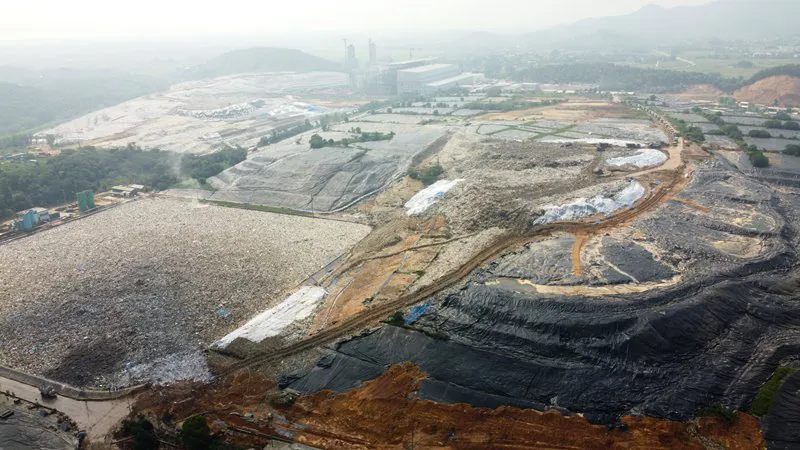
Chairman of the Hanoi People's Committee Chu Ngoc Anh approved the construction of new infrastructure at the landfill, as well as roads and lighting, and planting trees.
The upgrading will help expand the landfill's capacity, protect the environment, and prevent diseases in its surrounding areas. The work is expected to be completed in the second quarter of 2022.
Le Duy Dung, head of the Planning Department under the Hanoi Urban Environment Company (Urenco) which manages Nam Son landfill, said it receives about 5,000 tons of waste daily from 17 districts of Hanoi, adding that due to large amount of plastic waste which is hard to be decomposed, more space for dumping was needed.
“Trash burial slots piled as high as 35 meters above the ground will not be allowed to receive any more garbage and will have to be covered with sheets to prevent rainwater from leaking in and the stench from creeping out. Ten trash burial slots of the first phase have reached their limit," Dung told The Hanoi Times.
He added that the huge amount of waste prevents the effectiveness of chemical treatment hindering the decomposing process.
Dung stressed that environmental pollution in and around landfills sparked the ire of people living around the landfill.
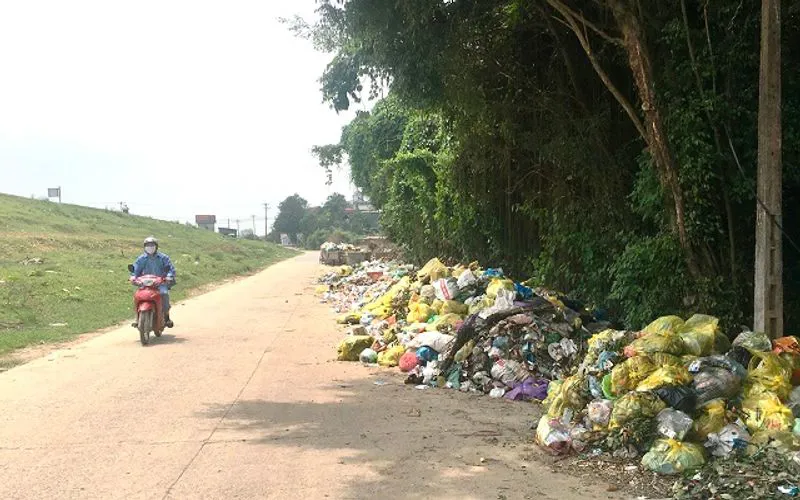
Waste is backlogged on the dyke road in Hanoi's outskirt district of Me Linh. Photo: Trong Tung/The Hanoi Times |
Built-in 1990, the Nam Son waste treatment complex in Soc Son District spans over 157 ha and its construction is divided into two phases. The first phase included 10 trash burial slots spanning over 83 ha, while the second one included eight slots spanning over 73 hectares, together with technical and service infrastructure. All slots built in the first phase have now been filled.
The landfill's southern area, estimated at around 36 hectares, has six trash burial slots and has been operational since 2015, with a capacity of around five million m3 of trash. All these slots reached their limit by 2019, so another two more slots have been added.
Meanwhile, the northern dumpsite, part of the second phase, has not been built yet due to clearance problems since 2015. It would cover 37 hectares and have two trash burial slots with a capacity of 1.9 million cubic meters.
Within a 500m radius of the Nam Son landfill live over 2,000 families who need to be relocated from the site, leaving behind around 396 hectares of agricultural and residential land. But clearance processes are still being delayed, which further affects the management and operation of the landfill.
Over 6,500 tons of trash is dumped in Hanoi every day. Around 6,200 tons are buried while the rest is incinerated. The capital city plans to have 17 facilities to process solid waste by 2030.
Hanoi is also building a trash-to-energy plant. The project is expected to become operational in 2021 with a designed capacity of 4,000 tons per day.