Hanoi stays firm in Vietnam’s top 10 business-friendly localities: PCI 2019
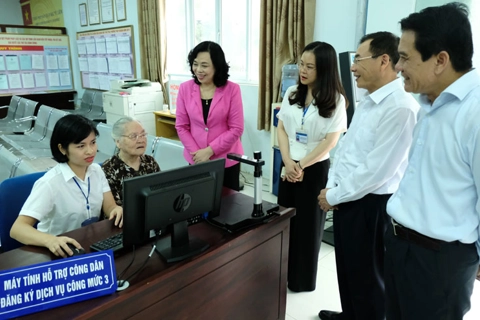
Although Hanoi's ranking stayed unchanged at ninth, its PCI score has improved from 65.4 to 68.8, showcasing strong efforts from the local authorities towards administrative reform.
Hanoi remained firm among the top 10 business-friendly localities in Vietnam for two consecutive years, after the city’s first inclusion in the top 10 of Vietnam’s provincial competitiveness index (PCI) ranking in 2018.
| Top 10 business-friendly localities. Source: PCI 2019. |

Despite the fact that the city’s ranking stayed unchanged at ninth, its PCI score has improved from 65.4 to 68.8, showcasing strong efforts from the local authorities towards administrative reform and creating a favorable business environment for enterprises.
Among the 10 PCI sub-indices, Hanoi has the highest score in Entry Costs, which evaluates entry costs for business startups, at 7.98 points out of 10, and the lowest at 5.39 in Policy Bias, an indicator assessing the possibility of crowding out of private activity from policy biases toward state, foreign or connected firms.
| Hanoi's results of 10 PCI subindices. Source: PCI 2019. |

Notably, Hai Phong has upstaged Ho Chi Minh City in the top 10 group and relegated the latter to 14th. This is despite the fact that Ho Chi Minh City has earned higher score of 67.16 compared to 65.34 in 2018, which showed fierce competition among provinces/cities in efforts to stay competitive in the eyes of the business community.
Echoing this view, Dau Anh Tuan, director of the VCCI’s Legal Department, said an average overall PCI score of 65.13 was the highest since 2005.
Tuan added even Lai Chau as the province with the lowest score of 59.95 still significantly achieved a score higher than around 36 reported 15 years ago.
This year, Quang Ninh province continued to maintain its top ranking with 73.40 points for the third straight year, followed by Dong Thap with 72.10 and Vinh Long with 71.3.
| Source: PCI 2019. |

According to Tuan, key findings of the report demonstrated provincial authorities have become more proactive and creative in policy implementation. In 2019, 54.1% of respondents rated provincial authorities’ attitude towards the private sector as “positive.” This aspect of governance continued to grow from its low of 35.1% in 2015.
Meanwhile, 80% of the surveyed firms agreed with the statement “my provincial People’s Committee is very flexible, within the scope of laws, to create a favorable business environment,” the highest level over the 15 years of the PCI survey.
There are also signs of declining favoritism towards large and connected firms. About 63.4% of respondents agreed that “government procurement contracts, and other business resources mostly fall into the hands of enterprises that have strong connections with the provincial authorities” (versus 76.9% in 2015). Up to 51.1% of firms affirmed their perception that favoritism towards big companies posed obstacles to their business operations (down from 56.5% in 2015).
Tuan also noted a positive sign that informal charges have been on the declining trend for three consecutive years, as 21.6% of PCI respondents were concerned that “paying bribes is common to influence court decisions in legal proceedings,” compared to 31.6% in 2017 and 28.8% in 2018.
In 2019, 53.6% of firms claimed to have paid informal charges, the lowest percentage over the last six years, Tuan added.
Optimism remains high
This year, the PCI Business Thermometer demonstrated that business confidence in 2019 remained at a fairly high level, with 51% of respondents planning to expand their business operations in the following two years. This marginally surpasses 49% in PCI 2018 and significantly exceeds the 2012-2013 level during Vietnam’s economic downturn.
Additionally, 53% of the foreign-invested enterprises (FIEs) plan to expand in the next two years. However, this represents a decline from 60% achieved in 2017 and from 55% last year. The sectors which reported the highest interest in expansion in 2017 (when Vietnam achieved the highest growth rate over a decade) also tended to have the highest actual expansion (measured by employment growth) in 2019.
| Source: PCI 2019. |

Tuan noted, however, as this survey was conducted before the outbreak of the Covid-19 pandemic, business sentiment from large and small firms would be likely now significantly lower than before.
Regarding the FDI sector, Tuan said the composition and size of FDI is changing incrementally.
“In particular, we are seeing greater entry and business expansion by firms producing higher technology goods, requiring more skilled labor,” he said.
In Vietnam, most foreign investors are form Asia, with South Korea, Japan and Taiwan (China) topping the list, while the majority of FIEs are manufacturers. The most popular manufacturing activities are fabricated metals (involving 9.2% of operations), rubber and plastic (7.2%), computers and electronics (6.7%), textiles (4.8%), and garments (3.16%).
In addition to high business confidence, FIEs also report strong improvement in entry procedures, reduction in expropriation risk after the promulgation of the 2013 Land Law, and efforts to combat corruption, Tuan noted.
The report, jointly launched online for the first time today by the Vietnam Chamber of Commerce and Industry (VCCI) and the US Agency for International Development (USAID), has been produced annually since 2005 to assess the ease of doing business, economic governance, and administrative reform efforts by the provincial and city governments in Vietnam in order to promote the development of the private sector.
Based on a rigorous survey of nearly 12,500 domestic and foreign firms operating across Vietnam, the 2019 PCI endeavors to amplify the collective voice of private entrepreneurs in Vietnam over essential areas of governance and business environment, including business prospect, ease of doing business, human capital, and infrastructure quality.