Hanoi strives to become key pomelo-growing area
Over the years, Hanoi's agriculture sector has been highly committed to the safe and organic cultivation of pomelo to make full use of this famous variety.
Hanoi's agricultural sector has focused on growing pomelo over the past few years to make the city a key pomelo-farming hub in the country in the time ahead.
In the Ministry of Agriculture and Rural Development (MARD)'s fruit development project for 2025-2030, Hanoi is one of nine key pomelo production hubs of Vietnam together with Hoa Binh, Phu Tho, Bac Giang, Ha Tinh, Tien Giang, Ben Tre, Vinh Long, and Hau Giang. Hanoi is the only place in the Red River Delta to develop pomelo growing.
In the ministry's project, Vietnam is expected to develop 120,000 hectares of pomelo, with a total production of 1.2-1.6 million tons per year. Pomelo is one of 14 kinds of key fruits for export, including dragonfruit, mango, banana, litchi, longan, orange, pineapple, durian, passion juice, and avocado.
Nguyen Manh Phuong, Deputy Director of the Hanoi Department of Agriculture and Rural Development, said that the northern provinces and Hanoi need to focus on Dien pomelo, which accounts for about 70% of the area, and the remaining 30% of the crop will be diversified as directed by MARD.
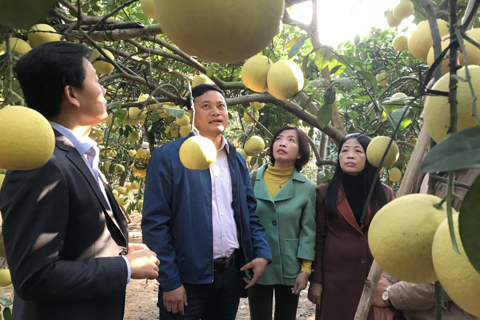
Hanoi is one of nine key provinces and cities focusing on growing pomelo trees. Photo: Trong Tung/The Hanoi Times. |
In addition to traditional pomelo strains, MARD suggested the listed localities select and restore indigenous pomelo specialties. "It is necessary to develop new pomelo varieties with good quality and suitable for the market," Phuong added.
“Over the years, Hanoi's agricultural sector has made great efforts to ensure pomelo is grown safely and organically, including Dien pomelo, Tan Lac red pomelo, Cat Que pomelo, which opens up opportunities for Vietnam to penetrate demanding markets such as the United States and the European Union,” Phuong told The Hanoi Times.
According to the Department of Crop Production under the MARD, the different climatic conditions have resulted in special pomelo varieties with high value and quality. Some pomelo varieties have been exported, including Nam Roi pomelo (in the Mekong Delta province of Vinh Long) and Da Xanh pomelo (in the Mekong Delta province of Ben Tre).
The market demand for pomelo has continued to grow in recent years. However, the economic value of pomelo exports in Vietnam currently accounts for only about 0.1% of the global total. It is estimated that countries worldwide import about US$1.1-1.2 billion worth of pomelo per year.
Nguyen Nhu Cuong, Head of the Department of Crop Production under the MARD, said Hanoi's pomelo growing areas are scattered, making it difficult to export on a large scale. While the market is always fluctuating, the production and consumption chains of pomelo are still stable.
According to data from the Hanoi Department of Agriculture and Rural Development, there are currently about 7,500 hectares of pomelo cultivation throughout the city. The total grapefruit production last year reached more than 105,000 tons.
In particular, Hanoi currently has about 10 varieties of pomelo. Other varieties are also widely planted, besides the specialty Dien pomelo, which occupies nearly 81% of the area. These include pomelo of Hiep Thuan, Van Ha, Tho Phu Xuyen, Sai Son, among others.
A kind of pomelo with unique and distinctive fragrance in Hanoi
Dien pomelo, or the pomelo planted in Dien Village of Bac Tu Liem District in the west of Hanoi, is a specialty that nature has bestowed on the capital city. It is one of the meaningful, valuable gifts for Vietnam's traditional Tet holiday.
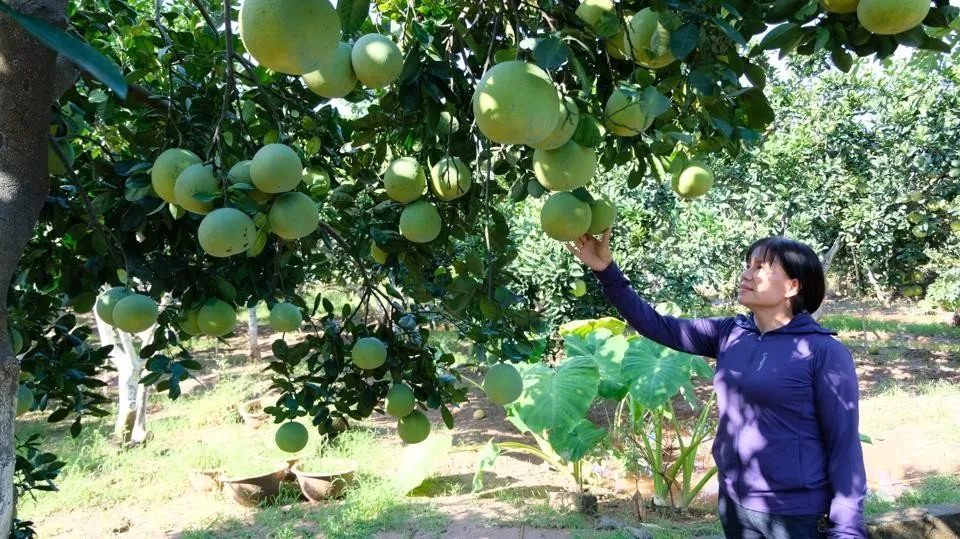
Some 30-year-old trees of Dien pomelo in Phu Dien Ward, Bac Tu Liem District, Hanoi. Photo: Thoi Nguyen/The Hanoi Times |
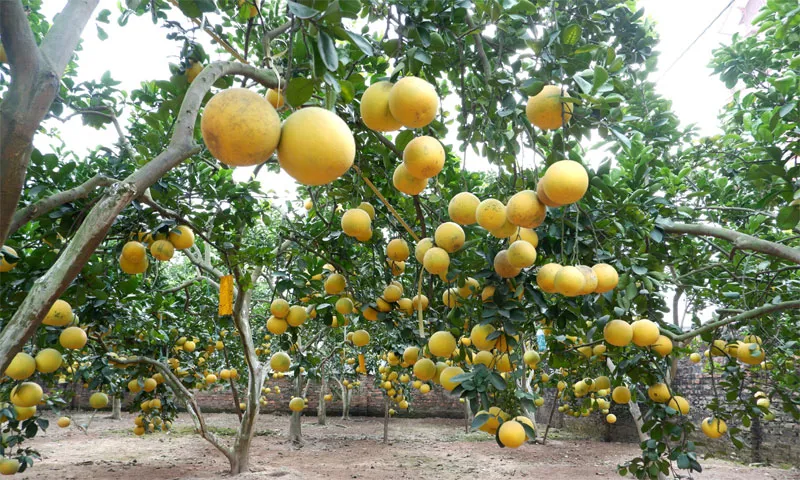
Dien pomelo has a fresh, delicious taste that no other pomelo or grapefruit can match. The fruit has a refreshing sweet taste and a long-lasting fragrance, which is very different from other pomelos and grapefruits grown throughout Vietnam.
In the past few years, the local authorities have realized the economic value of Dien pomelo and have encouraged the farmers to cultivate this kind of pomelo on a large scale. In these modern days, some scientific advances are also being applied to improve the yield and quality of the crop.
Dien Village has one of the three largest pomelo-growing areas in Bac Tu Liem District. In Dien Village alone, about 35 hectares out of 45 hectares of farmland are under pomelo cultivation. The villagers are proud of such a precious gift from nature. They said that although Dien pomelo has been grown elsewhere in northern Vietnam, only those in their village could have a unique and distinctive fragrance and taste.