Hanoi strives to add value to Vietnamese products
Vietnamese consumers have developed the habit of choosing branded and reputable products.
Localities in Hanoi have been striving to add value to Vietnamese products in both the domestic and international markets. This is a process that requires businesses to constantly innovate, develop, and create high-quality products.
By prioritizing domestic food and household appliances, Le Thi Bich Ngoc, from Hanoi's Cau Giay district, said he does so not only because of their affordability but also because of her willingness to contribute to the "Vietnamese people buy Vietnamese products" campaign.
"I usually buy Bat Trang ceramics, Dien pomelo, Canh orange, and some other famous Hanoi handicrafts and agricultural products that have been evaluated and classified by the One Commune One Product (OCOP) Program," Ngoc told The Hanoi Times.
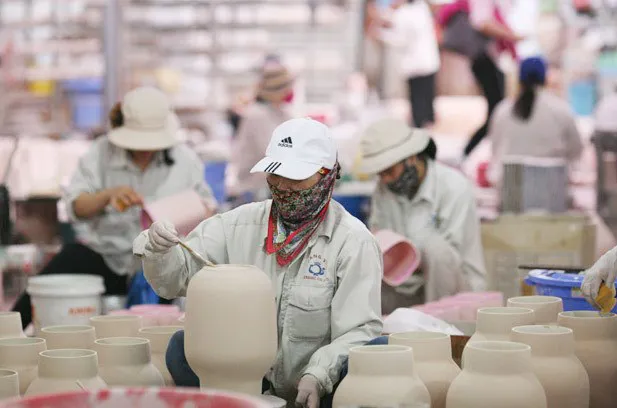
Ceramic vase production at Quang Vinh Ceramic Co.Ltd in Bat Trang commune, Gia Lam district, Hanoi. Photo: Hanoimoi |
"OCOP and other producers of Vietnamese agricultural products have invested in technology to improve quality, which has attracted many Vietnamese consumers, not just me. This has contributed to the upgrading of Vietnamese products," she added.
According to the businesses, most products have higher value and expanded consumer markets after being awarded OCOP stars. In Soc Son District, the Trai Tim Hong Cooperative manufactures eight products (made of fine wooden beads) that have been awarded four OCOP stars by the Hanoi People's Committee. Since then, they have become well known to a wide range of consumers and are helping to improve the district's economic efficiency.
Some products made in Bat Trang commune in Hanoi's Gia Lam district, including a red lotus dinnerware set and a tea set printed with swallows and lotus, have been recognized as five-star standards - the highest ranking in the OCOP ratings.
Sales Director of Huong Viet Sinh Co., Ltd Nguyen Thanh Ha, said the company currently has 18 OCOP-certified products.
"We have drawn up a plan to export our products to foreign markets soon. Participating in the city's OCOP program is the right direction not only for enterprises but also for most localities and enterprises in Hanoi," Ha said.
Nguyen Viet Dat, Head of Dan Phuong district's economic department, told The Hanoi Times that OCOP units have created jobs for nearly 300 workers, with an average income of VND5-7 million (US$203-284) per month.
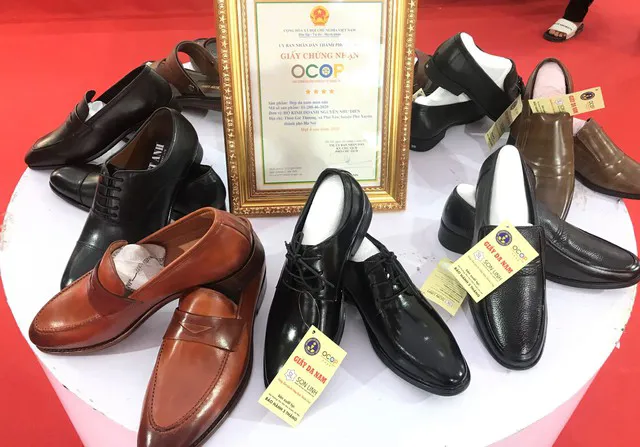
Four-star rating OCOP products. Photo: VGP |
"The ranking has helped the products win over domestic and international consumers, as well as reaffirming the brand of Vietnamese goods," Dat stressed.
"However, the demands of the market are becoming more stringent. Price competition requires domestic production units to apply national technical standards and regulations, and apply science and technology in production to promote labor productivity and improve product quality," he noted.
Bui Nguyen Anh Tuan, Deputy Director of the Department of Domestic Market under the Ministry of Industry and Trade, said Vietnamese consumers have developed the habit of choosing branded and reputable products. "Therefore, the establishment of OCOP sites plays an important role in promoting OCOP products," Tuan said.
As a long-time companion of the Vietnamese market, Paul Le, vice president of Central Retail Group in Vietnam, said his group is trying to support Vietnamese suppliers and companies, including OCOP manufacturers. "Vietnamese companies need to intensify brand building and market research. In particular, they need to focus on developing potential domestic markets, as the OCOP scheme has done recently," he said.
A livestream event to sell OCOP products. Photo: VGP |

With the current trend of globalization, especially the boom of e-commerce, the competitive pressure on goods is increasing. Meanwhile, consumers themselves can buy goods anywhere just by surfing the Internet and ordering from foreign e-commerce sites.
"This is an opportunity for Vietnamese businesses to build brands and expand domestic distribution channels for Vietnamese export goods, find a solid foothold for Vietnamese products with quality and national brands, and key products of localities," Paul Le stressed.
According to Tran Thi Phuong Lan, Acting Director of Hanoi's Department of Industry and Trade, they usually coordinate with districts every year to open sales outlets for OCOP products throughout the city. "Many OCOP products have been sold at nearly 80 sales locations in the city and 600 e-commerce websites to promote exports," Lan said.
She stressed that many products have proven their value and quality, gradually forming OCOP product value chains and contributing to production, income, and market expansion. They are now present in many provinces and cities across the country and are exported to many countries and regions.
"Most of the products nominated for national OCOP evaluation have a sales growth rate of 10-40%. Many have been upgraded to be sold as luxurious and valuable gifts in line with consumer trends and market demand," Lan added.