Hanoi taps into lotus tourism potential
Tay Ho District has all the makings of a lotus tourist destination in Hanoi, with many lotus ponds and the famous sights and relics of the West Lake area.
As one of the country's most famous lotus plantations, Hanoi has many advantages for developing the lotus tourism brand, according to Dang Huong Giang, Director of the city's Department of Tourism.
At present, Hanoi has set aside 600 hectares for lotus in the districts of Tay Ho, My Duc, Me Linh and Thach That, and lotus ponds are becoming popular tourist destinations that draw large crowds. In addition, the city is exploiting and developing lotus-related handicrafts, fine arts and culinary dishes. Many products have been recognized by the OCOP (One Commune, One Product) program, including lotus silk scarves, Quang An lotus tea, Me Linh lotus tea, lotus buns, lotus sticky rice, lotus longan sweet soup, lotus jam, and others. According to Giang, a large number of these goods are shipped to many countries.
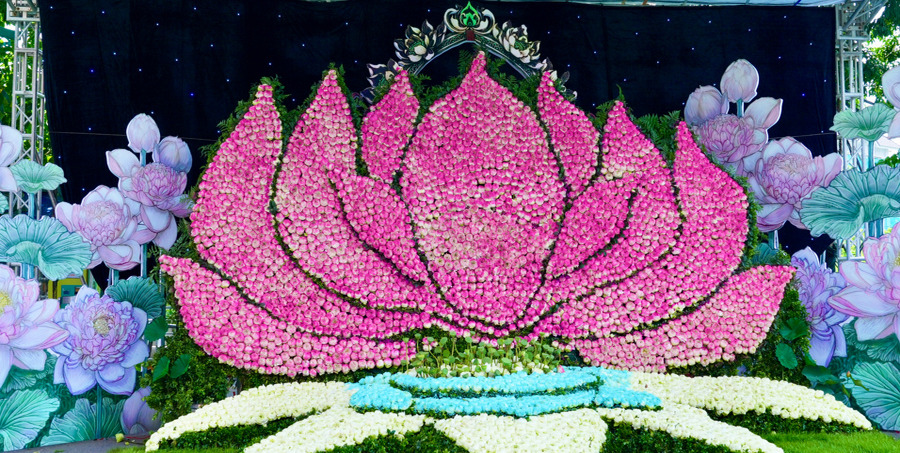
The giant lotus flower made of 10,000 lotus blossoms is an impressive highlight of the Hanoi Lotus Festival 2024, which kicked off on July 12 in Tay Ho District. Photos: Duy Khanh/The Hanoi Times |
She believed that Hanoi's lotus tourism has the potential to flourish. Some places can become typical tourist destinations in Hanoi, such as Tay Ho District.
"With many lotus ponds and many famous attractions and relics in the West Lake area, Tay Ho District is qualified to become a lotus tourist destination in Hanoi, especially in the summer," Giang told Hanoimoi.
Chairman of Tay Ho District People's Committee Nguyen Dinh Khuyen said there are more than 70 historical and cultural relics in the district, typically Tran Quoc Pagoda, Quan Thanh Temple, and Tay Ho Palace.
In addition, visitors to Tay Ho District can explore the Nhat Tan Tourist Area, West Lake Flower Valley, West Lake Creative Cultural Space, which has many night tourism activities, West Lake Water Park, Lotte Shopping Center, and so on.
Previously, Hanoi's lotus flowers only bloomed in summer. Thanks to the scientific and technological applications, many new varieties of lotus have been created, so the lotus season lasts from April to November every year, which helps develop the lotus brand and sustainable tourism economy, the official said.
He noted that Tay Ho District can build tours related to the Hanoi Lotus Festival, which is underway from July 12 to 16. "We will make the festival an annual event every year, expand the lotus plantation in the district, promote tourist attractions associated with Hanoi Lotus, and make association with more localities growing lotus," Khuyen told Hanoimoi.
Speaking to the Vietnam Portal Government (VGP), Associate Professor Bui Hoai Son, a Member of the National Assembly's Committee on Culture and Education, emphasized the symbolism of the lotus in the cultural and spiritual life of the Vietnamese people. "The lotus has great significance in our country and fully deserves to be Vietnam's national flower."
A lot of local people take photos to record their beautiful moments at the Hanoi Lotus Festival 2024. |
.jpeg)
The lotus flower has also been incorporated into art and literature through famous songs, essays, and poems that embody the meaning of life. Especially in architecture, lotus flowers are widely used to express sophistication and artistry.
He highlighted that the lotus flower is associated with the image of a Vietnamese girl, pure beauty, graceful and arrogant but always gentle, tolerant, and hard-working.
Meanwhile, Deputy Director of the Hanoi Department of Agriculture and Rural Development (DARD) Nguyen Dinh Hoa said that the lotus is a symbol of purity and innocence; it symbolizes the spirit and identity of the Vietnamese soul.
There are many famous lotus places in Vietnam, including Thap Muoi Lotus (Dong Thap Province), Hue Lotus (Thua Thien-Hue Province), and Nam Dan Lotus (Nghe An Province). "In Hanoi, when people talk about lotus flowers, they immediately think of the Bach Diep lotus (Momo botan) in Tay Ho District.
"With nearly one hundred petals, the Bach Diep lotus has a unique color, pale pink, and fragrance. It is very different from lotus flowers found in other parts of the country," Hoa told VGP.
However, the area of Bach Diep lotus cultivation is shrinking due to urbanization. Therefore, to preserve and develop the precious Tay Ho lotus, DARD has coordinated with the Fruit and Vegetable Research Institute to test more than 30 new lotus varieties in Hanoi. As a result, nearly 20 varieties have been selected, including those for special flowers, silk, tubers, and seeds with higher quality and yield.