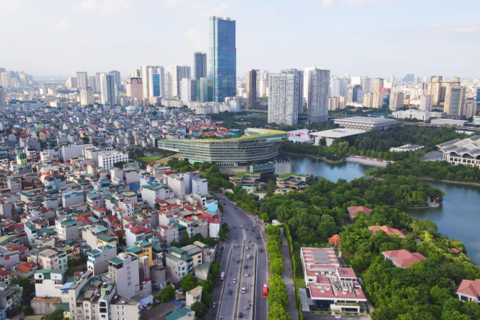
Hanoi
Hanoi to gradually ban motorbikes in downtown by 2030
Director of the Hanoi Department of Transportation Vu Van Vien finds it necessary to ban motorbikes in the city ahead of 2030.
Over the next 10 years, Hanoi's authorities will gradually implement a roadmap to ban motorbikes in urban districts with the aim of reducing traffic congestion and environmental pollution, local media reported.
The capital city two years ago passed a resolution to restrict the number of motorbike and phase them out by 2030.
According to statistics, Hanoi currently has about 6.01 million motorcycles registered, and an uncountable number of those from other localities circulating in the city. The average growth rate of motorbikes in the period of 2011 - 2018 is 6.7% per year. Meanwhile, only 9.38% of the city’s area is reserved for transport.
The number of vehicles has exceeded the capacity of transport infrastructure by 1.34 times. In Hanoi, there still remain 27 points of traffic jams, 80% of which are located in the city’s downtown.
Director of the Hanoi Department of Transportation Vu Van Vien finds it necessary to ban motorbikes in the city ahead of 2030.
It is expected that by 2030, Hanoi’s metropolitan area will be expanded to cover another five districts, including Gia Lam, Dong Anh, Hoai Duc, Thanh Tri and Dan Phuong, accounting for 25% of the city’s total area. The city’s downtown has seen the largest concentration of traffic pressure and should be closed to motorcycles.
One of Hanoi residents’ biggest concerns is when motorbikes are banned, which transport modal would replace them and whether it would meet the locals' commuting demand. Dr. Le Do Muoi, an urban transport expert said: “By 2030, Hanoi's public transport will meet at least 40% of the whole city’s travel demand, thus, citizens need not to worry about how to move around."
Hanoi’s authorities have made great efforts to improve transport infrastructure and expand the public transportation network. By 2030, it is possible to put into operation eight urban railway lines, about 200 bus lines, 50,000-55,000 contracted cars, 35,000 taxis, 15 – 20 minibus routes, and 8,000 – 10,000 public bicycles.
"Certainly, public transport must be capable of meeting the people’s commuting demand, so that we can ban motorbikes in the city," the Hanoi Department of Transportation’s director affirmed.
At a meeting with workers in early May 2019, Chairman of the Hanoi People's Committee Nguyen Duc Chung said if the city would speed up motorbike ban along side with the improvement of the public transport network.
The city plans to expand public transport with 16-to-24-seat buses linking industrial parks and residential areas to reduce the people’s reliance on motorbikes, Chung stressed.
For distances of one or two kilometers (0.6-1.2 miles), people should choose to walk, or ride bicycles "which will be environment-friendly," he said.
Many cities in China have successfully banned motorbikes and people have switched to trams and bicycles, while many European cities will stop using gasoline-fueled cars by 2022, Chung noted.
In those countries people usually walk to metro, bus and tram stations, he added.
The capital city two years ago passed a resolution to restrict the number of motorbike and phase them out by 2030.

Traffic jam on Chua Boc street, Hanoi at rush hour. Photo: Thanh Hai
|
The number of vehicles has exceeded the capacity of transport infrastructure by 1.34 times. In Hanoi, there still remain 27 points of traffic jams, 80% of which are located in the city’s downtown.
Director of the Hanoi Department of Transportation Vu Van Vien finds it necessary to ban motorbikes in the city ahead of 2030.
It is expected that by 2030, Hanoi’s metropolitan area will be expanded to cover another five districts, including Gia Lam, Dong Anh, Hoai Duc, Thanh Tri and Dan Phuong, accounting for 25% of the city’s total area. The city’s downtown has seen the largest concentration of traffic pressure and should be closed to motorcycles.
One of Hanoi residents’ biggest concerns is when motorbikes are banned, which transport modal would replace them and whether it would meet the locals' commuting demand. Dr. Le Do Muoi, an urban transport expert said: “By 2030, Hanoi's public transport will meet at least 40% of the whole city’s travel demand, thus, citizens need not to worry about how to move around."
Hanoi’s authorities have made great efforts to improve transport infrastructure and expand the public transportation network. By 2030, it is possible to put into operation eight urban railway lines, about 200 bus lines, 50,000-55,000 contracted cars, 35,000 taxis, 15 – 20 minibus routes, and 8,000 – 10,000 public bicycles.
"Certainly, public transport must be capable of meeting the people’s commuting demand, so that we can ban motorbikes in the city," the Hanoi Department of Transportation’s director affirmed.
At a meeting with workers in early May 2019, Chairman of the Hanoi People's Committee Nguyen Duc Chung said if the city would speed up motorbike ban along side with the improvement of the public transport network.
The city plans to expand public transport with 16-to-24-seat buses linking industrial parks and residential areas to reduce the people’s reliance on motorbikes, Chung stressed.
For distances of one or two kilometers (0.6-1.2 miles), people should choose to walk, or ride bicycles "which will be environment-friendly," he said.
Many cities in China have successfully banned motorbikes and people have switched to trams and bicycles, while many European cities will stop using gasoline-fueled cars by 2022, Chung noted.
In those countries people usually walk to metro, bus and tram stations, he added.