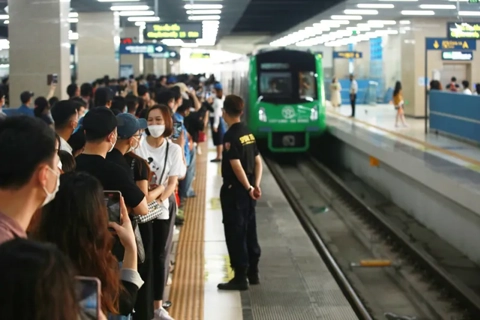
Hanoi to increase small electric buses for public use in urban areas
Hanoi seeks to harness the use of electric minibuses, install more charging stations, and invest in mass public transport to realize a plan on banning gasoline vehicles in July 2026.
THE HANOI TIMES — Small, four-seater electric vehicles will be alternative transportation for gasoline motorcycles in narrow, short streets, according to Duong Duc Tuan, Deputy Chairman of the Hanoi People’s Committee.
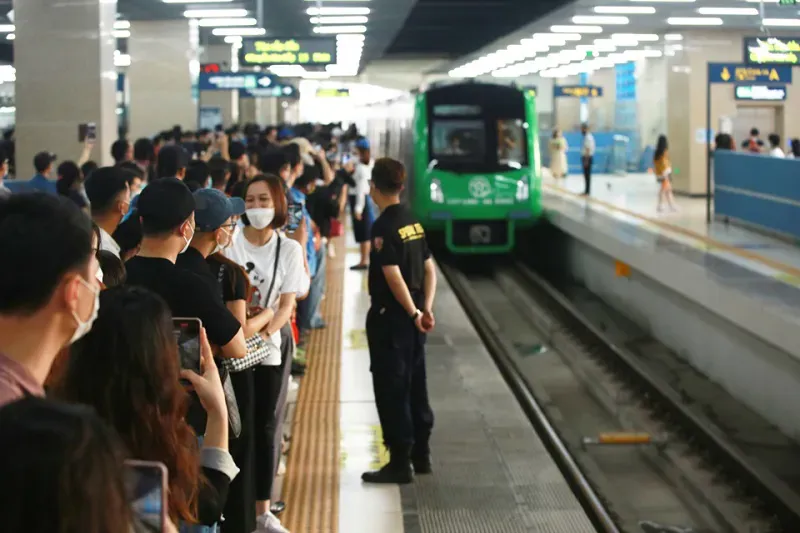
The Cat Linh–Ha Dong train is seeing an increasing number of commuters. Photo: Pham Hung/The Hanoi Times
At a seminar held earlier this week, Tuan said that the city will also deploy 8-12 seat buses for larger roads to shuttle people to transfer hubs.
He added that the use of these vehicles is part of a citywide plan to support people when gasoline motorcycles are banned next year.
Curbing private vehicles requires significant support for people, especially low-income earners transition to alternative vehicles, Tuan said.
According to the deputy chairman, Hanoi may waive registration fees, reduce special consumption taxes, or provide interest-free loans to people buying electric vehicles.
Hoang Van Thuc, Director of the Department of Environment under the Ministry of Agriculture and Environment, said that significant investment in public charging infrastructure and urban railway lines will be critical.
He added that people’s awareness is the key to ensuring the success of the ban on motorcycles.
The Prime Minister on July 12 issued Directive 20 to ban vehicles running on fossil fuel in Hanoi, and asking the city government to prepare an action plan to do so.
Accordingly, Hanoi will prohibit gas-powered two-wheelers within Ring Road 1, a highway encircling central Hanoi, starting July 1, 2026.
The ban will expand to Ring Road 2 in 2028, and encompass Ring Road 3 in 2030. After that, restrictions will also apply to gasoline and diesel cars.
Hanoi may buy back around 450,000 gas-powered motorcycles owned by residents living within Ring Road 1 for between VND3 million (US$120) and VND5 million ($220) per vehicle owner, depending on their income levels.
The Hanoi Department of Construction is gathering feedback on a resolution regarding the transition to green vehicles, the development of charging stations and clean energy infrastructures, feasible financial incentives, and measures to restrict polluting vehicles.
From the date the resolution is enacted, the municipality plans to exempt eco-friendly vehicles from 100% of the vehicle registration tax and license plate fees until the end of 2030.
Public service units, passenger transport services (excluding bus operators), freight transport firms, and other enterprises that invest in facilities for recycling old vehicles are expected to receive preferential loans at an interest rate of 3-5% per year. The maximum loan amount is 100% of the contract value, and the maximum loan term is five years.
Hanoi now has two urban railway lines operating in the area inside the Ring Roads 1 and 2: the Cat Linh-Ha Dong line and the Nhon-Ha Noi Railway Station line (elevated section).
In October 2025, work on urban railway lines 5 (Van Cao-Ngoc Khanh-Lang-Hoa Lac) and 2 (Nam Thang Long-Tran Hung Dao) will begin.