Log in
Hanoi

Hanoi to tackle traffic congestion on Lang Road for US$826M

Once complete, the new Lang Road is expected to give a huge boost to the capital's traffic and socio-economic growth.

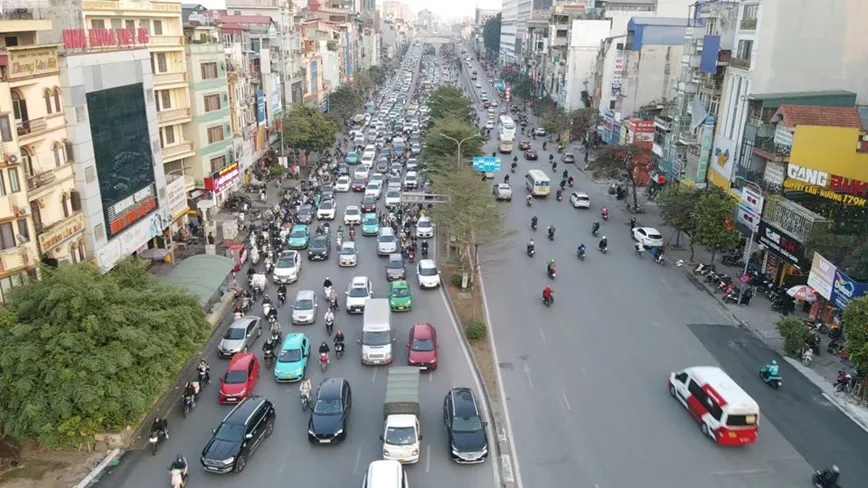
Hanoi’s Department of Transport plans to widen a stretch of Ring Road 2 from the Nga Tu So intersection to the Cau Giay-Lang intersection, Lang Road, at a total cost of VND21 trillion (US$826 million).

 Ram to the elevated road to the Nga Tu So junction on Truong Chinh Street. Photo: The Hanoi Times

Under the plan, the capital will build an elevated section at a cost of VND3.9 trillion ($153.3 million) and widen the existing route for VND17 trillion ($668 million), of which VND16.7 trillion ($656.4 million) will be spent on land clearance.

When completed, the new road will be 53.5m wide, allowing a maximum speed of 80km per hour. It is expected to complete Hanoi's Ring Road 2.

Work on the project is scheduled to begin in 2026 and be completed in 2030. The capital government will partner with private investors to deliver the project.

Hanoi's Ring Road 2 runs along Minh Khai, Dai La, Truong Chinh, Lang, and Vo Chi Cong streets from Vinh Tuy Bridge to Nhat Tan Bridge.

Two sections of the ring road, one from Vinh Tuy Bridge to Nga Tu So intersection and the other from Cau Giay intersection to Nhat Tan Bridge, were widened a few years ago. From a two-lane road, the ring road now has five to six lanes in each direction.

Meanwhile, some sections of the road still have three lanes in each direction, such as from Nga Tu So to the Cau Giay junction. According to the Hanoi Department of Transport, Lang Road was designed for an average of 3,000 vehicles per hour, but now has to cope with the traffic of 8,000 vehicles per hour, leading to chronic congestion during the day, even at off-peak times.

According to Doan Minh Tam, former director of the Institute of Science and Technology under the Ministry of Transport, the upgrading of Ring Road 2 and Lang Road will help relieve traffic congestion.

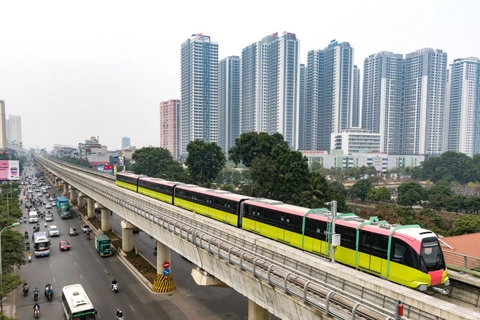
Hanoi is also considering 10 other infrastructure projects. These include the upgrading of the National Route 21 section between Son Tay Town, Hoa Lac, and Xuan Mai Town; the construction of an underground transfer depot between the Cat Linh-Ha Dong and Nhon-Hanoi Station metro lines; and the Tay Thang Long line in the Dan Phuong and Phuc Tho districts.

Reactions:
Share:
Trending
Most Viewed
Related news
Hanoi Metro launches automated ticket-control system to boost smart mobility

Hanoi Metro launches automated ticket-control system to boost smart mobility

Hanoi Metro has introduced a fully automated fare-collection system on the Cat Linh–Ha Dong line, marking a major milestone in the capital’s transition toward smart and green public transportation.

Hanoi to roll out time-based bans on polluting vehicles near pedestrian hotspots

Hanoi to roll out time-based bans on polluting vehicles near pedestrian hotspots

These locations already have the foundations for sustainable traffic and tourism management.

Hanoi, Seoul strengthen strategic cooperation in smart urban and river development

Hanoi, Seoul strengthen strategic cooperation in smart urban and river development

Both sides highlighted the strong foundation of their three-decade partnership and emphasized the need to deepen collaboration in innovation, urban planning and people-to-people exchanges.

Hanoi looks to Seoul’s Han River revival for Red River transformation

Hanoi looks to Seoul’s Han River revival for Red River transformation

The revival of the Han River transformed Seoul’s urban landscape, improved residents’ quality of life and supported South Korea’s broader growth, the possible transformation for the Red River.

Hanoi set for special measures to unlock mega projects

Hanoi set for special measures to unlock mega projects

Such a move would help Hanoi launch major infrastructure projects and advance the city’s long-term development.

Hong Van Commune rises as Hanoi’s emerging model for community-based tourism

Hong Van Commune rises as Hanoi’s emerging model for community-based tourism

Blessed with natural beauty, strengthened by deep cultural heritage and supported by its residents, Hong Van Village is emerging as one of Hanoi’s most distinctive tourism destinations. From ecology and agriculture to handicrafts and festivals, this Red River village is shaping a dynamic vision of sustainable community tourism for the capital.

Hanoi unveils digital heritage journeys to connect tradition with modern urban life

Hanoi unveils digital heritage journeys to connect tradition with modern urban life

Hanoi has launched a new digital heritage program that brings centuries-old cultural assets into a modern, interactive format. By mapping key monuments and creating themed journeys, the city aims to help residents and visitors explore its deep-rooted identity through fresh, engaging experiences.

Hanoi launches two-wheel electric vehicles to expand green urban mobility

Hanoi launches two-wheel electric vehicles to expand green urban mobility

Hanoi has introduced two-wheel electric vehicles for the first time in its transport network, offering residents a new green mobility option and marking a key step in the city’s smart-transport development.