Hanoi's economic growth set to reach 3.94% this year
Hanoi's economic growth is set to rebound to 7.5% next year as the city continues to pursue the dual target of both containing the pandemic and boosting economic recovery.
Hanoi’s gross regional domestic product (GRDP) growth is estimated to reach 3.94% this year, which is lower than the year’s target of 7.5% but would be 1.5 times higher than the national average (2.5–3%), according to Vice Chairman of the Hanoi People’s Committee Nguyen Doan Toan.
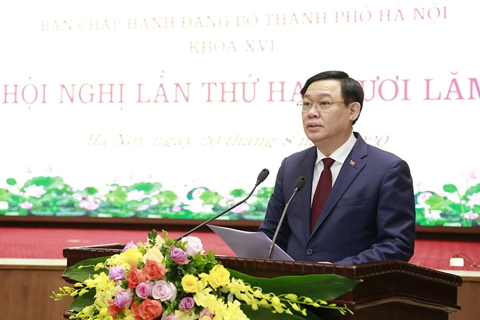
| Hanoi's leaders at the meeting. |
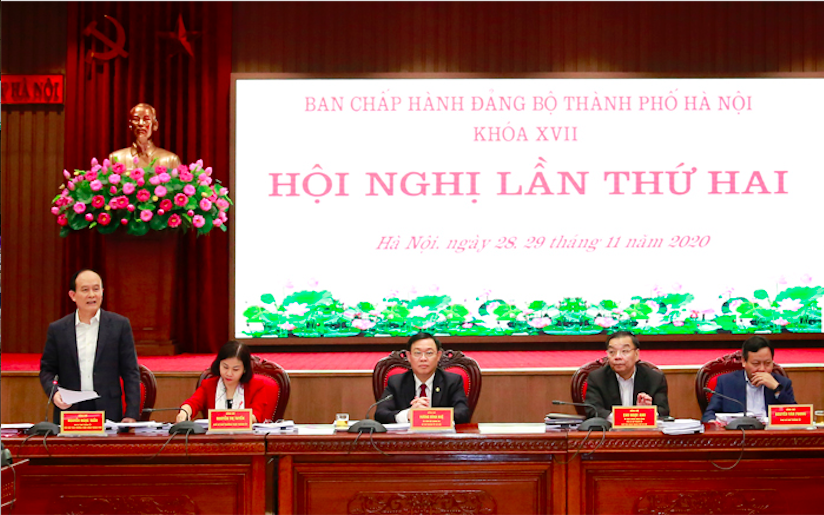
For the 2016 – 2019 period, Hanoi’s average GRDP growth was 7.36%. In 2020, given the severe impacts of the Covid-19 pandemic, the city’s average economic growth in the 5-year period of 2016 – 2020 would be 6.67% (higher than the national average of 5.9%), informed Mr. Toan at a meeting on November 28.
Additionally, Hanoi’s nominal GRDP stood at VND1,024 trillion (US$43.5 billion) in 2019, resulting in income per capita of US$5,250, or 1.43 times that in 2015 and 1.9 times the national average.
In 2020, the productivity is estimated at VND253 million (US$10,900), 1.65 times the national average.
There has also been a positive shift in the economic structure, with a higher proportion in the services, industry and construction sectors from 85.75% to 86.1% and a lower contribution from the agro-forestry-fishery sector.
The industry and construction sector would maintain a positive growth rate of 6.76% this year, in which industry is set to expand by 5.64%, and results in an average growth of 7.65% in the five year-period.
Additionally, total retail sales are estimated to grow by 2.4% for this year, services by 3.1% and exports by 3.5%.
For the 2016–2020 period, services are projected to grow by an average of 6.36%; total goods retail sales and services revenue is set to reach by 9.10% per annum, and exports by 9.18%, 1.7 times higher than that of in the 2011–2015 period.
Hanoi’s consumer price index (CPI), a gauge for inflation, would grow in a range of 2.73% - 2.79% this year.
Over the years, tourism has become Hanoi’s spearhead economic sector, with revenue growing by an average of 12.1%. Last year, the city welcomed over 7 million foreign tourists and was included among the top 10 destinations for travelers around the world.
However, the Covid-19 pandemic has led to a plunge in the number of international tourists, and the figure could be around 1.11 million this year.
The agricultural sector has been a key contributor for growth this year with an estimated growth rate of 4.2%, a record rate in the last several years.
Total social investment capital in 2020 is estimated at VND416.15 trillion (US$18.03 billion), accumulating a total of VND1,725 trillion (US$74.7 billion) in the 2016 – 2020 period, and 1.65 times that of in the 2011 – 2015, or 39.1% of the GRDP.
For the 2016 – 2020 period, Hanoi is forecast to attract US$25 billion in foreign direct investment, up 3.9 times that of in the 2011 – 2015 period.
A highlight of Hanoi’s economic performance this year is the city’s budget revenue reaching an estimated VND279.3 trillion (US$12.1 billion), 0.2% higher than the target set by the municipal People’s Council and 3.5% year-on-year.
Meanwhile, the city’s expenditure is 84.7% of the estimate at VND87.46 trillion (US$3.78 billion).
For next year, Hanoi expects its economic growth to accelerate to 7.5% as the city would continue to pursue the dual target of both containing the pandemic and boosting for economic recovery, stated Mr. Toan.