Log in
Hanoi

Hanoi’s first metro line to start operating from Nov 6

The China-financed urban railway took 10 years of construction and exceeded 205% of the initial investment.

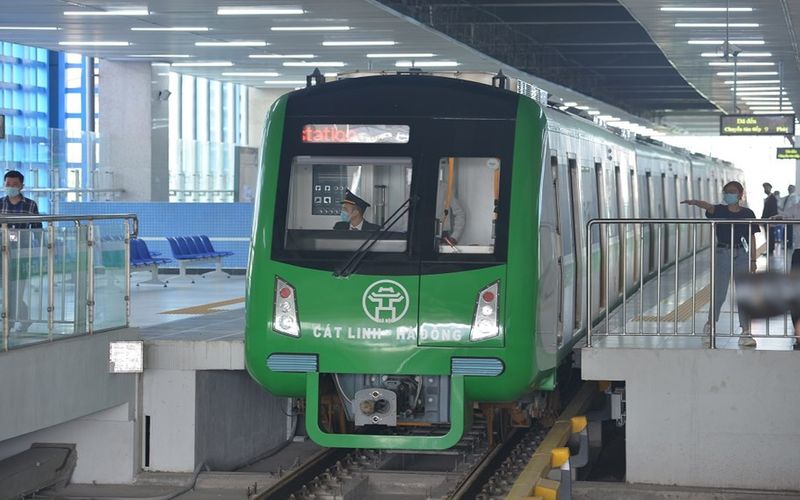
The Ministry of Transport will hand over the China-funded Cat Linh-Ha Dong urban railway project, the first of its kind in Hanoi, to the municipal government on November 6 for commercial operations.

Local authorities will decide the operating timetable but passengers will benefit free rides in the first 15 days of operations, Director of the Hanoi Department of Transport Vu Van Vien said.

“Hanoi has been fully prepared for the operations which will be in discussions between the local authorities in the Ministry of Transport. In the initial operations, four to six trains will be used” Vien told The Hanoi Times.

He added that the quality assessment results of the metro line were approved by the State Council for Acceptance of Construction Projects on October 29. It is the final step for the project to begin commercial operations.

 Hanoi's first metro line ready to welcome passengers. Photo: Pham Cong/The Hanoi Times

Vu Hong Truong, director of Hanoi Railway Company Limited, the unit that directly operates the service, said that the station staff will count the number of passengers.

Notably, the ticketing area is marked for people to keep a safe distance while lining up. Passengers entering and exiting stations must scan a QR code. Each station has an isolation room for any person suspected of being infected with Covid-19, Truong added.

The fares are expected to start at VND8,000 (35 US cents) for the shortest distance, while the maximum cost for a trip covering the entire line between Yen Nghia Station and Cat Linh Station, will be VND15,000.

Commuters can enjoy unlimited rides in a single day if they purchase a Day Pass which costs VND30,000 (US$1.31) while a monthly pass will cost VND200,000 (US$8.72), with a 50% reduction in price for students and workers at industrial parks.

In a related move, Deputy Prime Minister Le Van Thanh requested that the Hanoi authorities thoroughly examine the operation plan to facilitate the movement of passengers using the mass transit network.

He also required the strict enforcement of Covid-19 prevention and control measures, ensuring traffic safety, and transparent information of the project in the public.

The Cat Linh-Ha Dong urban railway is 13-kilometer long and has 12 stations and 13 trains. Each train, whose designed speed is 80 km per hour, has four carriages capable of carrying over 900 passengers.

It starts at the Cat Linh Station in Ba Dinh District and ends at the Yen Nghia Station in Ha Dong District. The metro line has total investment of approximately US$886 million. Works on the railway began in 2011 but the project left numerous setbacks and delays.

The trial run was completed in December 2020, with thousands of trips covering more than 70,000 km.

Reactions:
Share:
Trending
Most Viewed
Related news
Hong Van Commune rises as Hanoi’s emerging model for community-based tourism

Hong Van Commune rises as Hanoi’s emerging model for community-based tourism

Blessed with natural beauty, strengthened by deep cultural heritage and supported by its residents, Hong Van Village is emerging as one of Hanoi’s most distinctive tourism destinations. From ecology and agriculture to handicrafts and festivals, this Red River village is shaping a dynamic vision of sustainable community tourism for the capital.

Hanoi unveils digital heritage journeys to connect tradition with modern urban life

Hanoi unveils digital heritage journeys to connect tradition with modern urban life

Hanoi has launched a new digital heritage program that brings centuries-old cultural assets into a modern, interactive format. By mapping key monuments and creating themed journeys, the city aims to help residents and visitors explore its deep-rooted identity through fresh, engaging experiences.

Hanoi launches two-wheel electric vehicles to expand green urban mobility

Hanoi launches two-wheel electric vehicles to expand green urban mobility

Hanoi has introduced two-wheel electric vehicles for the first time in its transport network, offering residents a new green mobility option and marking a key step in the city’s smart-transport development.

Thai AirAsia launches new Hanoi–Luang Prabang route to boost regional travel

Thai AirAsia launches new Hanoi–Luang Prabang route to boost regional travel

Thai AirAsia has opened a new direct Hanoi–Luang Prabang route using Fifth Freedom traffic rights, creating a faster and more convenient link between two major heritage destinations in Vietnam and Laos.

Hanoi orders strong air-pollution measures and warns schools to adjust schedules

Hanoi orders strong air-pollution measures and warns schools to adjust schedules

Hanoi has issued new directives requiring schools to restrict outdoor activities and consider suspending classes when air quality drops to hazardous levels, while launching a sweeping crackdown on pollution sources across the city.

Hanoi – Vientiane ties set pace for bilateral cooperation

Hanoi – Vientiane ties set pace for bilateral cooperation

The two sides have inked two city-level agreements and eight agreements covering areas such as Party building, economic and investment cooperation, agriculture, health, education and people-to-people ties.

Hanoi completes tunneling for four underground stations of 2nd metro line

Hanoi completes tunneling for four underground stations of 2nd metro line

The completion marks a major step forward for the four-kilometer underground section of the metro line.

Rooftop solar push to boost Hanoi's green ambition

Rooftop solar push to boost Hanoi's green ambition

Rooftop solar in industrial zones has the foundations to become a new driver of Hanoi’s energy transition.