Hanoi’s greater autonomy under Capital Law unlocks new growth opportunities
A key breakthrough in the law is stronger decentralization, with the transfer of approval authority for investment projects from the Prime Minister to Hanoi’s local government.
The 2024 Capital Law grants Hanoi greater autonomy over public investment and PPP projects, paving the way for transformative urban development, according to Architect Tran Ngoc Chinh, Chairman of the Vietnam Urban Planning and Development Association (VUPDA).
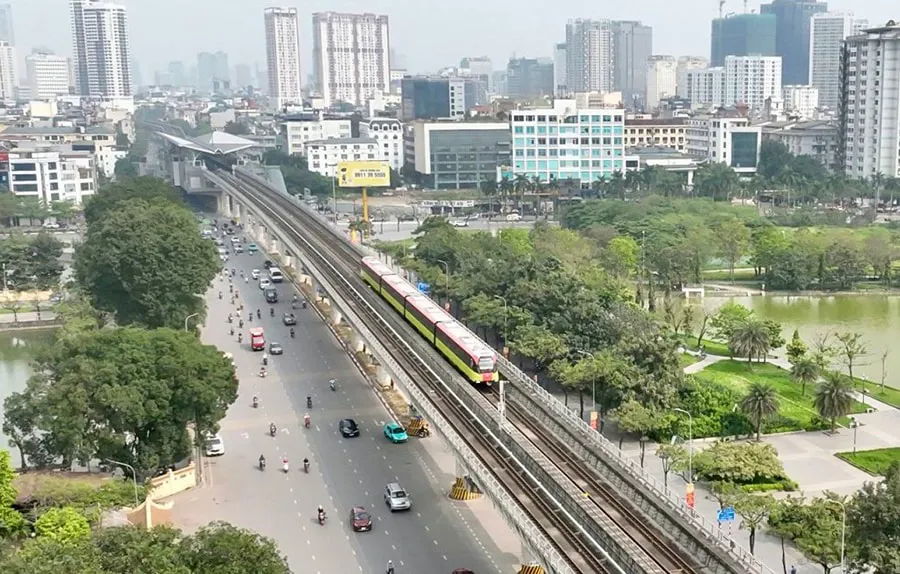
| The Nhon - Cau Giay section metro line. Photo: Nguyen Quang. |
“As a result, the capital’s development will not only expand vertically and horizontally but also in-depth, creating a well-integrated urban landscape,” said Chinh.
This approach maximizes land use, strengthens infrastructure, preserves historical and cultural heritage, expands green spaces, enhances the urban ecosystem, alleviates traffic congestion, and paves the way for a modern, sustainable city, he added.
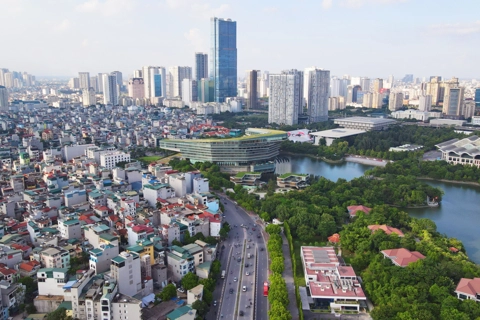
As Vietnam’s capital, Hanoi is not only the country’s political and administrative center but also a major hub for culture, education, science, technology, and economic growth.
By 2050, its population is projected to reach 13–13.5 million, requiring a forward-looking urban strategy. To ensure a “Bright, Green, Clean, and Beautiful” city, comprehensive planning initiatives have been introduced.
A representative of the Hanoi Department of Planning and Architecture, however, suggested that despite ongoing efforts, planning adjustments and detailed zoning at 1/500 scale remain hindered by legal and procedural barriers.
“Several key urban planning projects along transport corridors lag behind schedule, lacking feasibility and slowing critical infrastructure investments. Additionally, land allocation for transportation and public transit usage has yet to meet strategic goals,” he said.
The preservation and redevelopment of historic inner-city areas, including the Old Quarter, French colonial districts, historic mansions, and other architectural landmarks, remain fragmented due to regulatory constraints and limited social capital.
To address these issues, the 2024 Capital Law prioritizes sustainable urban development, a healthy living environment, and water security, positioning the Red River as Hanoi’s ecological and scenic backbone. It also facilitates zoning implementation along the Red and Duong Rivers, aligning with the Capital Master Plan and national urban planning frameworks. Additionally, new levee systems will be developed to enhance flood resilience and optimize land use.
To maximize the land potential of the riverfront, the law allows investment in cultural industries, ecological agriculture, experiential education, and tourism, leveraging Hanoi’s strategic location and cultural heritage.
A key breakthrough in the law is stronger decentralization, with the transfer of approval authority for investment projects from the Prime Minister to Hanoi’s local government. This allows the city to utilize agricultural land efficiently while maintaining flood control and disaster resilience. The Hanoi People’s Committee now has greater discretion over urban planning adjustments, functional zoning, and infrastructure strategies, while the People’s Council sets implementation procedures.
According to the Hanoi Council for Legal Education and Dissemination, these provisions represent a major turnaround from previous regulations, allowing Hanoi to accelerate its modernization. Notably, the law also strengthens policies for underground infrastructure development, supporting the construction of subway stations, underground metro networks, and integrated commercial service complexes based on the Transit-Oriented Development (TOD) model.
On March 15, 2022, the Hanoi People’s Committee issued Decision No. 913/QĐ-UBND, approving Vietnam’s first official underground urban space plan, covering development through 2030 with a vision to 2050.
“Going forward, Hanoi must further institutionalize the special policies outlined in the 2024 Capital Law to ensure bold, transformative urban development and cement its status as a modern, dynamic metropolis,” said Chinh.