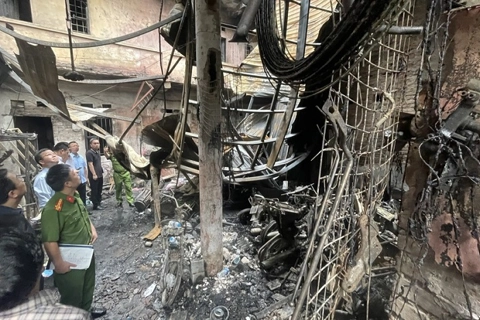
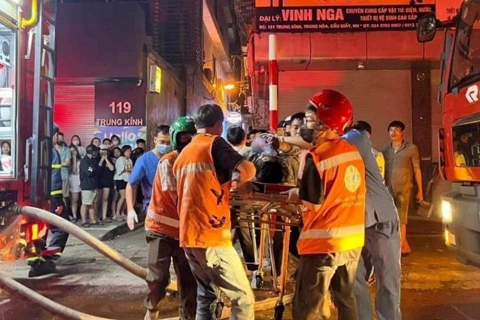
Hanoi's narrow alleyways make firefighting and rescue challenging
Many of the capital's 4,500 alleys are extremely narrow, making fire scenes inaccessible to fire trucks.
Once a preferred option for low- and moderate-income people looking for rentals, small alleys now pose a great danger to residents if their homes catch fire.
| Firefighting in Hanoi's Old Quarter. Photo: Hoang Binh/The Hanoi Times |
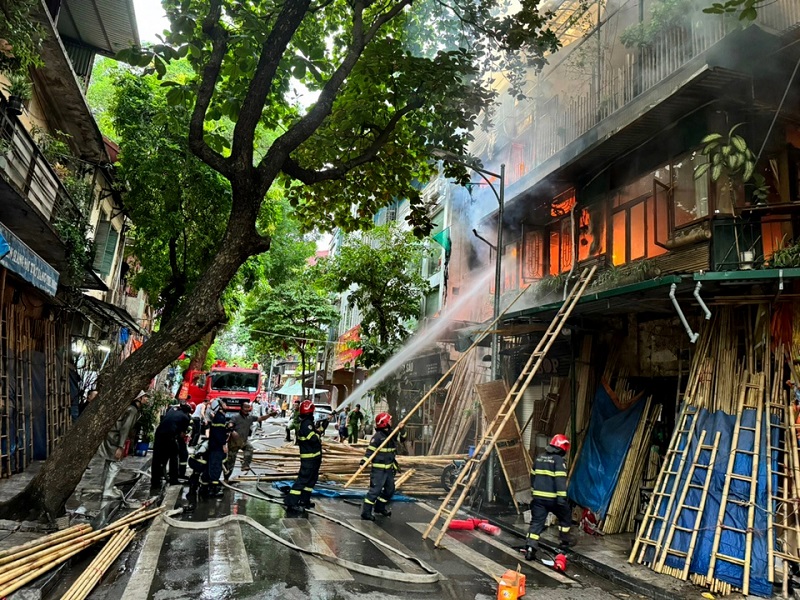
These alleys were once the intra-village roads of centuries-old rural hamlets. Now, once urbanized, they are urban neighborhoods with high population density.
Nestled in these deep and narrow alleys are the houses and tenement buildings that provide low-cost housing for locals and migrants throughout Hanoi.
Lacking direct access to major roads and highways means that these locations can be rented cheap.
Nguyen Thi Hien, 34, now lives with her family in an old apartment on Thai Thinh Street. She rents the place for VND6 million (nearly US$236) a month, a rate affordable for her income level.
Her home is about 50 meters from the main street. As you go further in, the alley gets narrower.
"It is unlikely that a fire truck can fit into this alley," she told The Hanoi Times.
Before settling on the current address, Hien had looked at a few other rentals, but they were all deep in small alleys, she said. "We were worried that if a fire broke out, there would be no way for us to escape."
Hien said she plans to build a fire exit in her current apartment for safety reasons.
Meanwhile, Nguyen Thi Nhung, who now rents an apartment on De La Thanh Road, said she plans to move several times for fear of fires and explosions.
"My building is deep in the alley and there are no emergency exits other than the balcony where I can jump out and land on the neighbor's roof," she said.
There have been several major fires in Hanoi recently, killing dozens of people. Late last month, a fire broke out in an apartment building on Trung Kinh Street, killing 14 people.
The structure was built in small alleys and were designed to occupy as much of the lot as possible. There were no fire exits in these buildings. Although fire extinguishers were available and worked, they were not enough to save people's lives.
According to the Hanoi People's Committee, there are more than 4,500 narrow alleys and streets in the city that fire trucks can't pass through.
From January to May, there were nearly 490 fires. Of these, more than 280 were in places that combine residential use with shops or workshops.
City officials claim that fire trucks can't get to the fires because of the narrow alleys. The firefighters spent a great deal of effort getting their equipment to the scene before actually working to extinguish the fires.
Local authorities take action
A survey conducted by the Cau Giay People's Committee shows that there are more than 3,300 rented houses in the district. Of these, more than 1,800 buildings are leased for residential use, and more than 1,500 buildings combine residential and business use.
| A firefighting drill in Phu Dien Ward, Bac Tu Liem District. Photo: Tran Thao/The Hanoi Times |
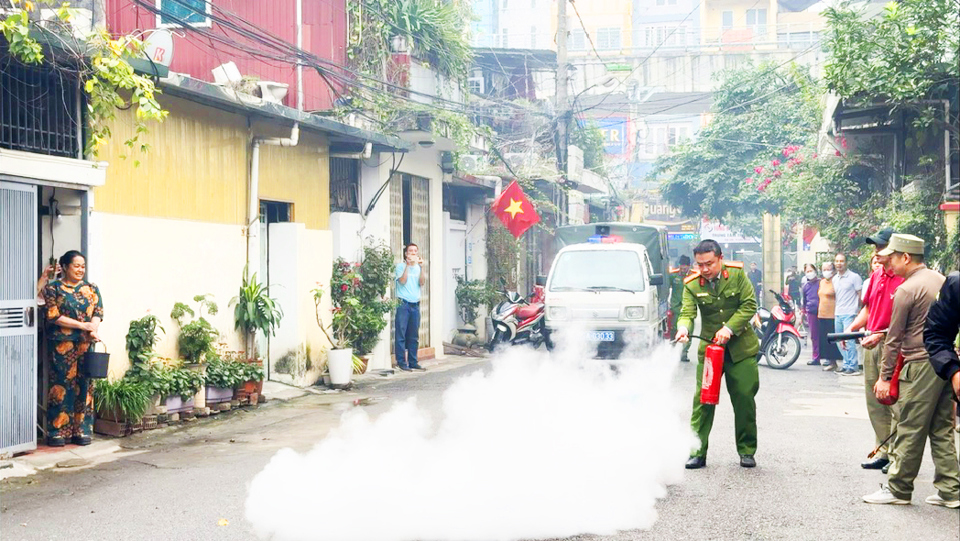
In Thanh Xuan District, there are now nearly 1,600 alleys and small passages less than three meters wide. Meanwhile, Bac Tu Liem District has nearly 1,000 narrow alleys where fire trucks cannot fit, with buildings that lack fire exits and are unable to isolate the fire if it breaks out.
To deal with the situation, Hanoi has organized inter-family fire-fighting teams and installed community fire-fighting kits (with axes, hammers, pliers and fire extinguishers). People are trained to use fire extinguishers and rescue tools to keep the fire under control until firefighters arrive.
Major Le Tien Thanh, deputy captain of the Fire and Rescue Police under the Bac Tu Liem District Public Security Division, said the district needs more than 1,900 community firefighting kits.
So far, Bac Tu Liem District has set up 122 inter-family firefighting teams and installed some 336 firefighting kits, he said.
According to the Cau Giay District People's Committee, the district will step up its supervision of rental properties in the area, and will suspend rentals of buildings that lack emergency exits, are poorly equipped with firefighting gear, and inaccessible to fire trucks.
Colonel Duong Duc Hai, Deputy Director of Hanoi's Department of Public Security, said that 90% of fires are often caused by electrical malfunctions and that people are sometimes careless in their use of electricity.
"Almost all apartment buildings and rental houses are not well maintained, and overconsumption often leads to overloaded power lines, especially on summer days," he said.
Hai advised that the local fire department needs to review firefighting and rescue protocols and regulations, and then develop appropriate plans and scenarios to deal with catastrophic incidents.
Local police units need to make their equipment, kits and instruments easier to use, taking into account the local landscape, especially deep and narrow alleys, he added.
Experts said Hanoi authorities need to catalog neighborhoods into different categories of fire risk based on population, density, and alley width, and consider not allowing rental houses in places inaccessible to fire trucks.