Hanoi's second metro line opens
The metro system has always been a priority for the Vietnamese government and Hanoi authorities, as it is a modern mass transit mode that helps reduce traffic congestion and pollution.
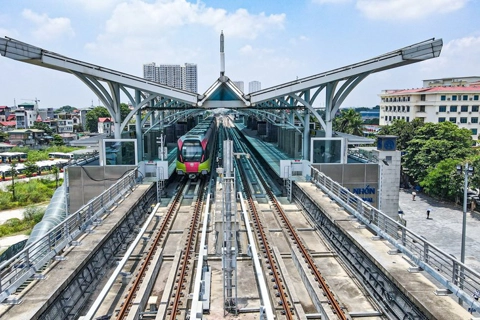
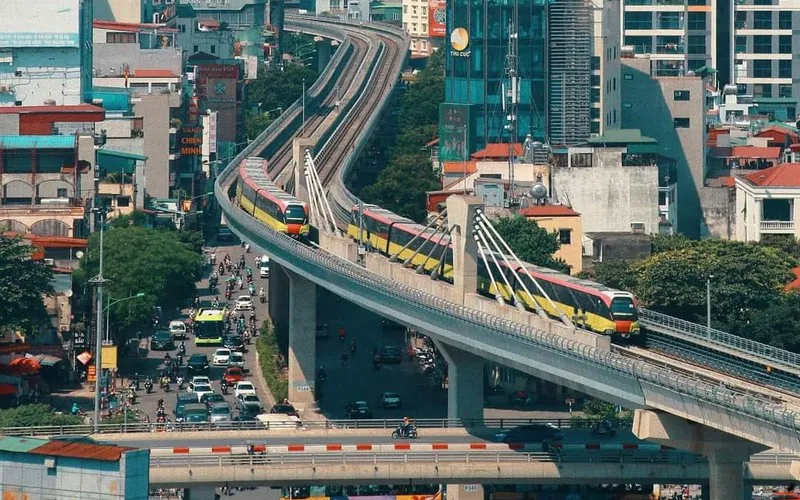
An 8.5-kilometer elevated section of the Nhon-Hanoi Station metro line was commissioned on the morning of August 8.
After a long wait, many Hanoi residents are excited to experience the country's second metro project. This was supposed to happen in 2015, but the project has been plagued by long delays and cost overruns.
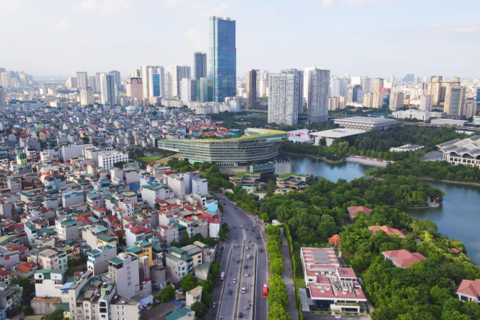
Hanoi's second metro line Nhon-Hanoi station. Photos: Anh Kiet/The Hanoi Times |
Vu Nhat Nhat, a student at Vietnam National University-Hanoi who took a ride on the opening day, told The Hanoi Times that the stations and trains are nice. "Now I probably won't have to worry about slogging through the congested streets every day to get to the university or back home near Nhon station. I found the ride to be quite smooth and quiet," Nhat said.
Le Quang Chung, a 76-year-old resident of Ba Dinh District, said he was happy to be among the first passengers on the metro line. He live near Cau Giay station and often visit his nephew who lives near Nhon station, so he is very excited at the launch of the metro line.
"I was hoping that more rail lines would be built because it would make commuting easier and more convenient for people," Chung stated.
Students from universities along the second metro line are the happiest. They said they have been waiting for the line since their freshman year, and after three years they can take the train instead of their private vehicles.
"I will use a monthly pass to travel because it will save me 30 minutes to get to my university," said Hoang Thuy Duong, a student at Hanoi University of Industry.
Others praised the advantages of the mass transit system, especially in terms of convenience, safety, and protection from pollution compared to riding a motorcycle, which is currently the most popular mode of transportation in Vietnam.
Nguyen Ba Son, Deputy Head of the Hanoi Metropolitan Railway Management Board (MRB), said that the Nhon-Hanoi Railway Station metro line is expected to be a game-changer for public transport in a congested city with millions of private vehicles.
Nguyen Ba Son, Deputy Head of MRB (in white shirt), one of the first passengers to board the Sky Train on the morning of August 8. |

"The metro line would help increase the number of public transport passengers and help the city's public transport network meet up to 45% of demand. In the first three months of operation, trains on this line will run every ten minutes from 5:30 a.m. to 10 p.m. In the future, the operating hours will be adjusted according to passenger demand," Son said.
The elevated section of the Nhon-Hanoi Station metro line includes eight stations: Nhon, Minh Khai, Phu Dien, Cau Dien, Le Duc Tho, Vietnam National University, Ha Pagoda, and Cau Giay.
After being free for the first 15 days, a trip will cost VND8,000-12,000 (US$0.3-0.5) for a ticket. Commuters can enjoy unlimited rides in a single day by purchasing a daily or monthly pass.
Daily passes will be available for VND24,000 ($1), allowing unlimited rides within a day. Monthly passes will cost VND200,000 ($7.90) and VND100,000 ($4) for students.
A total of 36 public bus lines run along the Nhon-Hanoi metro line. People who are entitled to free bus travel are also free to use the metro, i.e. children under the age of six, people with disabilities, the elderly, people with merits for the revolution, and members of poor households.
A ticket to enter the metro. It is circular and resembles a coin with the symbol of Hanoi's Khue Van Cac. |
.jpeg)
"A war veteran waiting for a train at Cau Giay Station at 7:30 am is one of the motivations for me and my team to improve service quality," said Vu Hong Truong, General Director of Hanoi Metro and Manager of Nhon-Hanoi Station Metro Line.
Hanoi's first metro line, the Cat Linh-Ha Dong metro, was inaugurated in November 2021, also the first in Vietnam.
The second line has a total length of 12.5 km, with eight elevated and four underground stations. Only the 8.5 km elevated section from Nhon to Cau Giay was inaugurated today, while the 4 km underground section from Cau Giay to Hanoi Station is scheduled for completion in 2027.
Work on the metro line began in September 2010 and was originally scheduled to be completed in 2016. However, the project was delayed several times for various reasons, increasing the total investment from $712 million to $1.4 billion.
The metro line consists of 10 trains with a maximum speed of 80 kilometers per hour. Each train has four cars, with a maximum capacity of 236 passengers per car. The line is operated by a total of 353 employees.
.jpeg)
Inside a train on the Nhon - Hanoi Station metro line in Hanoi on August 8. |
.jpeg)
A crowd of passengers waits at Cau Giay station in Hanoi on August 8. |

After years of waiting, Hanoi residents can finally ride the train on the Nhon-Hanoi station metro line. |