Hanoi's transport infrastructure development ends 2022 on high note
Hanoi completed a number of projects for better intra-city connection and inter-regional economic linkage.
The robust development of the transport infrastructure and mass transit network shows that Hanoi can find the right way to improve the city's traffic flow for better socio-economic performance.
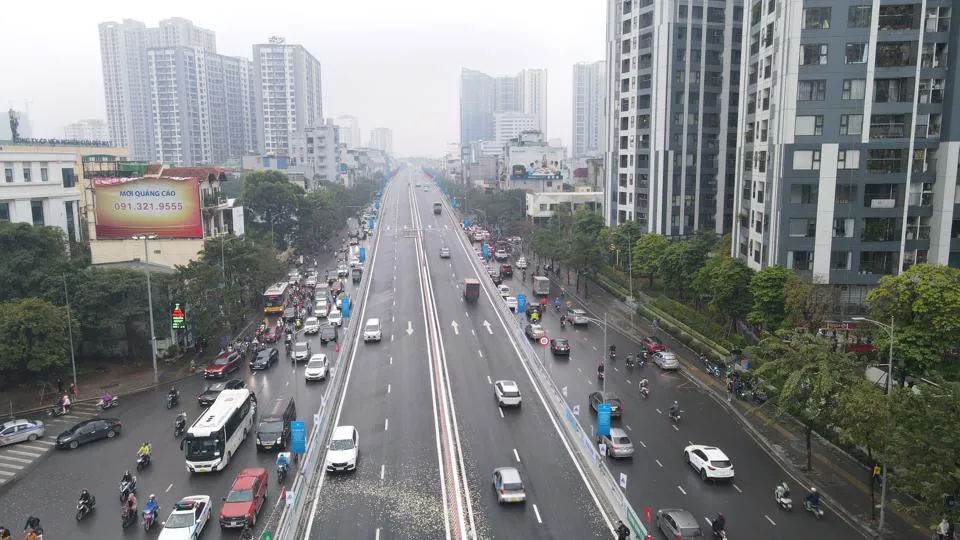
| Ring Road No.2 connecting Vinh Tuy Bridge and Nga Tu So crossroads officially opens on November 1, 2022. Photo: Pham Cong/The Hanoi Times |
The capital city has built almost 23,600 kilometers of roads of all types that allow for better intra-city connections with other provinces in the northern delta region.
Hanoi will start construction of Ring Road No.4, linking Hanoi with Bac Ninh and Hung Yen provinces. The project, with a total investment of VND85.8 trillion (US$3.7 billion) has attracted efforts of the entire municipal political system and neighboring localities. Hanoi Party Committee’s Secretary Dinh Tien Dung directly supervises the project.
So far, land clearance has begun. The city is committed to handing 100% of the required land to investors by the end of 2023.
In 2022, Hanoi also put a number of traffic infrastructure projects into operation, including the Le Van Luong underpass, and the elevated stretch of Ring Road N.2 connecting Vinh Tuy Bridge to Nga Tu So junction. Several projects started in 2022 or were almost completed last year, such as the Kim Dong underpass, the second phase of Vinh Tuy Bridge and National Road No.6 from Ba La Ward to Xuan Mai Town.
According to Phan Truong Thanh, an urban development specialist, Hanoi has taken vigorous measures to secure financial resources and issue regulations to implement a large number of infrastructure development projects at the same time. "Most outstanding is the leadership and management of the municipal Party Committee and People's Committee, without it, many projects would be stalled due to regulatory obstacles in financing and land clearance," he said.
Mass transit network expanded
“Hanoi’s mass transit in 2022 recovered strongly after the pandemic and achieved significant results,” Nguyen Hoang Hai, Director of the Hanoi Urban Transport Management and Operation Center, said.
According to him, the biggest success was the commissioning of the Cat Linh - Ha Dong urban railroad. In 2022, the ridership of the Cat Linh - Ha Dong railroad exceeded 7.2 million, encouraging people to leave their private vehicles at home.
In 2023, the city hopes to put the second urban railroad Nhon - Hanoi Station into operation so that the traffic burden for the western gateway area would be eased, Hai said.
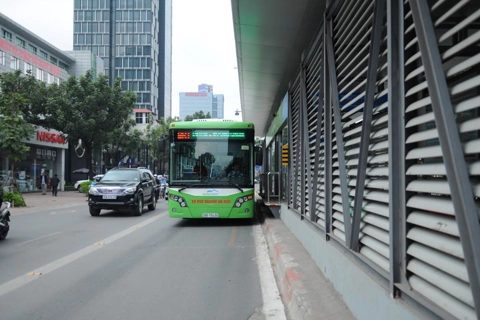
Along with the urban rail system, other modes of public transport were launched, such as e-buses from Vinbus - a member of the Vingroup conglomerate - shared bicycles and minibusses, which have gained public preference. These mode shares will pave the way for Hanoi to expand the mass transit network to reduce congestion and emissions.
"The large population, the high number of personal vehicles, and narrow roads have prevented Hanoi from developing a good ride-sharing network," said Nguyen Tuyen, Head of the Transportation Administration Division of the Hanoi Department of Transportation. Hanoi is the second most populous city in the country after Ho Chi Minh City and is currently home to some 8.4 million people and 7.6 million private vehicles (motorbikes and cars).
So far, 17.8% of Hanoi's people use public transport to get around, while the capacity of the entire network can meet 30% of travel demand. Most Hanoians still prefer to use their own motors and cars rather than public transport, which worsens the city's infrastructure.
For that reason, the introduction of minibusses and bike sharing to connect people's homes with urban railway and bus systems is a strategic move to encourage people to use public transport. Specialists attributed poor accessibility to public transport to Hanoians' discouragement from using public vehicles. They hope that minibusses and bike sharing will make it more convenient for commuters to reach train stations and bus stops, thus leaving their personal vehicles at home and choosing public transportation as their primary means of commuting.
Transportation specialist Le Trung Hieu said Hanoi ends 2022 with several achievements in the development of transport infrastructures and mass transit network but there are still challenges that the authorities and people of Hanoi have to work on together, and perhaps they need the support of the Government as well.
In 2023 and years to come, Hanoi needs to relocate major agencies, organizations, and facilities out of the urban core, Hieu said. Currently, Hanoi is home to 43 central and municipal hospitals, 2,500 schools, from preschool to university, and more than 56,000 public agencies, which is considered one of the key reasons causing infrastructure overload and traffic congestion.
"To move these facilities outside the urban core, Hanoi needs to speed up the development of public transport in rural areas, especially in the five satellite towns," Hieu emphasized.