Health Ministry urges emergency measures after Typhoon Bualoi flooding
Localities need to prepare disinfectants, treat domestic water sources, collect waste, early detect and handle infectious diseases.
THE HANOI TIMES — Vietnam’s Ministry of Health (MoH) has ordered northern and central provinces to urgently respond to flooding after Typhoon Bualoi, prioritizing emergency care and epidemic prevention.
The MoH directed provincial departments of health to mobilize medical staff, equipment, medicine and hospital beds to treat flood victims and ensure readiness in all situations.
Hospitals were told to maintain uninterrupted services, particularly electricity, water, transportation and IT systems. They must also prepare backup generators and reinforce intensive care units that rely on ventilators and other critical equipment.

The Ministry of Health gives chemicals to localities in the central province of Ha Tinh to treat the environment. Photo: VNA
Hospitals need to ensure regular medical examination and treatment activities, focusing on maintaining electricity, water, transportation systems and information technology.
The MoH has required a plan to prepare a backup generator and arrange additional human resources for the intensive care unit, which uses many ventilators and essential equipment.
Proactively preventing epidemics and cleaning the environment after storms, the ministry noted that there should be no shortage of drugs or price fluctuations.
Localities need to prepare disinfectants, treat domestic water sources to ensure clean water for people, collect waste, early detect and handle infectious diseases and prevent epidemics from breaking out after floods.
Hydropower plants release water
Following the intense rainfall caused by the circulation of typhoon Bualoi, the Ministry of Agriculture and Environment has ordered to opening of gates at two major hydroelectric reservoirs due to rapidly rising floodwaters from upstream.
Three major hydropower plants, including Thac Ba, Tuyen Quang and Hoa Binh, were forced to release water through 11 spillways this morning to ensure reservoir and downstream safety.
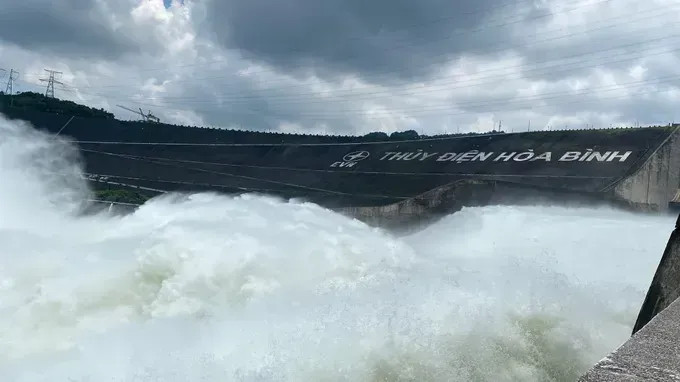
Hoa Binh Hydropower Plant is releasing water. Photo: VNA
Tuyen Quang Hydropower Reservoir is discharging water through seven bottom spillways, while Hoa Binh Hydropower Reservoir is releasing water through two bottom spillways, and Thac Ba Hydropower Reservoir is regulating through two spillways.
As of October 1, the Department of Dyke Management and Flood Prevention reported that water levels had exceeded alert level 3 on the Thao River in Lao Cai Province and the Ca River in Nghe An Province. Inflows into reservoirs remain high, with many northern provinces, including Cao Bang, Lang Son, and Phu Tho, still experiencing severe flooding.
As a result, water levels on the Red River are expected to rise rapidly. The National Center for Hydro-Meteorological Forecasting has issued a warning of forceful floods on the Thao River.
Meteorologists cautioned that heavy rainfall will persist for several days and urged residents in midland, mountainous, and riverside areas to remain vigilant. Local authorities are implementing evacuation plans for areas at risk of landslides, flash floods, and deep inundation.
Residents are advised to avoid traveling through flooded or landslide-prone areas until conditions improve.