High-quality human resources key to Hanoi’s science, technology, and innovation breakthroughs
As Hanoi pioneers six major resolutions on science, technology, innovation and digital transformation, attracting talent, building trust and effective implementation will determine whether the capital can turn ambitious policies into lasting development gains.
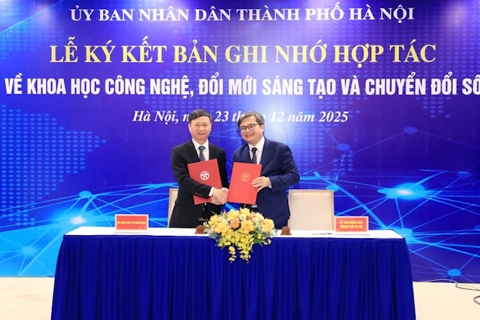
THE HANOI TIMES — As science, technology, innovation and digital transformation are identified as top strategic breakthroughs for national development, Hanoi has taken a pioneering step by issuing six thematic resolutions simultaneously. These resolutions aim to realize the Capital Law and Politburo Resolution No. 57-NQ/TW.
Bui Thi An, President of the Hanoi Association of Women Intellectuals and Director of the Institute for Natural Resources, Environment and Community Development, spoke with Hanoimoi Newspaper about the key factors behind effective policy implementation in the capital.

A next-generation humanoid robot developed by VinMotion and VinRobotics on display at a Hanoi-based event. Photo courtesy of the company
How do you assess Hanoi’s decision to issue six resolutions on science, technology, innovation and digital transformation at the same time?
I strongly welcome Hanoi’s clear political determination and proactive approach. In a short period, the city conducted wide consultations, refined policy content and issued six resolutions at once to implement the Capital Law and Politburo Resolution No. 57-NQ/TW on breakthroughs in science, technology, innovation and digital transformation.
This decision shows a clear transition from general policy orientation to concrete execution, rather than stopping at broad statements.
What stands out is the high level of coordination and completeness. The resolutions address core issues, including sandbox mechanisms, venture capital funds, technology exchanges, support for innovation ecosystems and the establishment of the city’s Innovation Center.
This approach tackles a long-standing weakness where policies existed in isolation and lacked connection. From the outset, Hanoi has built a unified framework for a functioning innovation ecosystem.
Hanoi has strong science and technology potential that has not been fully utilized. Why is that?
Hanoi hosts the country’s largest concentration of intellectuals, scientists, research institutes and universities. It also serves as a major hub for international scientific cooperation. This represents a rare and valuable development advantage.
Yet for many years, the city has struggled to mobilize this intellectual capital effectively. In my view, the core issue lies in incomplete and unsuitable science and technology policies.
Management mechanisms have failed to reflect the unique nature of science, technology and innovation. These fields involve complex work that generates high value while carrying inherent risks.
Such approaches create administrative barriers, weaken incentives and limit creativity. As a result, the science and technology market has grown slowly, supply and demand remain disconnected and research outcomes face difficulty reaching commercialization.
In this context, how important is the revised Capital Law in addressing these limitations and creating new momentum?

Bui Thi An, President of the Hanoi Association of Women Intellectuals and Director of the Institute for Natural Resources, Environment, and Community Development. Photo: Thanh Hai/The Hanoi Times
The 2024 Capital Law plays a pivotal role. It provides a special legal framework that allows Hanoi to apply more flexible and advanced mechanisms than other localities, especially in science, technology and innovation.
The law creates institutional space for Hanoi to pilot sandbox mechanisms, stimulate investment in research and development, apply targeted land and infrastructure policies for high-tech zones, attract and retain talent and expand public–private partnerships in innovation.
This legal framework forms the strongest foundation for Hanoi to design, operate and govern its own innovation ecosystem.
Why do you place such strong emphasis on people and trust in policy implementation?
High-quality human resources determine whether policies succeed or fail. Even the most carefully designed mechanisms will fall short if the city cannot attract, retain and empower talented scientists and leading experts.
Trust plays a decisive role. Without trust in scientists, without autonomy for innovation and without acceptance of reasonable risk, breakthroughs remain unlikely.
History shows that trust functions as a catalyst. In science and technology, trust unlocks creativity, accountability and long-term commitment.
Do you have any additional recommendations to ensure the resolutions deliver maximum impact?
Effective implementation requires unified and decisive leadership, along with a capable focal agency that holds sufficient authority to coordinate action. This structure will allow businesses, research institutes, universities and scientists to connect and participate efficiently.
At the same time, the city must strengthen communication so the scientific community, enterprises and the public clearly understand their rights, roles and responsibilities. Policies that remain confined to administrative documents rarely translate into real outcomes.
Another essential factor is gender equality in implementation. Women account for a large share of the science and innovation workforce, yet current policies rarely define specific targets or indicators. Addressing this gap would support more inclusive and sustainable development in Hanoi.
Thank you for your time!