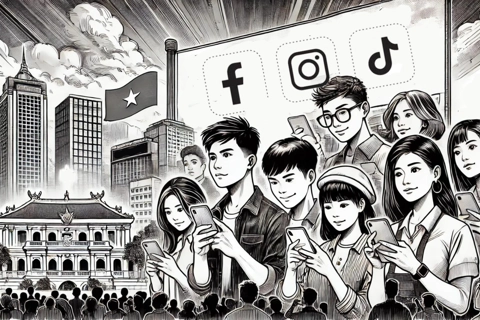
How fake news hooks us?
This week's Words on the Street explores the allure and impact of fake news, revealing why it captivates us and how it spreads through social media.
This week's topic, "How fake news hooks us," uncovers the powerful grip that sensational headlines and misleading information have on our society. From clickbait thumbnails to viral misinformation, we explore the psychology behind why fake news captivates us, the role of social media in its spread, and the real-world consequences of believing and sharing unverified stories.
My mom sent me a dramatic message with a link to a video from a page called ***News.
Curious and a bit skeptical, I clicked on it. What I found was an absurdly ridiculous video with a clickbait thumbnail and a laughably bad bot-sound voiceover. The video showed an illustration of a doctor standing with his arms crossed and an AI-generated voice. I sat through the entire two-minute video, only to find that it was completely devoid of any useful or scientifically-backed information—just wild, unsubstantiated statements being thrown around.
I couldn't help but notice how many Vietnamese folks are hooked on tabloid news and unverified sources. These unofficial news sites rack up massive followings and tons of likes.
Celebrity scandals? Even more interactions and comments. There are many private community groups on Facebook that restrict content visibility and require registration and invitation to join, yet they attract an overwhelming number of members. Some of these groups and fan pages spread rumors about everything under the sun, from businesses to celebrities and public officials.
Recently, a TikTok content creator blew up, amassing 1.5 million followers in just two months. This channel focuses on exposing the shady stories of micro-influencers, aka TikTokers. The speed at which they gained followers is staggering! Tragically, the pressure and public shaming led one micro-influencer to take his own life.
It's all about human psychology. Since time immemorial, people have always been drawn to sensational, dramatic, and sometimes shocking stories. It's not just a Vietnamese thing; it's a universal trait of human nature.
Interestingly, people tend to bond over mutual dislikes rather than shared interests. This psychological quirk makes negative information spread more powerfully and widely.
Media and social networks play a huge role in propagating and amplifying negative news. With advances in technology, information spreads faster and easier than ever. Sensational headlines and shocking images are designed to grab readers' attention, leading to widespread sharing on social media platforms.
Our daily news-reading habits also play a part. Many people habitually scroll through news sites and get hooked by negative headlines. Not a few end up becoming accidental "news spreaders," sharing these unverified stories without fact-checking.
Attention is power
In this day and age, the ability to get attention is power. The more sensational and negative the news, the more attention it grabs and the more widely it travels. It's a self-feeding cycle that feeds into itself and creates an environment where negative and tabloid news thrive.
Many content creators, from individuals to businesses, disregard professional ethics, ignoring the potentially serious consequences of spreading false information.
I still remember nearly a decade ago when extreme weight loss recipes flooded the internet with eye-catching headlines like "LOSE 20KG in a month with just 2 ingredients." Or bizarre drink recipes involving various citrus peels boiled with pink salts, advertised as "drink a glass daily to instantly lose fat while eating as much as you want." It was both hilarious and sad—my mom's friend ended up in hospital with severe energy depletion after following these online diet recipes. She then had to spend months recovering, including consulting with doctors about her eating disorders.
A friend of mine from a high-ranking official family in Vietnam went through a similar ordeal. While his family was on holiday in Europe, they weren't seen in the news or at central government events. Many anti-government and slanderous news sites falsely reported that his family member had died of illness, peppered with photoshopped images and maliciously edited videos. This left my friend shocked and feeling a mixture of sadness and anger, helpless to stop the spread of these false reports. People seemed to care more about the gossip than the potential harm it caused. Even now, 11 years later, he has lost faith in social media and views online information with extreme skepticism.
Good News: Fact-checking and media literacy
But here's the good news: technology is making fact-checking easier. META, for instance, has rolled out blue check verification for ordinary users in some countries, helping to authenticate personal or influential organizational accounts online. This helps prevent impersonation and misinformation.
Moreover, as information exchange becomes easier, users of all ages are becoming more media literate, making it harder for misinformation to spread widely. Major social networks such as Facebook, X (formerly Twitter), and TikTok have also ramped up content controls on their platforms to reduce harmful content. Users can easily report bad content and request platforms to review and remove it.
Another simple and natural way to combat fake news is to ignore and scroll past nonsensical content. Social media platforms' AI and machine learning systems will automatically reduce the distribution of such content. This helps reduce the popularity of negative and unverified information. Let’s make it a habit; small actions by each individual can make a big impact.
So, the next time you come across a sensational headline or a dodgy video, take a moment to fact-check before sharing. Together, let's create a healthier, more informed online community!