Hanoi
Japan tech good to treat Hanoi’s dying river, but not enough: Minister
Wastewater in Vietnam, which is not pre-treated at the source, needs a more comprehensive approach to be treated radically.
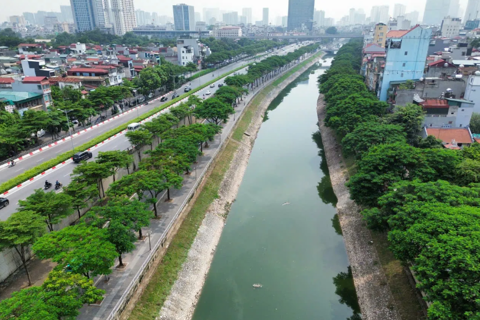
Japanese method of nano-biotech application is appropriate for urgent cases, wastewater treatment in Vietnam in general, but Hanoi needs more technologies to treat polluted rivers like the To Lich river.
Minister of Natural Resources and Environment Tran Hong Ha made the statement on October 30 while visiting experiment areas of the West Lake and the To Lich river treated with the Japanese technology.
Ha said that the above-mentioned treatment method has been certified by Japanese agencies, so it is safe and reliable. "We can apply this technology in wastewater treatment. Some factors that affect human health such as Ecoli and Coliform bacteria have been treated by nano-biotech application.”
However, the minister said that the composition of waste in Japan’s lakes and rivers is different from Vietnam’s because they are pre-treated at the source while wastewater in Vietnam is discharged directly into lakes and rivers.
"Many lakes and rivers in Vietnam have actually become a dumping ground," Ha said, adding that the wastewater in Vietnam is not only organic but also inorganic, requiring additional treatment technology.
The minister also suggested that Japan-Vietnam Environmental Improvement Company (JVE), which is carrying out the pilot project, should estimate the cost by an alternative method to cubic meter. The reason is that Vietnam’s lakes and rivers are open, with large amount of rainfall, thus, the calculation in cubic meters will not be accurate.
Minister Ha also affirmed Vietnam needs a particular plan to radically treat wastewater. "The current treatment plan is only suitable for the polluted rivers and lakes that need urgent treatment to ensure the people’s health," Ha said.
JVE started a pilot project to purify water in the To Lich river and West Lake with Japan’s nano-bioreactor technology on May 16.
After a while, bad smell of water in the treated area has reduced by 200 times in the To Lich river, 30 times in West Lake (measured by Japanese equipment), said Dr. Tadasi Yamamura, chairman of the Japan Trade Environment Promotion Commission cum JVE’s representative.
The initial investment capital of the project is nearly VND1.9 million (US$81.7) per cubic meter, much smaller than the VND55 million (US$2,365) per cubic meter of Ha Long city’s water plant project, Dr. Tadasi Yamamura added.
Japan's nano - bioreactor has four outstanding advantages compared to current technologies in Vietnam. The technology includes nanotechnology aeration using natural substances which the Japanese side has surveyed for two years before piloting it. The technology will save costs considerably than other wastewater treatment technologies.
After the pilot period of treating water in some sections, JVE’s report showed that the To Lich river’s water quality of the sections has been significantly improved and bad smell of the river has reduced.
In addition to the above-mentioned technology, Hanoi is piloting to clean up the To Lich river with Germany's Redoxy3C inoculant.
Minister of Natural Resources and Environment Tran Hong Ha made the statement on October 30 while visiting experiment areas of the West Lake and the To Lich river treated with the Japanese technology.

Bad smell of the river has reduced. Photo: Vietnamnet.
|
However, the minister said that the composition of waste in Japan’s lakes and rivers is different from Vietnam’s because they are pre-treated at the source while wastewater in Vietnam is discharged directly into lakes and rivers.
"Many lakes and rivers in Vietnam have actually become a dumping ground," Ha said, adding that the wastewater in Vietnam is not only organic but also inorganic, requiring additional treatment technology.
The minister also suggested that Japan-Vietnam Environmental Improvement Company (JVE), which is carrying out the pilot project, should estimate the cost by an alternative method to cubic meter. The reason is that Vietnam’s lakes and rivers are open, with large amount of rainfall, thus, the calculation in cubic meters will not be accurate.
Minister Ha also affirmed Vietnam needs a particular plan to radically treat wastewater. "The current treatment plan is only suitable for the polluted rivers and lakes that need urgent treatment to ensure the people’s health," Ha said.
JVE started a pilot project to purify water in the To Lich river and West Lake with Japan’s nano-bioreactor technology on May 16.
After a while, bad smell of water in the treated area has reduced by 200 times in the To Lich river, 30 times in West Lake (measured by Japanese equipment), said Dr. Tadasi Yamamura, chairman of the Japan Trade Environment Promotion Commission cum JVE’s representative.
The initial investment capital of the project is nearly VND1.9 million (US$81.7) per cubic meter, much smaller than the VND55 million (US$2,365) per cubic meter of Ha Long city’s water plant project, Dr. Tadasi Yamamura added.
Japan's nano - bioreactor has four outstanding advantages compared to current technologies in Vietnam. The technology includes nanotechnology aeration using natural substances which the Japanese side has surveyed for two years before piloting it. The technology will save costs considerably than other wastewater treatment technologies.
After the pilot period of treating water in some sections, JVE’s report showed that the To Lich river’s water quality of the sections has been significantly improved and bad smell of the river has reduced.
In addition to the above-mentioned technology, Hanoi is piloting to clean up the To Lich river with Germany's Redoxy3C inoculant.