Keeping the fire of blacksmithing
Through many ups and downs of the history, the talented smiths of Hanoi’s old Hoe Thi craft village have still hold on with their ancestor’s trade.
On today’s Nguyen Khuyen Street (Hanoi), formerly known as Sinh Tu Street, there are still many households selling forged items of various types and sizes, most of which are hand-crafted. Ride along the street once full of blacksmith shops, you will see a shop named Sinh Tai - a 100-year-old brand.
| The tiny Sinh Tai shop in 15A Nguyen Khuyen Street offers the best fabric scissors in town, according to local tailors. Photo: Kim Ngan |
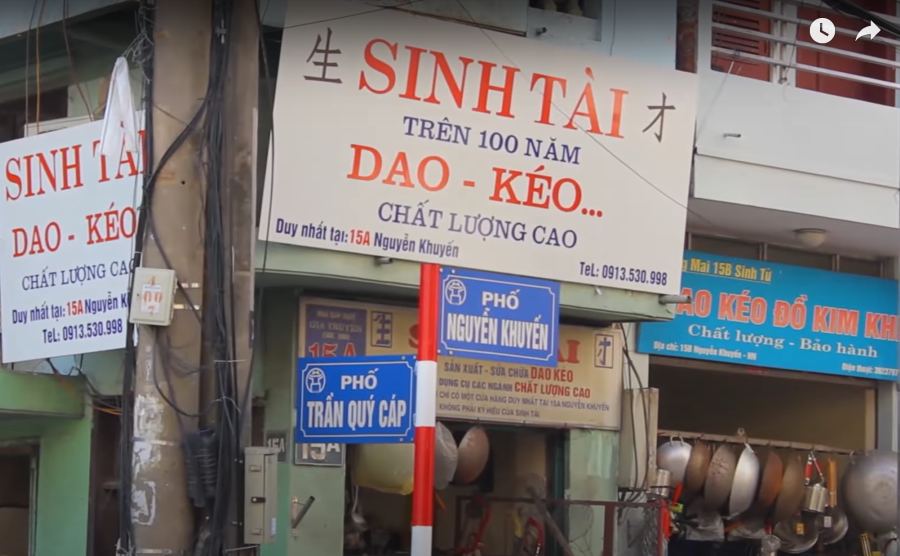
Not only the Old Quarter residents but many Hanoians know about this brand, along with fascinating oral stories about the Nguyen Dac blacksmith family in the old Hoe Thi craft village, who persistently keep hammering metals on an anvil through ups and downs.
The hereditary trade
Having found Nguyen Dac Binh (80 years old), owner of Sinh Tai cutlery shop, we were told loads of stories about a time when Hoe Thi blacksmithing was well-known throughout the capital.
The shop was opened in 1895 at 30 Sinh Tu Street by Binh’s grandfather, Nguyen Dac Nghi, who migrated to Hanoi from Hoe Thi Village, Hoai Duc District (Hanoi). Then, Binh’s father, Nguyen Dac Can (born in 1898), diligently and passionately succeeded his father in the trade.
Nghi was famous for his ability to manually temper steel from cast iron and tin. The man had three sons, and following oriental tradition, the eldest inherited his business and the family.
Can has learned blacksmithing since he was 15 years old and was not only dexterous in working with metal but an expert at making knives and cutters for a range of traditional crafts including embroidery, paper making, cooking, tailoring, shoe-making, soldering, gold-and silver-leaf making, and carpentry.
At the death of his father, Can has assumed control of the Sinh Tai store, while Nghi’s second son opened the Chinh Tai store, specializing in razor and chisel making, and his third son, Dac Gioi, opened Quoc Tai, specializing in farm tools such as sickles and plowshares.
Over time the Sinh Tai trademark developed an enviable reputation on the local market and by the beginning of the 1940s, the family’s tools were being exported by Chinese traders to neighboring countries.
| Nguyen Dac Binh is always proud of the craft of blacksmithing that was passed down by his ancestors hundreds of years ago. Photo: Kim Ngan |
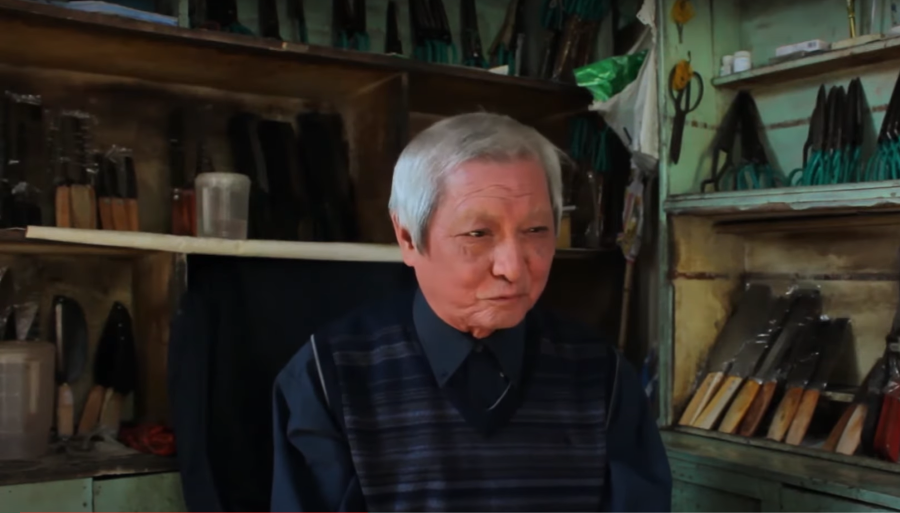
At their height, his family moved the forging business to houses 57 and 29. From 1950 until now, Sinh Tai shop is settled at 15A Nguyen Khuyen Street when Binh took over the trade. Now, Binh’s son continues the handicraft as the fourth generation.
Since he was born, Binh was familiar with the sound of hammering on anvils. Witnessing hardships throughout his childhood, he still felt passionate about the work.
Binh is a rather special case: he had many years of working in the construction industry, but in his heart, the fire of blacksmithing was always smoldering and flickering.
Not until his retirement could he devote all his time and enthusiasm to follow his father's footsteps. Perhaps that’s the reason why so many smiths consider their work both an occupation and a destiny.
In addition to good health and skillful hands, the craft requires sharp eyes and ears, as well as extraordinary patience. This lesson is passed down from generation to generation.
A time of fame
According to Binh, the forging in Hoe Thi Village has a long history, practiced by the “Big Four” families, namely Mai, Pham, The and Nguyen Dac. These smiths still remember every milestone.
“In the past, each family would specialize in, as well as be renowned for, a number of typical products. Particularly, the Mai family’s specialties included farm tools such as plows, harrows, hoes, shovels, among others. Whereas the Nguyen Dac and The families were known for making knives and scissors,” he said.
| So far so good: The simple yet essential tools for craftsmen in Hanoi and the surrounding area. Photo: Kim Ngan |
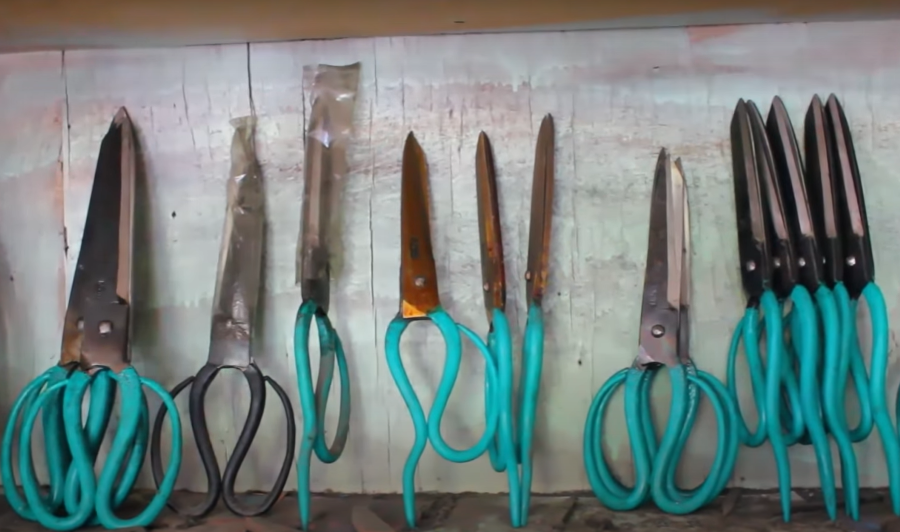
When it comes to Hoe Thi blacksmithing, it is impossible to ignore the “golden age” of the handicraft. That was the period when the railway industry started to restore the main routes from the capital to other regions, like Hanoi-Lao Cai, Hanoi-Yen Bai, Hanoi-Vinh, and so on.
The demand for bolts, then, was enormous. Hoe Thi village’s Mai and Nguyen Dac families were entrusted with bolt forging to supply rails. Binh emotionally recalled the atmosphere when the village were full of hot forges and the blacksmiths were up to their ears in work.
After the country’s liberation, along with the brilliant development of the garment industry, the demand for scissors increased dramatically. Hoe Thi blacksmiths continued to prosper, as tailor shops everywhere sought to buy Hoa Thi-branded scissors, whose elaborateness, standard and durability made users refuse other alternatives.
Binh and his family members still clearly remember the unexpected turning point that ended the heyday. From the 1990s onwards, blacksmiths and forging shops from Da Sy Village (Ha Dong Dist., Hanoi) and provinces such as Nam Dinh or Bac Ninh were pouring in the city like a “storm” due to the ever-growing demand of the locals.
| This tailor's scissors made by Sinh Tai's blacksmith is very sharp. It can cut a thin layer of fabric or dozens of thick ones. Photo: Kim Ngan |
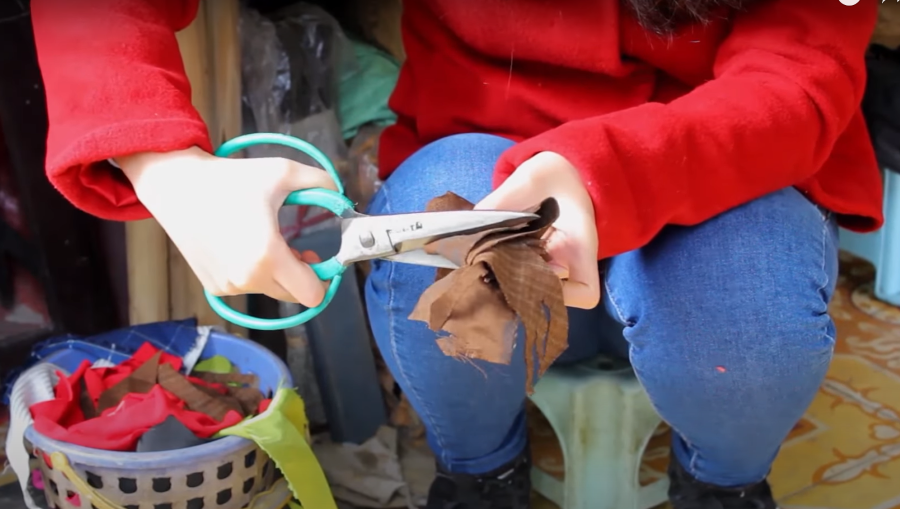
Tricks of the trade aside, there is one crucial factor which Dac Binh always keeps in mind- the importance of remembering the spiritual values of patience, virtue, honesty and enthusiasm which practiced by the family and stand as a testament to the truth of the old Vietnamese saying “A happy family is the one whose children are more successful than their father.”
When being asked about the reason why the smiths choose and stick to a job that is considered “full of dirt and hardships”, Binh pointed the flashing fire sparks and affirmed: “It’s the profession that chooses people. Blacksmithing is hard work, but as long as we can keep the fire, we can still have joys and smiles,” he said. The competition regarding prices, locations, among others, and other reasons undermined Hoe Thi blacksmithing’s prestige. Besides, mass-produced metal products at low prices from large factories quickly flooded the market, overthrowing the hand-forged tools. Forges in the village became fewer and fewer, while the street shops gradually shrunk. For Hoe Thi smiths with their never-ending passion, it is forever an inconsolable regret, a void that cannot be filled.
![[Uniqueness of Hanoi's craft villages] Artisan brings Vietnamese silk to a new height](https://cdn-media.hanoitimes.vn/2021/08/11/Cover_2.png?w=480&h=320&q=100)
![[Uniqueness of Hanoi's craft villages] Local artisans preserve and promote Dao Thuc water puppetry](https://cdn-media.hanoitimes.vn/2021/07/27/Lang_Viet_Mua_roi_nuoc.JPG.jpg?w=480&h=320&q=100)