Kieu Phu Commune spring fair brings local products closer to Tet shoppers
In the days leading up to Tet, a spring fair in Hanoi’s Kieu Phu Commune turns everyday shopping into a shared cultural moment, where Vietnamese goods, local stories and festive anticipation meet in a rural setting.
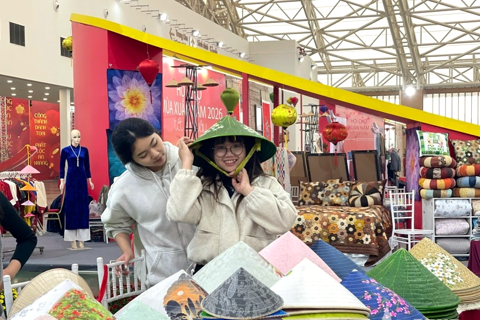
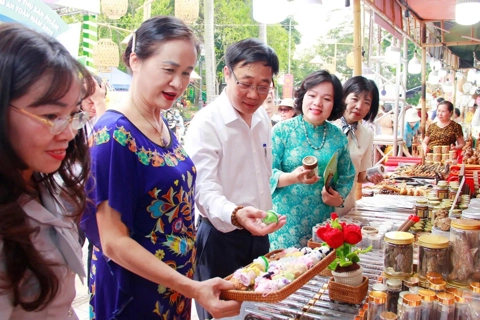
THE HANOI TIMES — As the 2026 Tet (Lunar New Year) approaches, the spring fair and commercial exhibition in Hanoi’s Kieu Phu Commune has become a popular destination for residents, offering nearly 100 booths displaying locally-made products from Hanoi and neighboring areas.
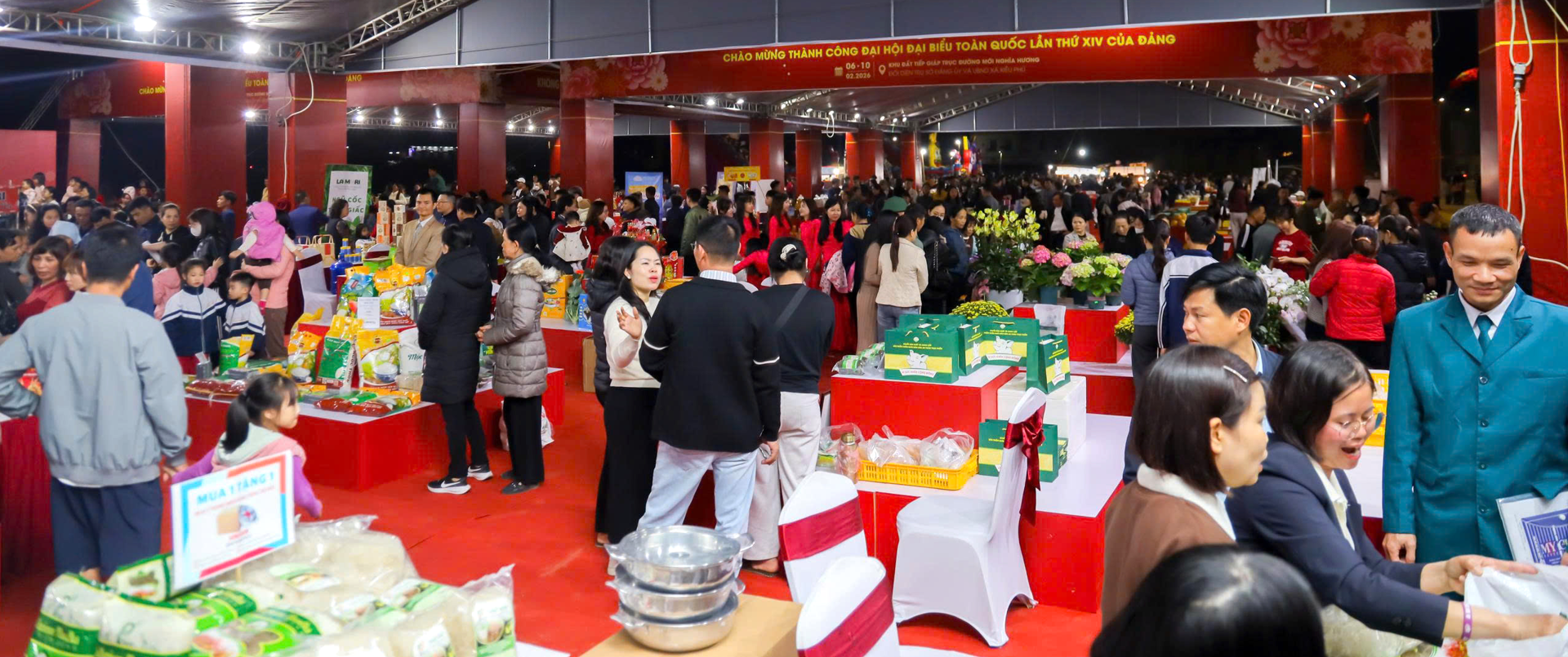
The spring fair and commercial exhibition space in Hanoi’s Kieu Phu Commune. Photo: hanoi.gov.vn
The fair is part of a series of exhibition spaces linked to the 2026 Lunar New Year Spring Flower Fairs, running from February 6 to February 11, aimed at stimulating domestic consumption, stabilizing the market and promoting high-quality Vietnamese goods ahead of Tet.
More than 60 enterprises, cooperatives and production facilities are taking part, representing Hanoi and major cities of Haiphong and Danang and provinces including Hung Yen, Quang Ninh, Bac Ninh, Ninh Binh, Thanh Hoa, Lao Cai, Son La, Nghe An and Khanh Hoa.
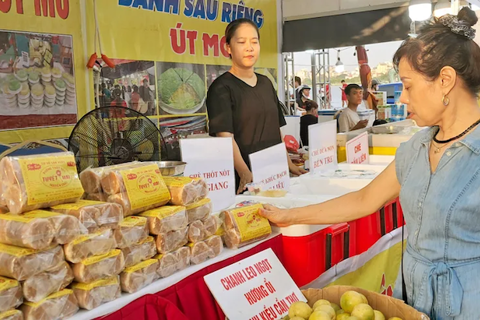
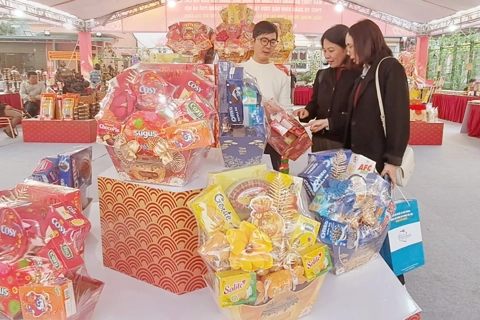
Products on display are diverse and practical, covering most Tet shopping needs, from safe food, sweets and traditional jams to agricultural specialties, handicrafts, village-made goods and certified One Commune One Product (OCOP) items.
Each booth reflects regional flavors, adding variety to the shopping experience. OCOP products rated from three to five stars include Ba Vi fresh milk, yogurt, milk cakes, honey, Ba Lang fish sauce, confectionery, beverages and processed foods.
Everyday consumer goods such as textiles, fashion items, footwear and handbags are also available, making the fair a convenient one-stop location for Tet preparations.
Agricultural products from the northwest sit alongside Haiphong seafood, while specialties such as Bac Ninh’s fermented pork rolls, Ninh Binh’s crispy rice, Quang Ninh’s grilled squid paste, Hanoi’s green rice flakes, Ha Giang’s humpback chung cake and Uoc Le’s traditional pork rolls continue to draw steady crowds.
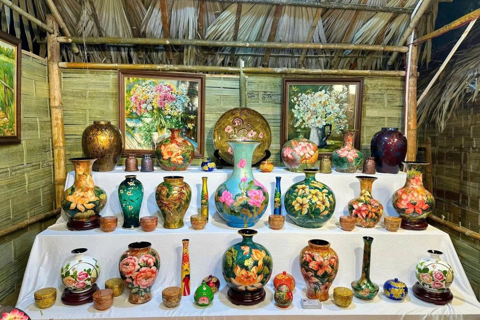
Handicrafts from well-known craft villages, including Chuong My’s mother-of-pearl inlay, Van Phuc silk, Bat Trang and Giang Cao ceramics and Ngu Xa bronzeware, add a cultural dimension that goes beyond simple consumption.
One of the fair’s standout features is the strong presence of high-quality Vietnamese goods. Clear origin labeling, careful packaging and practical designs help build consumer confidence during the busy Tet season.
Nguyen Thi Lan, a resident of Kieu Phu Commune, felt excited while visiting the fair.
“It’s good to have a Tet market in our commune with so many attractive Vietnamese products. I’ve already bought everything I need for Tet,” she said.
Her experience reflected a broader mood among visitors. Conversations flowed easily at the stalls, shopping bags filled quickly and the fair took on a warm, familiar atmosphere, more like a neighborhood gathering than a commercial event.
Kieu Van Hoa, another local resident, said the convenience made Tet shopping easier and more enjoyable.
“Vietnamese products are good quality and reasonably priced. The best part is that we don’t have to travel far for shopping,” he said.
According to Phung Huy Dien, Chairman of the Kieu Phu Commune People’s Committee, the spring fair carries a message that goes beyond commerce.
“People can see, experience and choose Vietnamese products right where they live. When quality proves itself through real use, trust in Vietnamese goods grows naturally,” he said.
Nguyen The Hiep, Deputy Director of the Hanoi Department of Industry and Trade, said the program aims to ensure stable supplies during Tet, support businesses and cooperatives and bring Vietnamese products closer to consumers.
“When people can easily access good-quality Vietnamese goods, they gradually develop a lasting habit of choosing locally-made products,” he said.