OCOP program strengthens rural brands and pushes Vietnamese products deeper into markets
Vietnam looks to reshape its OCOP program toward deeper product development, sustainability and experiential value as stricter green standards and market demands redefine competitiveness in the 2026-2030 period.
THE HANOI TIMES — The One Commune – One Product (OCOP) program has delivered a clear shift in both production scale and development mindset, reinforcing Vietnamese product brands in domestic and international markets while promoting a modern, innovative and integrated rural Vietnam.

Workers produce woven handicraft baskets at a traditional craft facility in Hanoi's Phuong Duc Commune. Photo: Hoang Anh/The Hanoi Times
According to the Ministry of Agriculture and Environment, Vietnam had nearly 17,500 OCOP products rated three stars or higher from more than 9,300 entities by the end of 2025.
This total represents an increase of about 2,900 products from the end of 2024 and exceeds the minimum target of 10,000 products set under Decision No. 919/QD-TTg dated August 1, 2022.
More than 72% of these products hold three-star ratings, 27% have four-star ratings and 126 products have achieved five-star certification.
The Red River Delta leads nationwide, accounting for roughly 32% of all OCOP products rated three stars or higher.
The Mekong Delta follows with about 22%, while the South Central Coast and the Central Highlands together account for around 18%. The Southeast region records the lowest share at approximately 6.5%.
Product composition reflects clear regional strengths, with food products dominating at about 78.3%. Other categories include handicrafts, beverages and several smaller product groups.
Through OCOP, many localities have adopted a more structured approach to developing indigenous resources, from tea and medicinal herbs in northern mountainous areas to coffee and pepper in the Central Highlands and seafood and fruit in the Mekong Delta.
At the program’s five-year review last October, Deputy Minister of Agriculture and Environment Tran Thanh Nam said these products form the core foundation for building Vietnam’s national OCOP image and brand.
The program has generated tangible benefits in rural areas. More than 60% of participating entities reported revenue growth, while product prices increased by an average of over 12% after OCOP certification.
OCOP has also helped create stable livelihoods for women, ethnic minority communities and vulnerable groups, while encouraging entrepreneurship across rural regions, Nam said.
Hanoi stands out as a locality with strong advantages in developing OCOP products linked with tourism and experiential activities. The capital currently leads the country in the number of certified OCOP products and has built a network of 115 OCOP promotion and introduction points.
According to the Hanoi Department of Industry and Trade, many of these products now appear consistently in major supermarket chains and on e-commerce platforms, gradually expanding into modern distribution channels.
Dang Huong Giang, Director of the Hanoi Department of Tourism, said 35 of Hanoi’s 119 OCOP introduction points could integrate with tourism routes, community-based tours and experiential models.
She noted that linking OCOP with tourism diversifies retail activities and enhances product value through direct experience.
Experts propose new directions for OCOP branding
Despite these gains, experts say OCOP trade promotion still needs recalibration.
Speaking with Cong Thuong (Industry and Trade) Newspaper, agricultural expert Hoang Trong Thuy said current promotion efforts remain overly focused on form, while market depth and sustainability lag behind.

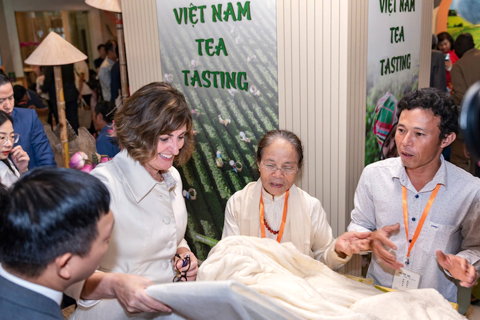
OCOP products, handicrafts a nd specialties displayed at a fair in Tay Ho Ward late May 2025. Photo: Tung Nguyen/The Hanoi Times
He said fairs and exhibitions occur frequently, yet they rarely generate long-term orders or help build stable distribution networks. Many OCOP retail points lack compelling product narratives and experiential elements, reducing their appeal to consumers.
As product quantity is no longer the main benchmark, Thuy argued that trade promotion must function as a strategic tool that helps OCOP products move beyond local markets into larger and more stable ones.
To support this shift, he called on the State to continue refining policies and standards.
Local authorities and OCOP entities must also move beyond simple sales toward brand building rooted in experience and cultural storytelling, Thuy added.
Director Giang of the Hanoi Department of Tourism recommended developing OCOP product introduction centers as experiential spaces that clearly communicate cultural values, production processes and product stories.
As these centers evolve toward experience-based formats, they will expand markets while preserving product identity and narrative value, she said.
Models such as Green Park Phu Dong and Hong Van rural village demonstrate the effectiveness of linking OCOP with tourism, Giang added.
Stable visitor flows at these sites have boosted product sales, generated additional service revenue and promoted the image of Hanoi’s new-style rural areas in a direct and sustainable manner.
Vietnam needs a renewed approach to inject vitality, create added value and strengthen the long-term competitiveness of OCOP products, Deputy Minister Nam said.
According to him, OCOP promotion can no longer rely on fairs or isolated campaigns. Instead, it must focus on deeper product development tied to raw-material areas, local culture and indigenous knowledge in each locality.
Nam stressed that sustainable quality improvement must go hand in hand with systematic investment in packaging, labeling, product storytelling and brand building to meet increasingly strict market demands.
“OCOP delivers real impact only when it connects with rural tourism, cultural festivals and experiential spaces,” he said.
These requirements come as the OCOP Program enters the 2026-2030 phase, a period marked by significant shifts in the development environment.
Nam said green development, emissions reduction, traceability, quality standards and digital transformation have become decisive factors shaping whether OCOP products can endure and scale in the market.