Kumquat Bonsai finds new expression for Tet
Along the Red River in Hanoi, artisans in Tu Lien village are preparing kumquat trees for the 2026 Lunar New Year, transforming carefully cultivated plants into living symbols of prosperity, craftsmanship and tradition.
THE HANOI TIMES — A quieter but more contemplative form of kumquat bonsai is gaining attention in Hanoi ahead of Tet, shifting the focus from dense canopies heavy with fruit to the exposed, sculpted roots beneath.

The Kumquat garden in Tay Ho Ward. Photos: Duy Khanh/The Hanoi Times
Developed by growers in Tu Lien village, the style highlights a rugged root system regarded as the tree’s “soul,” reflecting an aesthetic that values endurance, balance and inner strength rather than visual abundance alone.
Kumquat trees remain a Tet staple in Vietnamese homes, alongside peach blossoms and ochna flowers. Traditionally shaped with full, rounded crowns laden with fruit, they are placed in living rooms to bring warmth during the northern winter.
The bright orange clusters symbolize fertility and prosperity, with the belief that heavier fruiting signals greater luck in the year ahead. During the holiday, families often decorate the trees with greeting cards and talismans of good fortune, blending long-held customs with this evolving bonsai expression.
This Tet season, a new variation has caught attention: the Moc Can kumquat bonsai. Created by artisans in Tu Lien Ward, the design blends horticulture with storytelling, pairing carefully trained kumquat trees with miniature architectural motifs.
Ngo Thu Trang, owner of Xuan Loc kumquat garden and the creator of the concept, said each piece conveys a message. She described the house as a symbol of family bonds that foster resilience, connect generations and help people overcome hardship.
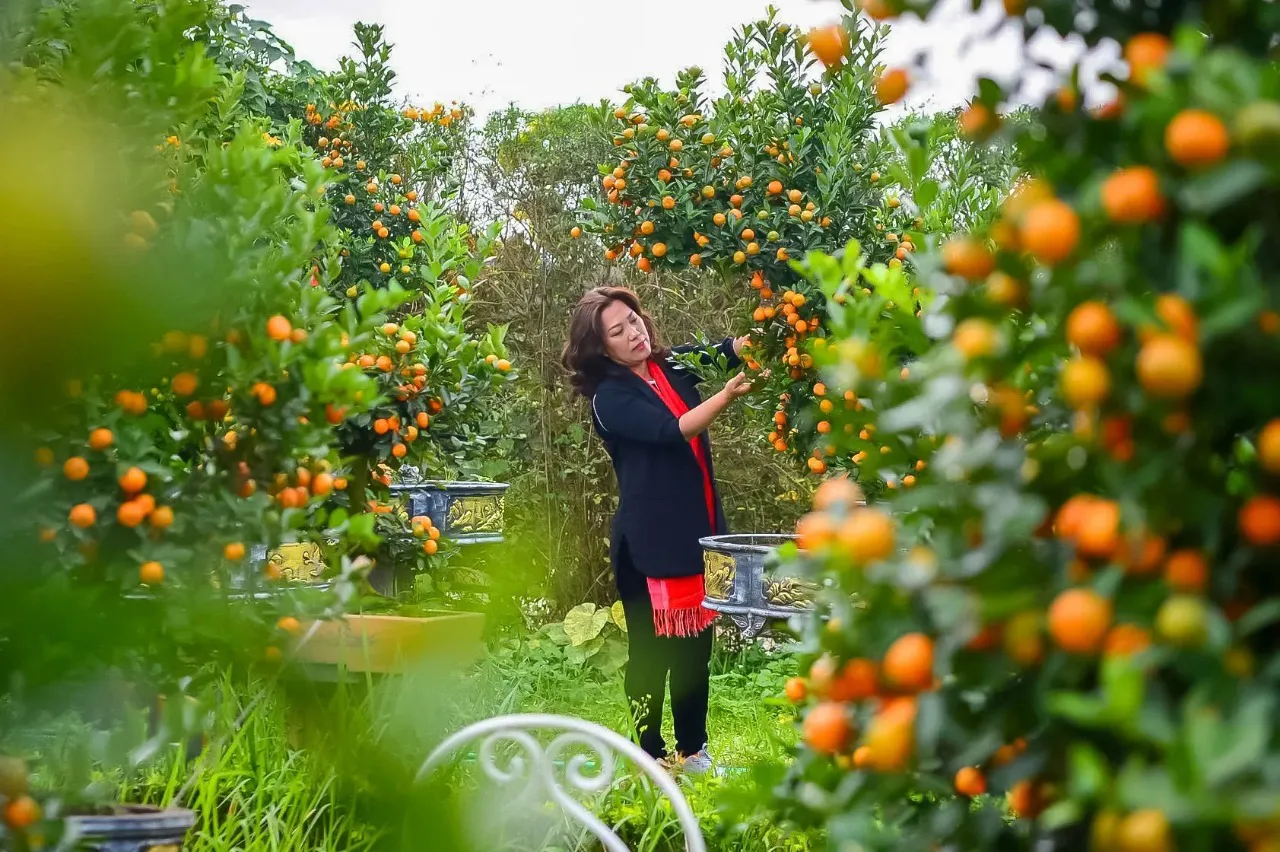
Bonsai artist Thu Trang poses with her kumquat bonsai.
To bring these scenes to life, Trang uses miniature models inspired by tiled-roof houses of the Northern Delta, communal houses of the Central Highlands and Hanoi’s ancient architecture, creating bonsai that feel both intimate and cultural.
The defining feature is the “wooden root” kumquat. Unlike traditional forms that stress fruit density and symmetry, this style centers on exposed roots. In Sino-Vietnamese, moc means tree and can means root, a name that reflects the philosophy behind the form. The roots rise upward, gnarled and resilient, echoing human perseverance.
This beauty comes at a cost, as exposed roots make the tree more fragile, complicating nutrient absorption and moisture control. The soil dries faster, requiring constant monitoring and careful adjustment.
A basic tree takes two to three years to complete, while outstanding specimens can require seven to eight years to achieve harmony between roots, trunk and canopy.
In a market often driven by surface abundance, Tu Lien’s kumquat bonsai offers a subtler narrative that aligns with Tet’s deeper themes of continuity, endurance and hope.

The days ahead of Vietnamese traditional Tet holiday, ripe kumquats glow gold against dense green foliage in Tu Lien village, Hanoi, along the banks of the Red River.


Soil moisture is usually monitored to prevent roots from drying during the critical growing period.

Alongside larger specimens, small kumquat bonsai trees are sculpted in varied forms to suit compact urban homes.

For the 2026 Lunar New Year, kumquat trees are valued not only as holiday decorations but as living artworks.

Each tree reflects years of cultivation, symbolizing resilience, growth and aspiration.

Moc Can kumquat bonsai represents the highest level of craftsmanship in Tu Lien village, where artisans shape each tree as a detailed miniature landscape.