Ly Thai To flower garden bears Thang Long - Hanoi’s imprint
The flower garden, a public space that attracts people of all ages and hosts many cultural and historical events of the capital city.
The Ly Thai To flower garden in the heart of Hanoi is the architectural space inspired by the development history of Thang Long - Hanoi, according to Vice President of the Vietnam Urban Planning and Development Association Dao Ngoc Nghiem.
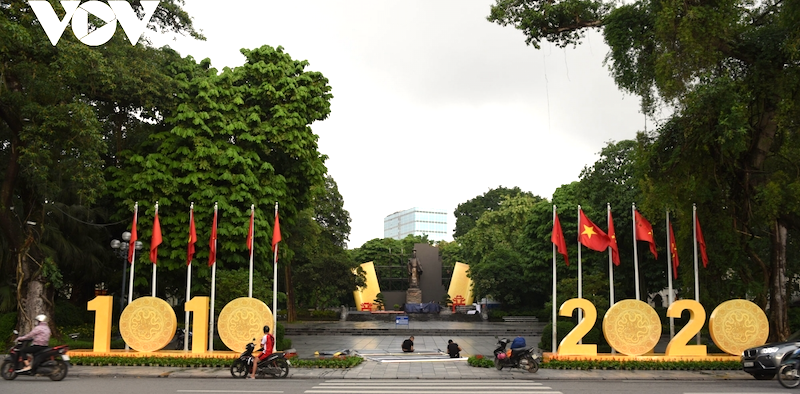
| Ly Thai To flower garden. Photo: VOV |
Undergoing name changes
It is located by Hoan Kiem lake, at the convergence of Dinh Tien Hoang, Le Lai, Le Thach and Ngo Quyen streets with an area of 12,153.5m2. In the past, it was the land of the Pho Giac pagoda.
The Hanoi map dated in 1873 shows the pagoda layout and the greenery area in the East of Ta Vong lake or Hoan Kiem lake. When the French invaded Hanoi and were granted a land concession by the Nguyen court in 1874, they immediately planned to renovate the area around the pagoda.
Since 1886, after being appointed as Resident Minister of Tonkin, Paul Bert and the Hanoi government at that time developed a quarter for French officials, soldiers and their families in the East and South of Hoan Kiem lake.
At that time, the land of the Pho Giac pagoda was reclaimed to build a plaza (flower garden) as well as various public buildings around it, such as the Resident Minister's Palace (the Tonkin Palace, now the Government Guest House and the Post Office. The pagoda was moved to present-day Ngo Si Lien street.
In the flower garden, imported vegetation and ornamental plants were planted and monuments were erected (a statue of liberty, in 1889 and demolished in 1945 by the then mayor of Hanoi, Tran Van Lai) and the octagonal house (1901) (also known as the wind trumpet house), the rehearsal place for the French army ensemble.
The flower garden was renamed many times, initially it was called Paul Bert, after the August Revolution in 1945, its name was changed to Chi Linh. Since 1984, it was named Indira Gandhi after the late Prime Minister of India. In 2004, when the flower garden was renovated and embellished, and the Ly Thai To Statue was erected here, it was renamed Ly Thai To flower garden.
The renaming of the garden and the installation of the Ly Thai To Statue here in 2004 required many scientific seminars to decide. In December 2002, the city held a contest on the Ly Thai To Statue design. In the first round, 29 works from the University of Fine Arts and sculptors were submitted, and artist Vi Thi Hoa's submission won the competition and her statue design was selected.
Respect to the heritage
The Ly Thai To Statue is 10.35m high (including 1.35m of its base) and is made of bronze. It is placed on the roof of the bunker (semi-submersible) built by the Japanese in 1945 to shelter from allied bombs and since 1964 it became a commanding bunker that is connected to the headquarters of the Popular Committee of the city. The plaza renovation left the octagonal house intact, which was considered a wise decision since it respected the heritage.
On October 7, 2004, the flower garden and the statue were inaugurated by the city People's Committee to celebrate the 995 year of Thang Long - Hanoi. Since then, the Ly Thai To flower garden has become the venue for many events of the city which attracts people of walks of life of the capital and around the country as well as foreign visitors.