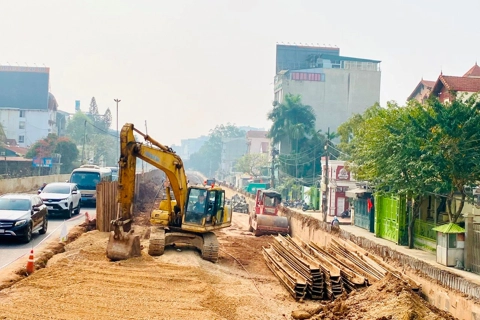
More flyovers to ease traffic congestion in Hanoi
Hanoi has more than 7.9 million vehicles, including 1.1 million cars and 6.6 million motorcycles
Hanoi will build five more overpasses to ease traffic congestion at intersections with high traffic volumes and frequent traffic jams during rush hours, according to the city's Department of Transport.
The five overpasses will be built at the intersections of Chau Van Liem - Le Quang Dao (Nam Tu Liem District); Co Linh - Thach Ban (Long Bien District); Hoang Minh Giam - Nguyen Tuan (Thanh Xuan District); Co Bi - Ngo Xuan Quang (Gia Lam District); and Nguyen Huy Nhuan - Ly Thanh Tong (Gia Lam District).
Heavy traffic at the Chau Van Liem - Le Quang Dao intersection in Hanoi's Nam Tu Liem District. Photo: Otosaigon.com |
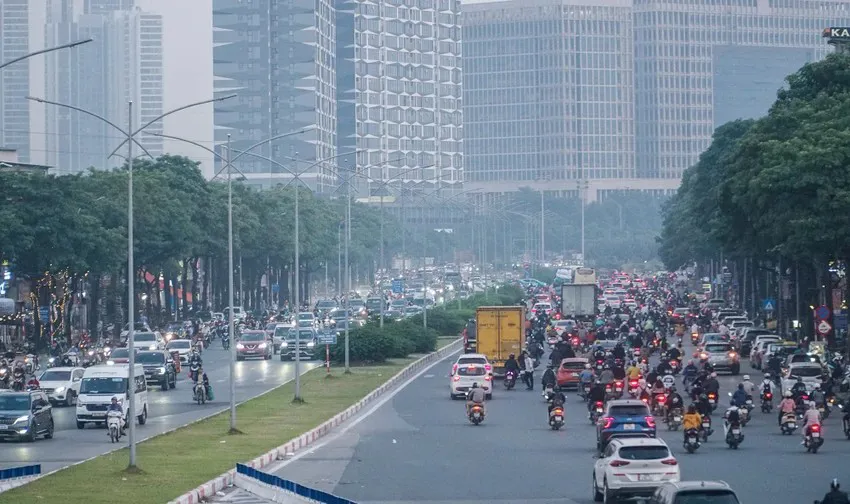
According to the department, the high volume of traffic at these intersections during rush hours, coupled with low awareness of traffic laws among some people, leads to serious traffic congestion.
The department sees the construction of overpasses at these intersections as one of the urgent solutions, helping to solve the "black spots" of traffic congestion in Hanoi.
According to Dr. Nguyen Xuan Thuy, former director of the Traffic Publishing House, to make the overpasses efficient, "solutions are needed to regulate traffic flow and effectively manage traffic, especially during rush hours.
"The overpasses are not built to last, so the construction and maintenance costs are low, the construction time is short, and the environmental impact is minor. Therefore, they can be dismantled and moved to other locations when needed," Thuy said.
He thought it would be an effective solution to traffic congestion in the city center. "The authorities need to carefully consider a suitable plan that meets the requirements in terms of landscape and environmental criteria to avoid disturbing the urban landscape," Thuy added.
In the period 2026-2028, Hanoi will build two more underpasses at the intersection of Me Tri - Duong Dinh Nghe - Ring Road 3 (Nam Tu Liem District) and at the intersection of Tay Thang Long - Ring Road 3 (Bac Tu Liem District).
However, with the current rapid increase in the number of vehicles, some overpasses and underpasses will inevitably be overloaded in the near future. Thuy said the city needs more strategic and synchronized solutions to solve traffic congestion.
He listed some alternatives that the city should focus on: building transportation infrastructure, expanding public transportation, and gradually reducing the number of private vehicles.
"Only if the above-mentioned solutions are implemented in synchrony, will the traffic congestion situation in the capital be improved. This is a difficult problem, but the city must set goals and have a clear roadmap to make it effective," Thuy stressed.
Recent statistics from the city's Department of Transportation show that Hanoi has more than 7.9 million vehicles, including 1.1 million cars and 6.6 million motorcycles. In addition, about 12 million vehicles from other provinces and cities ply Hanoi's roads. In Hanoi, the land area allocated for new urban construction is only about 10.3% of the total, while that for static traffic is less than 1%. Public transport ridership is growing at 18.5%.