National hotline matters to domestic violence prevention
Experts stressed the importance of timely support survivors of violence and responsibilities and obligations of the perpetrators.
Experts have highlighted the role of national hotline mechanisms in preventing and controlling domestic violence in Vietnam.
| Participants at the consultation workshop that opens in Con Dao, Ba Ria-Vung Tau on April 26. Photo: Tran Cuong |
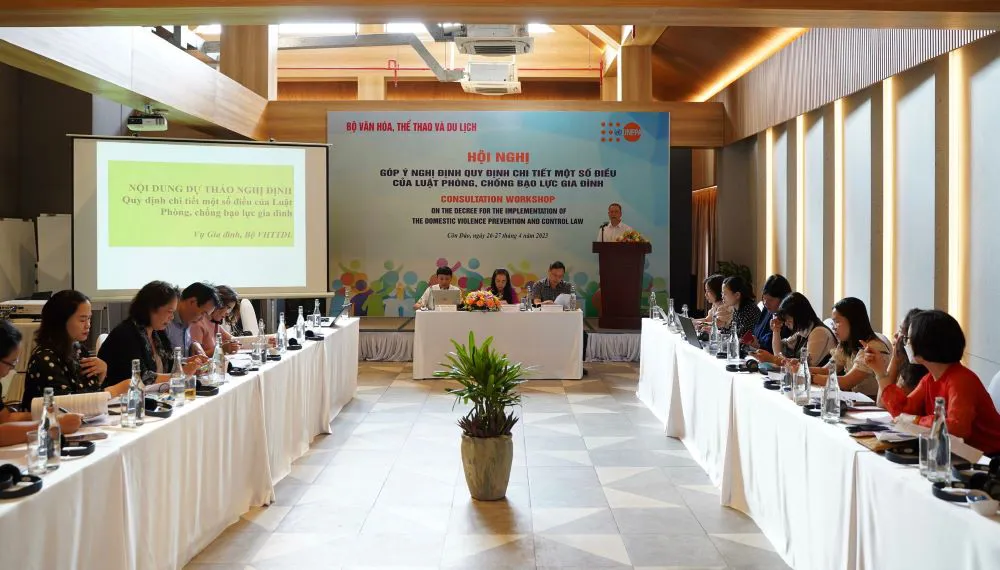
The idea was raised at a consultation workshop for the draft Decree on the implementation of the 2022 Law on Domestic Violence Prevention and Control held today [April 26] joined by different stakeholders, including the Ministry of Culture, Sports and Tourism (MCST) and the UN Population Fund (UNFPA) Vietnam.
At the event, domestic and international officials and experts discussed and provided valuable and constructive inputs to the draft Decree of the law which is likely to be submitted by MCST to the Prime Minister for approval in May 2023.
In the Decree consisting of 6 chapters and 44 articles, key issues stipulated include, among others, the national hotline mechanism for domestic violence prevention and control and how to receive and handle notifications and denunciations of domestic violence. Other things are no-contact order and how and when it can be applied and the establishment and operation of domestic violence prevention and control facilities.
The draft Decree on the implementation of Law on Domestic Violence Prevention and Control (DVPC) also explains regulations on the annual allocation of the state budget for domestic violence prevention and control, particularly for education and support for behavioral change.
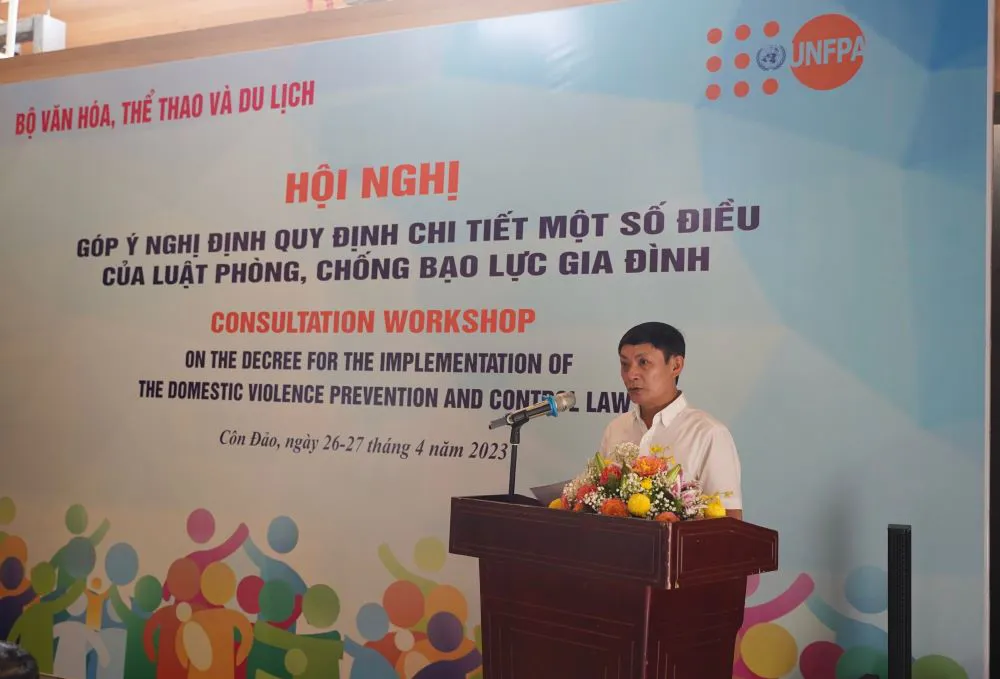
| Khuat Van Quy, Deputy Director of Ministry of Culture, Sports and Tourism's Family Department, at the two-day workshop. Photo: Tran Cuong |
The workshop, which was co-chaired by MCST and UNFPA Vietnam, marked the participation of representatives from the Government’s ministries and agencies and international organizations, social organizations, and local media.
Speaking at the workshop, Khuat Van Quy, Deputy Director of the MCST’s Family Department said: “The draft Decree, with a number of articles in the 2022 Law on Domestic Violence Prevention and Control, is an important legal document to ensure the implementation of the 2022 Law. Therefore, this consultation workshop plays a significant role in supporting the Ministry to finalize it.”
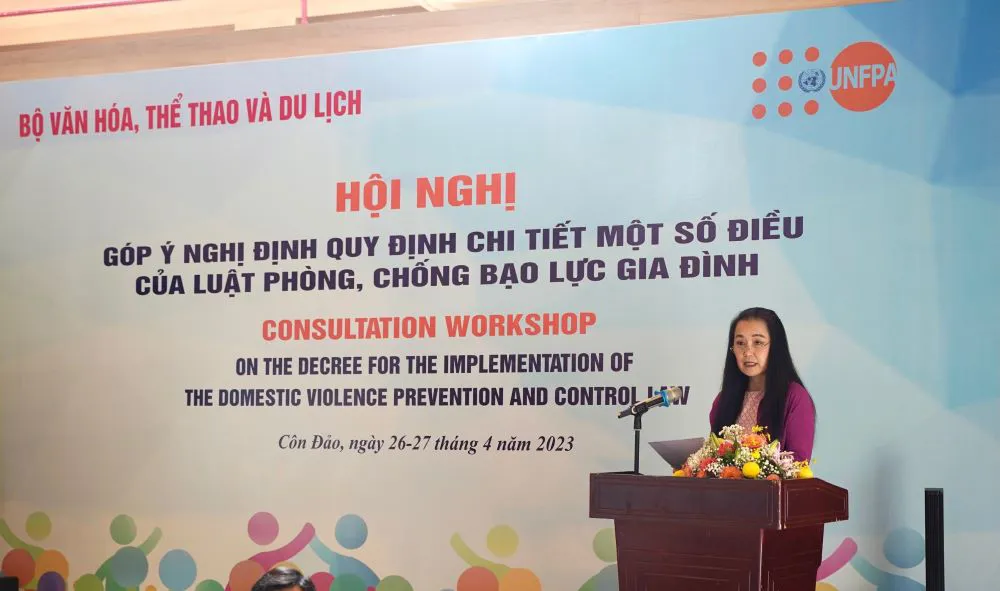
Meanwhile, Naomi Kitahara, the UNFPA Representative for Vietnam called for a consistent application of the rights-based and gender-sensitive approaches during the drafting of the Decree to protect the rights of survivors of violence and ensure the responsibilities and obligations of the perpetrators.
Naomi Kitahara stressed: “UNFPA commits to accompanying the Government of Vietnam in the path to ending violence against women and girls. We want to ensure that all women and girls in Vietnam, including those most vulnerable, have the right to live a life free of violence and with dignity. No one should be left behind in the country’s sustainable development process.”
| Naomi Kitahara, UNFPA Representative for Vietnam, speaks at the event. Photo: Tran Cuong |
High on the discussion during the workshop include regulations for new measures such as the national hotline services, protective orders and contact prohibitions, and facilities to support the survivors of domestic violence.
A representative from the Ministry of Labour, Invalids and Social Affairs commented that the responsibilities of the perpetrator to cover the fee of accommodation and living expenses of survivors would require careful consideration for its feasibility.
Commenting on the regulations relating to receiving and handling notifications and denunciations of domestic violence, a representative from the Public Security Department of Ba Ria – Vung Tau province stressed that the draft Decree had covered the key procedures on how to receive and handle as well as to ensure the confidentiality of domestic violence. However, he added: “The Decree should specify such a process more in detail. When handling domestic violence incidences, the Decree should also include the procedures for multi-sectoral coordination.”
A representative from the Vietnam Women’s Union shared her recommendations: “The procedures for implementation of a no-contact order should protect the benefits of all people concerned. Relating to the regulation on the application of the protective order, the Decree should specify the period of such an order. Procedures to govern violation of the protective order are also needed.”
All the comments and recommendations raised at this consultation workshop as well as those received in writing prior to the workshop will be incorporated into the draft Decree to ensure transparency, feasibility, and accessibility, facilitating the implementation of the Law.
Even though the DVPC Law was in place in 2007, the prevalence of violence against women by their husbands/intimate partners is still an alarming issue. According to the 2nd National Study on violence against women in Vietnam in 2019, 90.4% of gender-based violence survivors did not seek help from authority, and half of them never told anyone about the violence. Additionally, the national productivity losses as a result of violence against women were equal to 1.81% of Vietnam's 2018 GDP.