Paintings of King Ham Nghi to be auctioned in France
This is the first time that such a large number of paintings by the former emperor of Annam (the former name of Vietnam) have been offered for sale.
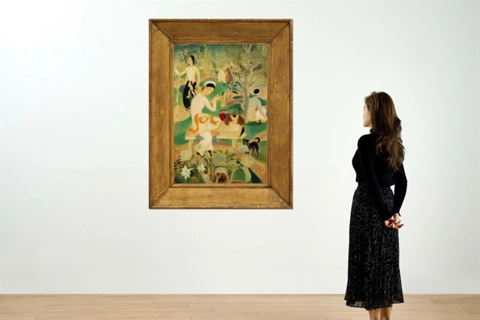
As many as 19 paintings by King Ham Nghi (1871-1944), who was exiled to Algeria by the invading French colonialists for his patriotism, are among the Indochinese artworks that will go under the hammer at French auction house Lynda Trouvé on September 22.
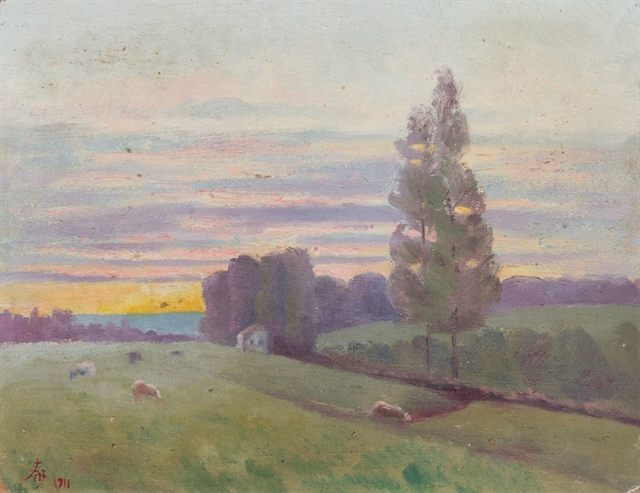
Of particular interest is Soleil Couchant Sur La Campagne (Sunset over the Countryside), painted in 1911, which bears the king's handwriting with the date, signature, and royal title.
This is the first time that such a large number of paintings by the former emperor of Annam (the former name of Vietnam) have been offered for sale. They belonged to Henri Aubé, a French military officer stationed in Hanoi between 1907 and 1909, and were discovered in the attic of his home.
| Soleil couchant sur la campagne (Sunset over the Countryside), painted by King Ham Nghi in 1911. |
According to Drouot.com, his works are extremely rare on the market, and these particular pieces have never been offered for sale. During his lifetime, the artist's works were exhibited at the Guimet Museum in 1926.
"It is very likely that Henri Aubé stayed at the military thermal hospital in Vichy for treatment, as many officers stationed in the colonies did at that time," according to Lynda Trouvé's official website.
In particular, between 1909 and 1913, Ham Nghi regularly visited this institution. If the two men met, it was most likely in Vichy. It is believed that Ham Nghi and Henri Aubé formed a friendship through their mutual friend, Henri de Gondrecourt. The paintings inherited by Henri Aubé's family remained in their private collection and are now being offered for sale by his descendants.
According to art critic Ngo Kim Khoi, the paintings are being praised more for their historical value than for their artistic elements, despite the king's excellent technique.
"Ham Nghi was one of the first painters to adopt the Western style, which was then followed by other acclaimed painters such as Le Van Mien, Nguyen Nam Son or Thang Tran Phenh, so his paintings are highly valued historically," Khoi said.
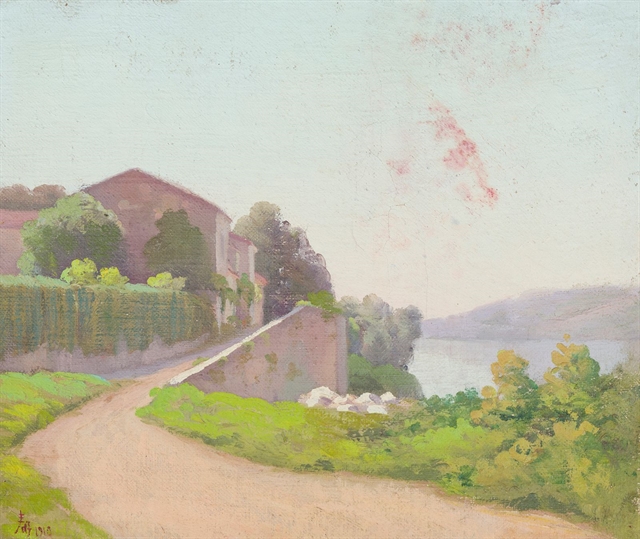
| Maison au bord de l'eau (House by the Water) painted by King Ham Nghi in 1910. |
He said the starting bid for each painting is between €3,000 (US$3,235) and €5,000 (US$5,329), which is perfectly feasible and guarantees a fiercely competitive bidding war among collectors.
"In my opinion, this price is a bit low. However, this time it promises to be an exciting auction because of the low starting price," Khoi said.
Khoi hopes that the Hue Provincial Museum can afford to buy at least one or two paintings, so that these royal artifacts could return to the king's homeland, and the rest would be purchased by Vietnamese collectors.
The 2010 auction of King Ham Nghi's Declin du Jour (Sunset) painting left many regrets when representatives of the central province of Thua Thien-Hue were unable to purchase it after Dr. Gérard Chapuis, a French-Vietnamese resident of Marseille, successfully bid for the painting by telephone for €8,800.
| Lac au crépuscule (Twilight Lake) by King Ham Nghi. |
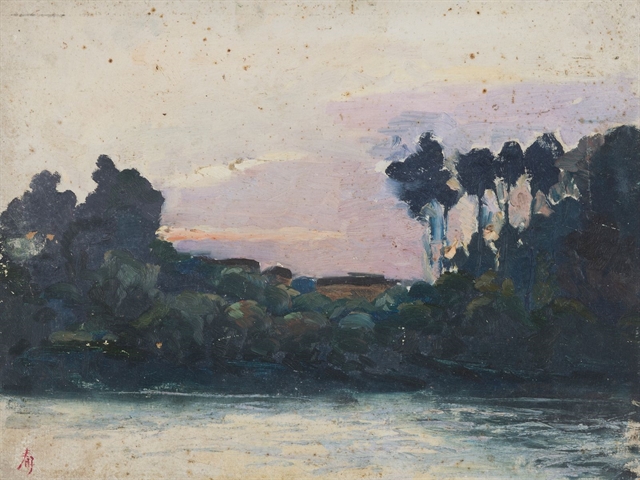
According to a descendant of King Ham Nghi, Ph.D. in history Amandine Dabat, there are about 100 of his paintings that are still preserved to this day.
One of these paintings is Lac des Alpes, which is currently housed in the Hue Royal Museum of Antiquities in Thua Thien-Hue. It was donated to the museum by an anonymous collector.
"In the paintings he painted, we can see the king conveying the loneliness of having to leave his hometown. What we can easily see in these paintings is that there is very little human appearance. Looking at the paintings, it is difficult to tell whether the landscape is in France, Algeria, or Vietnam. It's just a general vision of the landscape. This was the way the king wanted to convey nostalgia, and this was also the way he chose to overcome difficulties and suffering in order to go on, through art," said Amandine Dabat.
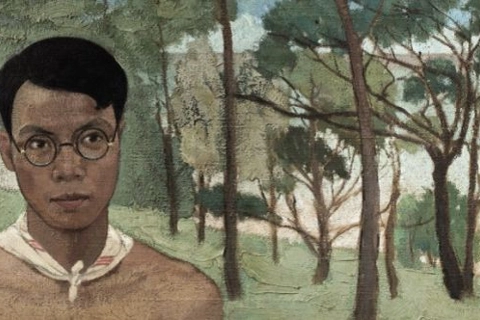
| Ham Nghi was the eighth emperor of the Nguyen dynasty. File Photo |
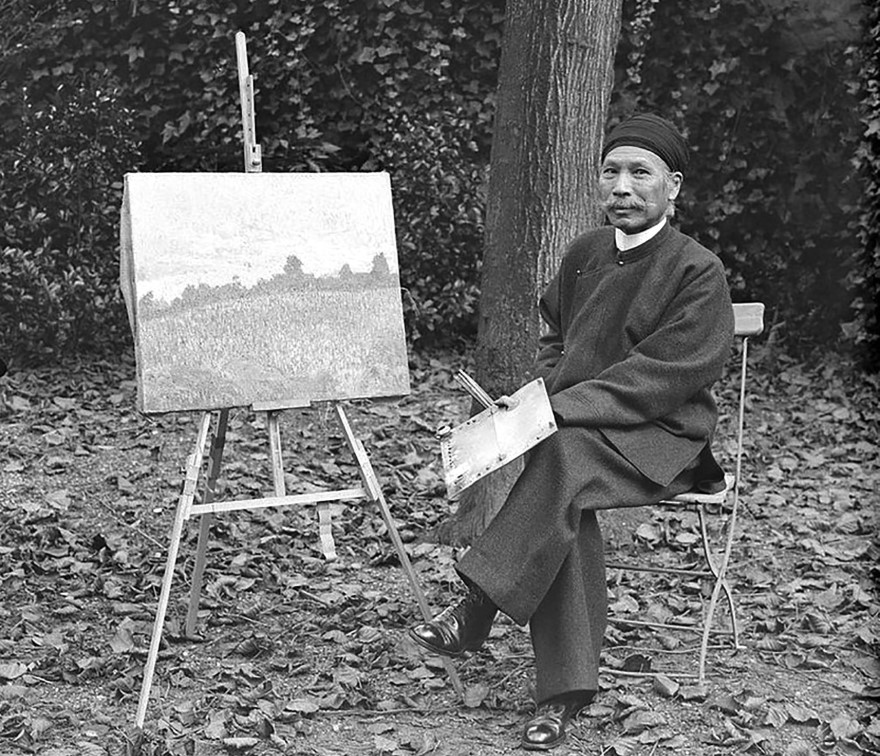
Ham Nghi was the eighth emperor of the Nguyen dynasty, but he only reigned for one year (1884-85).
After the failure of the Can Vuong (Save the King) movement against French colonial rule, King Ham Nghi was captured and exiled to Algeria, then a colony of France, on December 12, 1888.
While in exile in Algiers, he learned painting and sculpture techniques from the artist Marius Reynaud and dedicated his entire life to intense artistic activities as a painter, pastelist, and sculptor.
He made several trips to France under close surveillance, where he met artists such as Foujita, Rodin and the writer Judith Gautier.