

People’s council meets to talk socio-economic development
Five major topics related to the changes of management apparatus and financial support for medical staff, students and teachers will be discussed at the two-day session of the Hanoi People’s Council.
The Hanoi People’s Council on Monday started a two-day session to discuss five major topics related to the city’s socio-economic growth.
| Delegates of the Hanoi People's Council attend the two-day meeting starting on Monday morning. Photos: Thanh Hai |
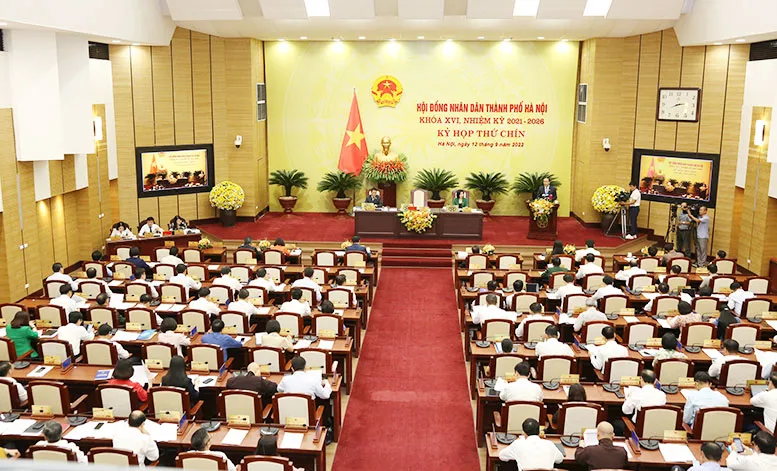
Delegates of the council will review the Project on the city’s decentralization of the management apparatus and discuss the new decree that may replace the Decree 08 issued by the council in 2016 on the matter.
The topic is considered to have significant impact on the city’s socio-economic development, and the efficiency and productivity of local authorities, the council’s Chairman Nguyen Ngoc Tuan said.
The issue was discussed in July 2022, he said, adding that the city People’s Committee has collected the opinions of council delegates, compiled a report on the project and drafted the decree to submit to the council at this meeting.
The city-level Party Committee and the Vietnam Fatherland Front Committee have also been consulted on the project and the drafted decree, chairman Tuan said.
In addition, council delegates will discuss the progress of public investment projects in the city. Despite the implementation of drastic measures, public investment projects have remained behind the schedule and the city's disbursement of public spending has been slow.
As of August 22, the disbursement for public investment projects accounted for 27.1% of the plan.
“In addition to the revision, adjustment and approval of the overall public investment plan for the 2021-2025 period and specific activities for 2022 and 2023, the delegates will discuss ways to address the flaws and their causes,” chairman Tuan said.
“Talks will also involve in the solutions for existing problems to speed up the progress of the projects, especially to solving the bottlenecks in the disbursement of public investment spending,” he said.
The third topic to be debated at the meeting is the levels of financial aids for employees and officials working at State-funded medical centers that are under the management of the city’s Department of Health.
According to the council’s chairman, the approval of financial aids for healthcare employees and officials will recognize their efforts and motivate them to keep up with their job, and improve the quality of healthcare services for local people.
Moreover, the city may decide to keep the tuition fees of the academic year 2022-2023 unchanged for pupils of public kindergartens and schools and maintain the financial support for those in difficulties.
The policy on tuition fees for the academic year 2021-2022 was developed to provide support for families and students amid the COVID-19 pandemic. The disease is now put under control and socio-economic recoveries are witnessed across the city, however, many people have still suffered from below-par living conditions.
The new tuition fee frame for the academic year 2022-2023 is expected to keep relieving the burden of Hanoi families and students, chairman Tuan said.
“The city will make up for the difference between the framed tuition fees and the actual payments. Moreover, tuition is exempted for those that live in remote, disadvantaged areas and those that live in poor conditions,” he said.
Last but not least, the city’s council will review and make decision on several topics and expenditures in line with its authority, as well as the allocation of public teaching staff.







