Planning shift to steer Hanoi toward climate resilience
Climate adaptation remains a major challenge, making effective planning and urban governance even more strategic.
THE HANOI TIMES — A long-term planning vision grounded in science, data and forecasting models will strengthen Hanoi’s resilience to climate change while also revitalizing the city’s cultural identity and local values, experts suggested.
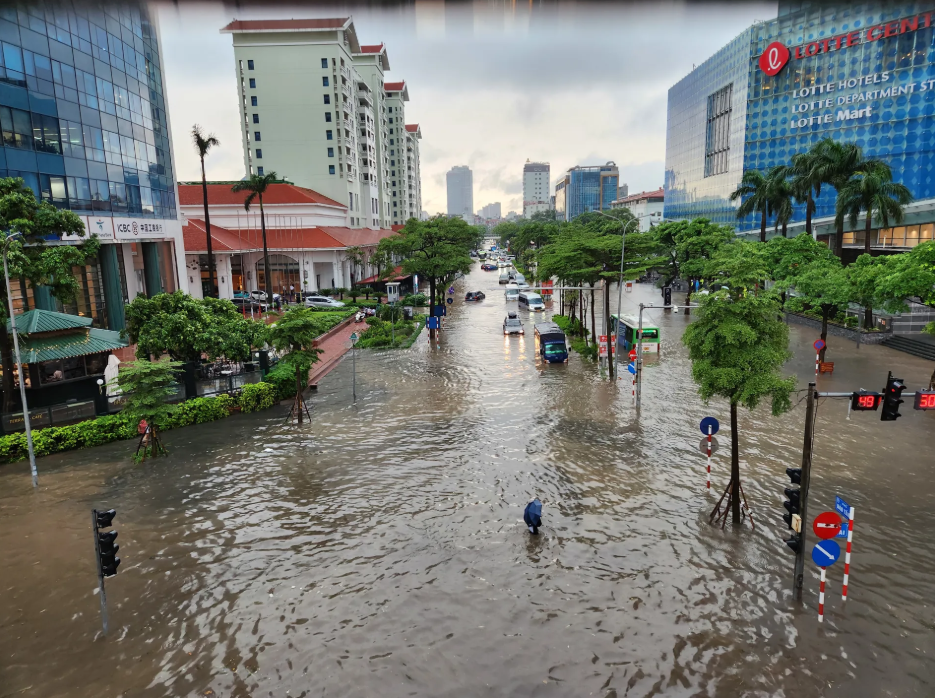
Hanoi flooded after a heavy September downpour. Photo: Thanh Hai/The Hanoi Times
Extreme weather a major issue
The point becomes even more important as extreme weather intensifies. Major cities like Hanoi and Ho Chi Minh City face frequent flooding and overstretched infrastructure that disrupt daily life and strain public services.
These conditions create an urgent need to strengthen resilience, improve planning and scale up climate adaptation measures to build safer and more sustainable urban areas.
According to Nguyen Du Minh, from the Ministry of Construction’s Urban Development Agency, most provinces and cities have assessed how climate change and rising sea levels affect their urban systems, especially coastal cities and mountainous areas exposed to flash floods and landslides.
In addition, 61 out of 63 provinces and cities issued their own action plans on climate change and sea level rise.
However, Minh pointed to remaining challenges, particularly limited funding and heavy reliance on international assistance. Domestic financial mechanisms and resource allocation are not stable or flexible enough to meet urgent needs and coordination across agencies and government levels is inconsistent, which slows down implementation.
The Ministry of Construction is now gathering feedback on a draft decree detailing several parts of the urban classification resolution. It introduces for the first time a full set of regulations on climate-responsive urban development. This step turns Government Decision 438/QD-TTg on climate-responsive urban development for the 2021–2030 period into concrete obligations by strengthening local responsibilities for emission reduction and sustainable urban planning.
Although the national program for 2021–2030 has been rolled out widely, requirements on adaptation and emission reduction have not been anchored in law, leading to uneven efforts among localities. Many provinces have added climate considerations to their planning, created disaster-risk zoning maps and implemented drainage and flood reduction projects. These efforts are important but remain within the program framework and lack binding legal force.
The draft decree is designed to clarify the concept and components of climate-responsive urban development. It also sets out monitoring mechanisms and assigns responsibilities to each level of government.
With this approach, the ministry aims to establish a unified and transparent legal framework that improves urban planning and management as climate pressures grow.
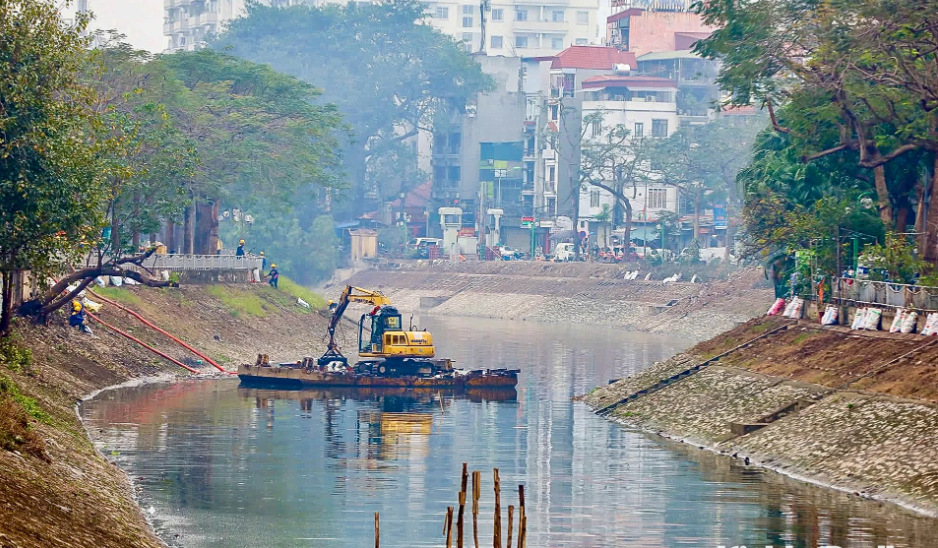
. Dredging work along the To Lich River. Photo: Duy Minh/The Hanoi Times
Smart urban planning
From the perspective of current urban flooding challenges, Pham Doan Khanh, Deputy Head of International Cooperation at the Ministry of Agriculture and Environment's Disaster and Dyke Management Authority, emphasized that drainage upgrades must come first.
“Land-use planning needs to support better water retention to reduce flood risks. Early warning systems also require stronger hydrometeorological monitoring and advanced forecasting technology to provide timely alerts to communities,” Khanh said.
Smart urban planning solutions include sensor networks that track water levels, rainfall and flooding in real time. Cities also need adaptive drainage systems and flexible transport networks that reduce congestion and flood impacts. Development in high-risk flood zones should be avoided, especially for critical facilities.
Looking at the broader urban system, Tran Thu Hang, Director of the Ministry of Construction’s Planning and Architecture Department, noted that Vietnamese cities are expanding quickly with diverse forms and functions. Urban areas have become engines of economic and social development as well as hubs for knowledge, innovation and technology. Yet climate adaptation remains a major challenge, making effective planning and urban governance even more strategic.
Quality of life in cities depends not only on income or physical amenities but also on safe, clean, humane and creative living environments. “Achieving this requires a shift from managing growth to governing development and from planning based on supply to planning based on needs and community values,” Hang said.
Sharing the same view, Tran Ngoc Chinh, Chairman of the Vietnam Urban Planning and Development Association, called for a transition from planning each city individually to planning the entire urban system. “This approach should ensure openness, regional connectivity and adaptability in the context of green growth, circular economy and energy transition,” Chinh said. Science, technology and innovation should guide this new vision of urban development.
Planning must take a long-term perspective grounded in science, data and forecasting models. It should support green and smart development, improve climate resilience and at the same time revive the cultural identity and local values of each place, he said.