PM rallies Vietnam’s entrepreneurs to “sail far, fly high”
Vietnam aims to have two million enterprises by 2030, including at least 20 large private corporations participating in global value chains.
THE HANOI TIMES — Vietnamese entrepreneurs must continue to uphold a spirit of confidence and self-reliance to “take longer strides, sail farther and fly higher.”
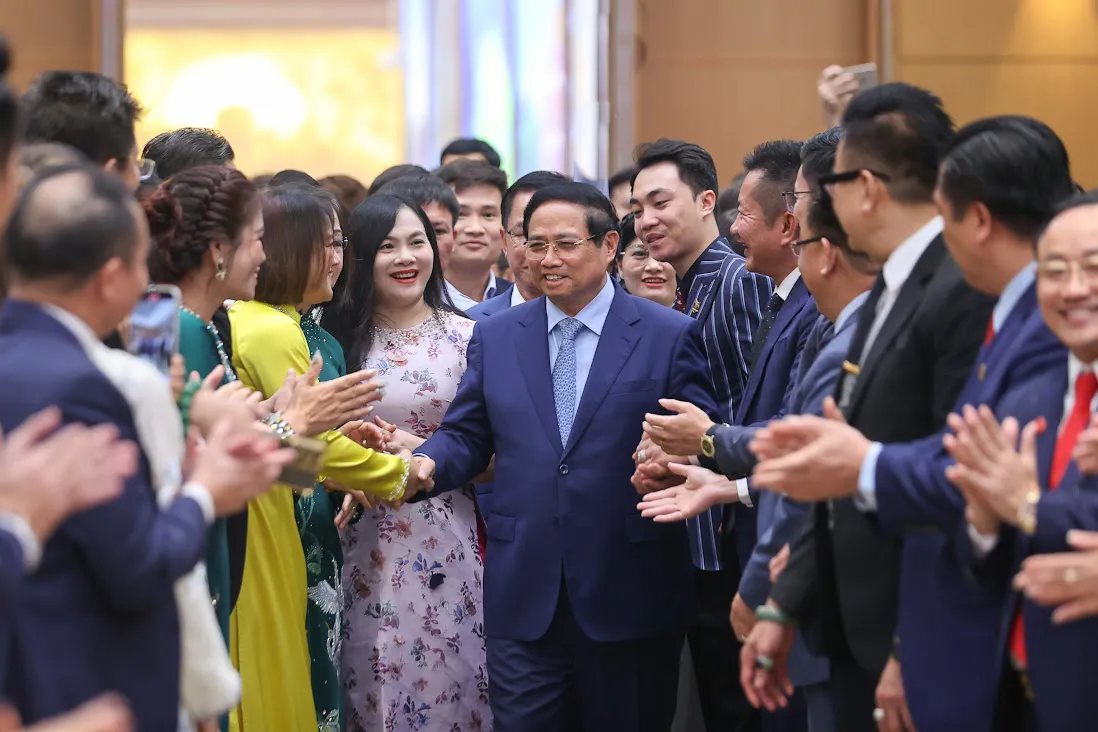
Prime Minister Pham Minh Chinh and representatives of the business community at the meeting on October 9. Photos: VGP
Prime Minister Pham Minh Chinh shared this message at a meeting with outstanding entrepreneurs and business representatives nationwide on October 9, marking the 21st anniversary of Vietnam Entrepreneurs’ Day (October 13).
According to Chinh, the business community has made a significant contribution to the country’s development.
The prime minister urged entrepreneurs to remain confident and self-reliant as they “take longer strides, sail farther, and fly higher” to generate new momentum and motivation as Vietnam enters a new era of growth.
“The business community has always stood on its own feet, striving for strong growth and contributing to the country’s GDP targets,” he said.
Vietnam currently has nearly one million enterprises, of which 98% are privately owned. According to 2023 data, they contribute about 51% of GDP and over 30% of total state budget revenue.
Resolution No. 68 of the Politburo on business development affirms that the private sector is a key driver of the economy and a pioneering force in science, technology and innovation. The resolution sets a goal for Vietnam to have two million enterprises by 2030, including at least 20 large private corporations participating in global value chains.
Representing the private sector, Tran Dinh Long, Chairman of Hoa Phat Group, expressed hope that the implementation of Resolution 68 would be accelerated to create more favorable conditions for businesses.
He urged the Government and ministries to handle enterprise petitions more promptly to seize development opportunities, noting that in today’s highly competitive environment, time is a decisive factor.
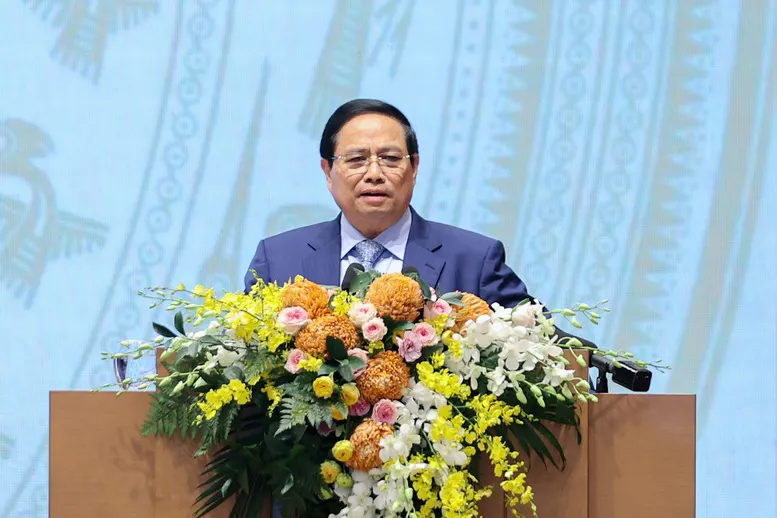
The government leader at the meeting.
He also proposed that the state give special priority to domestic products that can be locally manufactured and meet domestic demand. This would support Vietnamese enterprises while advancing the policy of “Vietnamese people prioritize using Vietnamese goods,” Long said.
Long added that domestic firms are actively investing and expanding production to participate in national programs such as social housing, infrastructure development and housing for workers and students.
He suggested that the government introduce transparent procurement and bidding mechanisms and prioritize Vietnamese goods in these projects to “create more momentum for sustainable business growth.”
Thai Huong, Chairwoman of the Strategic Council of TH Group, said policymakers need to design mechanisms and policies suited to each stage of development and each industry. While many resolutions have been issued, she noted that implementation remains challenging without specific execution guidelines and practical policies.
Huong identified two major bottlenecks faced by businesses. The first concerns the issue of non-retroactive laws.
Enterprises comply with legal regulations, but when laws change without transitional guidance, it causes disruption. For example, previous regulations required farms to be located at least 200 meters from residential areas. Businesses followed this rule, but when the law was amended to 400 meters, local authorities immediately enforced the new standard.
She highlighted the need for clear guidance to prevent “retroactive application” that hinders businesses.
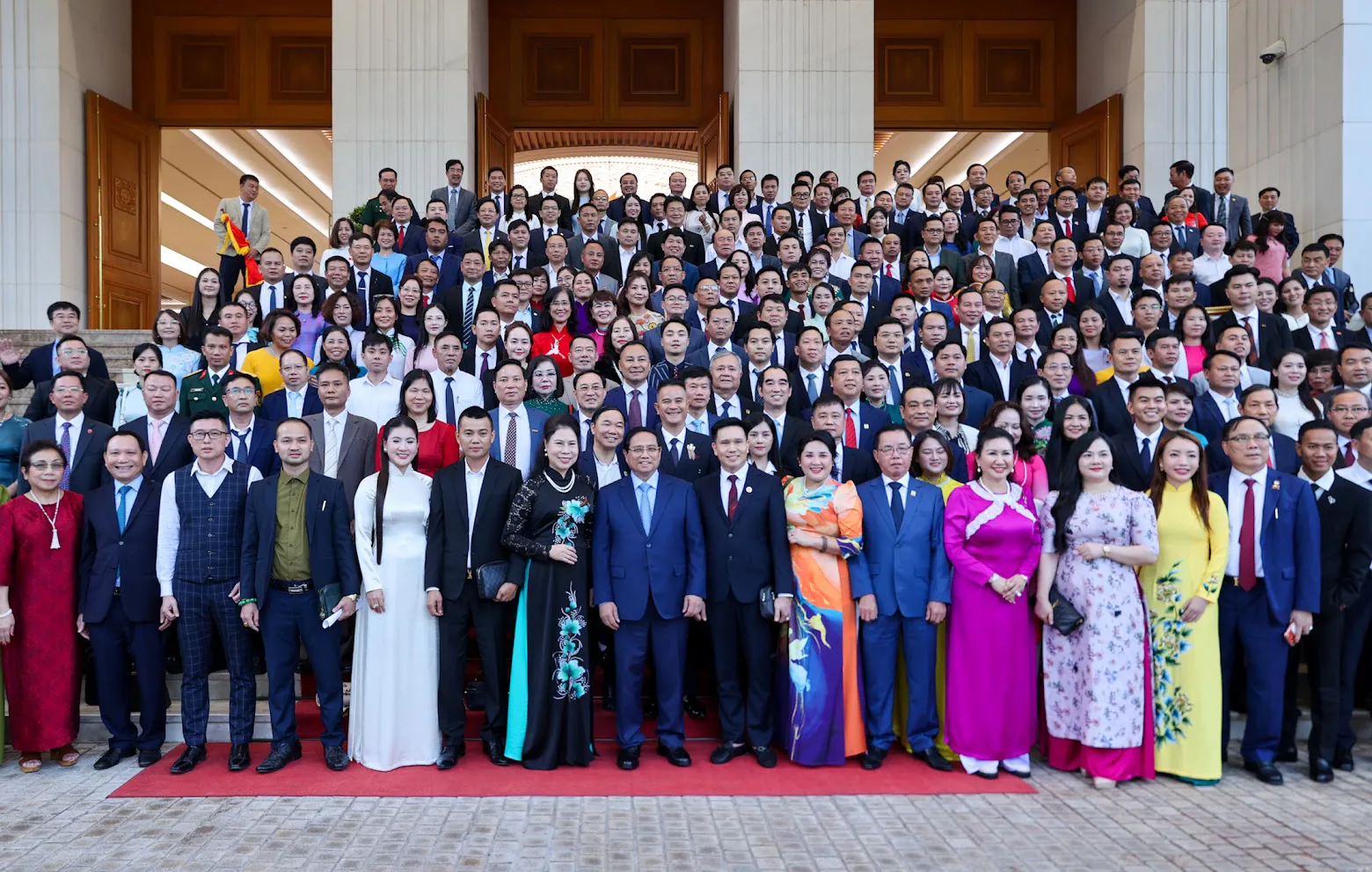
Delegates at the meeting.
The second issue involves staff and organizational mergers. Structural changes have delayed ongoing projects, wasting time and resources. She acknowledged the government’s strong efforts but stressed that ministries and agencies need to offer more concrete measures to resolve these bottlenecks so that policies can be implemented more effectively.
Beyond the private sector, Vietnam currently has around 671 state-owned enterprises (SOEs), including 473 wholly state-owned companies and 198 firms with more than 50% state capital. Additionally, 142 enterprises have partial state ownership.
The government aims for Vietnam to have at least 25 enterprises with equity or market capitalization exceeding VND25 trillion (US$1 billion) each, including 10 with over VND125 trillion ($5 billion) each. It also targets at least 30 SOEs to achieve annual net revenue above VND25 trillion ($1 billion) by 2030.
General Director of PetroVietnam (PVN) Le Ngoc Son said that leading SOEs such as PVN are aware of their pioneering mission to help maintain macroeconomic stability and lead the growth of other economic sectors.
He proposed that the government submit to the Politburo a new resolution on developing SOEs and the state economic sector to remove institutional barriers and foster breakthroughs in state enterprise performance.
“We believe that timely policy adjustments will provide a vital boost for businesses to continue innovating and growing sustainably,” Son said.