Log in
Hanoi

PM requests restriction of low-rise housing construction in Hanoi “suburbs”

The Prime Minister has just commented on the partial adjustment of Hanoi construction master plan to 2030 and vision to 2050.

Hanoi.
Hanoi.
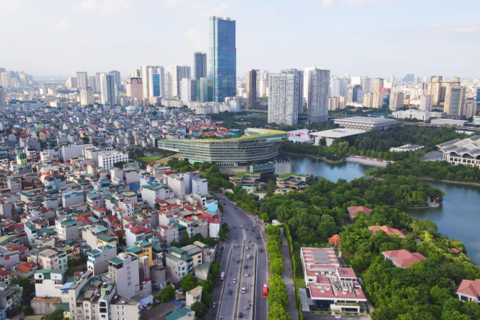
The Prime Minister assigned the People's Committee of Hanoi to assume the prime responsibility for, and coordinate with the Ministry of Construction and concerned agencies in, studying the planning of modern urban centers with synchronous technical and social infrastructures in the areas of Dong Anh, Gia Lam, Yen Vien and Long Bien; restricting construction of low-rise buildings to help reduce population in the historic inner city, from 1.26 to 0.8 million people, according to Prime Minister's Decision No. 1259/QD-TTg dated 26/7/2011; and  reporting to the Prime Minister.
At the same time, the Hanoi People's Committee will partially adjust the planning of an area encompassing communes: Xuan Canh, Mai Lam, Dong Hoi of Dong Anh District, in order to meet construction requirements of the National Exhibition Center and surrounding area, as commented by The Ministry of Construction; and organize the implementation in accordance with the provisions of Clause 6, Section 3.2 of Part III – Organization of implementation of the Management Regulation issued together with the Hanoi Master Construction Plan to 2030 and vision to 2050, which has been approved by the Prime Minister.
Hanoi construction master plan has been approved by the Prime Minister since 2011. The scope of planning covers the entire administrative boundaries of ​​Hanoi Capital, which is about 3,344.6 square kilometres, functional as the capital of Vietnam, the political and administrative center of the whole country, and a special urban center.
In February, 2018, Hanoi People`s Committee has issued a decision approving the partial revision of the Capital’s construction master plan to 2030 with vision to 2050.
Under the adjusted plan, public and mixed-land area increased by 14.39 ha (bringing the total to 34.24 ha, accounting for 8% of the total land use area), while the land area for greenery, amusement parks, and water surface decreased by 41.92ha (now 111.08ha, accounting for 26.21%) and the land area for training/education institutions was upwards adjusted to 22.7ha.
The land area for new residential units increased by 25.32ha (bringing the total to 122.2ha, accounting for 28.83%); project land in the green belt decreased by 35.72ha (its total is down to 63.15ha, accounting for 14.89%); urbanized rural areas increased by 3.16ha (its total is up to 8.13ha, accounting for 1.92%); land for defense and national security increased by 0.92ha (bringing its total up to 4.22ha, accounting for 1%); technical infrastructure focal area increased by 4.18 ha (accounting for 0.99%); roadways increased by 7.97ha (up 53.93%, accounting for 12.72%).
As such, the revised plan has increased the land area available for public use, common services, residential units, defense and national security, roadways and technical focal areas, and reduced park and project land in the green belt.
Reactions:
Share:
Trending
Most Viewed
Hanoi gears up for a vibrant 2026 Countdown

Hanoi gears up for a vibrant 2026 Countdown

With the energy of thousands gathering in Hanoi downtown, the Countdown 2026 promises to be an unforgettable way for people to welcome the New Year.

Hanoi launches AI-powered traffic control center for traffic violations

Hanoi launches AI-powered traffic control center for traffic violations

The system automatically detects common violations, significantly reducing the need for traffic police to be deployed directly on the streets while improving accuracy and transparency in traffic management.

Hanoi plans 10,000-hectare urban megacity with world-class stadium

Hanoi plans 10,000-hectare urban megacity with world-class stadium

The stadium’s design draws inspiration from Dong Son bronze drums and the Lac bird motif, symbolizing Vietnam’s aspiration to rise.

Hanoi greenlights Olympic sports city and Red River boulevard to drive next growth phase

Hanoi greenlights Olympic sports city and Red River boulevard to drive next growth phase

The approval of two landmark projects underscores Hanoi’s push to unlock new growth engines, reshape its urban structure and accelerate its ambition to become a green, smart and globally connected capital.

Hanoi targets 1,200 supporting industry firms by 2030

Hanoi targets 1,200 supporting industry firms by 2030

The city aims to enhance the competitiveness of the capital’s industrial sector by tightening cooperation with Vietnamese enterprises and multinational corporations operating in Vietnam.

Red River Boulevards shape Hanoi’s new growth axis

Red River Boulevards shape Hanoi’s new growth axis

The creation of a landscape boulevard can help Hanoi reconnect with its historic identity shaped by water and restore the river-based character that defined the city for centuries.

Hanoi moves to strengthen urban order and civility

Hanoi moves to strengthen urban order and civility

These include expanding public communication efforts, reorganizing and upgrading streets and sidewalks, maintaining a clean and orderly urban environment and carrying out strict inspections to address violations.

Hanoi honors 87 entities and buildings for using green energy

Hanoi honors 87 entities and buildings for using green energy

Enterprises adopted highly automated technologies in line with Industry 4.0 standards and all businesses in industrial parks, clusters, rural industries and craft villages will keep applying energy-efficient measures.