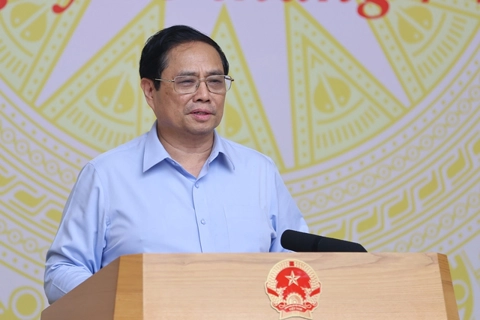
Prime Minister urges banks to cut lending rates further
The Government leader has called for the publication of average lending rates to allow individuals and businesses to choose their banks.
The average lending rates have been reduced, but remain high compared to the deposit rate, Prime Minister Pham Minh Chinh said in a directive issued on March 5.
| Adjusting interest rates at BIDV in Hanoi. Photo: Pham Hung/The Hanoi Times |

Vietnam’s credit growth in the first two months of 2024 is at a negative rate of 1.12% compared to the end of 2023.
Apart from the seasonal factors and the reduced demand for borrowing at the beginning of the year due to economic challenges, experts attribute the low credit growth to the difficulty individuals and businesses face in accessing capital, despite the decline in interest rates, which remain high.
In this context, Prime Minister Pham Minh Chinh has called for the publication of average lending rates to allow individuals and businesses to choose their lending banks.
Chinh noted that this requirement is one of the solutions to empower people and businesses in selecting suitable lending institutions.
Earlier this year, the State Bank of Vietnam (SBV) issued Directive 01, which requires credit institutions to publicly disclose and take responsibility for the average lending interest rates.
At a banking sector conference on February 20, SBV’s Deputy Governor Dao Minh Tu emphasized that public disclosure is a "management discipline" that all banks must adhere to. The interest rates disclosed will be the average rates, not specific rates for each target, business, or type.
From the perspective of banks, this measure is expected to promote fair and objective competition. Currently, the SBV has no penalty on this issue, but the Deputy Governor warned that "if banks do not disclose, they will be sanctioned by public opinion."
In order to further improve access to capital, the directive calls on the SBV to instruct credit institutions to reduce costs, simplify administrative procedures, and apply information technology and digital transformation.
The SBV has proposed solutions to reduce lending interest rates by reviewing the results of lending by sector. Tu emphasized that credit should be directed to production and business, priority sectors, and traditional growth drivers such as consumption, investment, exports, science and technology, and innovation rather than risky sectors.
Additionally, the head of the government has instructed the SBV to closely examine lending activities that do not conform to preferential targets, such as lending to board members, executives, and related individuals, as well as businesses within the ecosystem and shadow businesses.
The banking sector must ensure the economy has sufficient capital to enable businesses and individuals to invest in development. The directive emphasizes the importance of avoiding obstacles, delays, and untimeliness in this process.
The SBV is responsible for implementing tools to control inflation, minimize and limit non-performing loans in credit institutions, and is accountable to the Government and the Prime Minister for monetary policy management and credit growth.
In 2023, Vietnam’s credit growth reached 13.71%. In terms of value, the banking system injected around VND1,500 trillion ($60.7 billion) into the economy last year, resulting in a total outstanding credit of approximately VND13,560 trillion ($548.7 billion).
The SBV is targeting a credit growth target of around 15% in 2024. If this target is achieved, the banking sector would contribute nearly an additional VND2,000 trillion ($81 billion) to the economy.
In 2023, the SBV actively managed interest rates to support and address economic challenges, with four successive reductions in policy rates, ranging from 0.5% to 2.0% per annum. This was done in the context of rising global interest rates. Additionally, there were various directives and direct engagements with credit institutions, urging them to reduce costs and lower deposit rates in order to lower lending rates.
So far, interest rates have fallen significantly, with the average deposit and lending rates for new transactions in VND dropping by 2-3% compared to the end of 2022.