Poverty reduction policies benefit additional 10% of Vietnamese population
Vietnam has embraced the approach of multi-dimensional poverty (MDP) measurement for strategic planning since the middle of the last decade.
An additional 10 million people in Vietnam will benefit from the Government’s social protection and poverty reduction policies and programs in the 2021-2025 period, according to the United Nations Development Fund (UNDP).
The number of additional beneficiaries was counted following the new multi-dimensional poverty line approved in 2021, to which the near poor and poor household rate in Vietnam increased from 5.2% in 2020 to 9.35% in 2022.
By adopting the national multidimensional poverty line in 2015, Vietnam emerged as a pioneer in the Asia-Pacific Region, incorporating multidimensional poverty into national poverty analysis and targeting. However, the persistence of poverty among ethnic minority groups and in coastal, island areas is a challenge for Vietnam in the achievement of the Sustainable Development Goals (SDGs). The Covid-19 pandemic was a tremendous setback in the struggle to eliminate stubborn poverty.
The figures were shared at the launch of the Multi-Dimensional Poverty (MDP) Report 2021 in Hanoi on July 28.
The report was jointly produced by the Ministry of Labor, Invalids and Social Affairs (MOLISA), the Committee for Ethnic Affairs (CEMA), the General Statistics Office, the Ministry of Planning and Investment (MPI), with the support from the Government of Australia, and technical assistance by the Vietnam Academy for Social Science (VASS).
| Head of the Committee for Ethnic Affairs (CEMA) Hau A Lenh speaks at the event held in Hanoi on July 28. Photos: CEMA |

Head of CEMA Hau A Lenh said the application of the MDP approach has greatly supported the development, implementation, and measurement of the success of ethnic policies in the past period. The report is expected to point out the basic shortcomings and main causes of multi-dimensional poverty among ethnic minorities in Vietnam to have effective measures to support the Government of Vietnam in achieving the national targets for socio-economic development in ethnic minorities and mountainous areas in the 2021-2030 period.
MoLISA Deputy Minister Nguyen Ba Hoan shared that the report provides a detailed analysis of employment, social services, and social protection. It’s considered an effective solution to maintain the achievement of multidimensional poverty reduction and to complete the National Targeted Program for Sustainable Poverty Reduction in the future.
Multi-Dimensional Poverty Report
The launch presents key findings and recommendations for achieving rapid poverty reduction in all dimensions and throughout Vietnam, including further refinement of the two NTPs on social-economic development in ethnic minorities, mountainous areas, and sustainable poverty reduction in the coming period.
| UN Assistant Secretary-General and UNDP Regional Director for Asia and the Pacific Kanni Wignaraja at the event. |

Addressing the launch, UN Assistant Secretary-General and UNDP Regional Director for Asia and the Pacific Kanni Wignaraja highlighted five key recommendations for accelerating the reduction of poverty in all dimensions, including the necessary policy and investment efforts to encourage and improve levels of productive employment; improving the delivery of quality basic social services and getting this level of quality and access to the toughest to reach communities; the expansion of social protection, not as ad hoc efforts in response to crises, but as a standing system that is robust and more expansive; the expanded use of digitalization in improving delivery, in knowledge industries, enhancing efficacy and transparency, across all these elements; and promoting innovative solutions to specifically scale-up successful pilots conducted by and with ethnic communities.
In the last decade, poverty reduction in Vietnam has been impressive regardless of the measure used. The multi-dimensional poverty rate declined consistently and significantly, from 18.1% in 2012 to 10.9% in 2016 and 4.4% in 2020. While one in ten people were poor in income terms in 2014, half moved out of poverty sustainably in the pre-pandemic period.
According to the report, Vietnam has seen progress in multi-dimensional poverty reduction thanks to the rapid expansion of productive employment; improvement of social services; and expansion of the social protection system. However, vulnerabilities and disparities represent significant challenges. Transient income poverty increased during Covid-19. Although the poverty rate dropped nationally, it remains high among ethnic minorities.
| The MDP rate by ethnic groups |
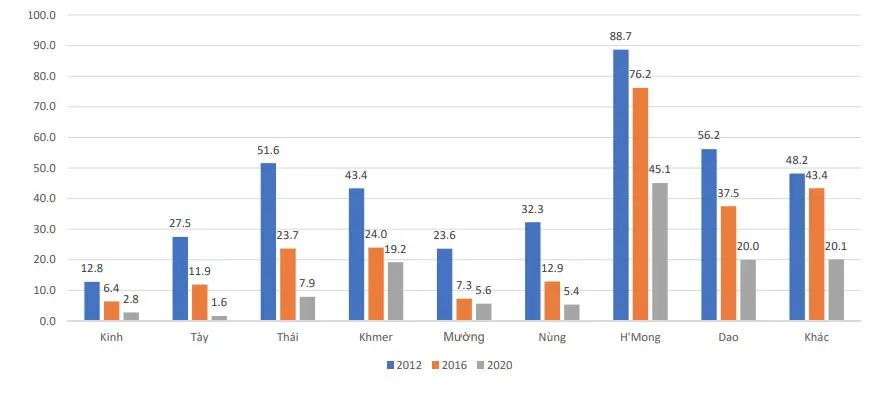
More specifically, while digital transformation in the education sector has increased, inequality in access to technology and equipment is still a challenge. The digital divide was more pronounced during covid-19. Access to health services has improved, but disparities remain, especially between the national level and district/community level health service providers. When it comes to social assistance, cash assistance programs have limited coverage and low benefits. Migrants are broadly excluded.
In this regard, comprehensive policy measures are needed to enable Vietnam to meet more rigorous targets and to make sure that everyone benefits from the mainstreamed economic development and no one is left behind.