President applauds boy for translating The Tale of Kieu
The classic Vietnamese epic poem translated into English has significantly contributed to spreading the beauty of Vietnamese culture, people, and literature to the world.
President Nguyen Xuan Phuc highly appreciated the English translation of the Vietnamese classic literary work, The Tale of Kieu, by Nguyen Binh, 21, at the meeting with the translator on November 28.
| President Nguyen Xuan Phuc highly appreciated the young talent translator Nguyen Binh. Photo: VNA |

Phuc said The Tale of Kieu is a work with great historical and cultural values. While the poem itself is very difficult for Vietnamese readers, it is even much more complicated when translated into other languages. The classic poem requires the translator to understand its meaning to translate it thoroughly.
Thanks to the English version of The Tale of Kieu, Nguyen Binh has just been honored with the “Young Author” award by the Vietnamese Writers' Association in the “Translated Literature” category in 2021.
According to Nguyen Quang Thieu, President of the Vietnamese Writers’ Association, the English translation of The Tale of Kieu by Nguyen Binh has been thoroughly checked by local and international writers, poets, and linguists. “The translation is considered to add a new spirit and modern beauty to the classic work,” he said.
Nguyen Binh is currently an Astronomy student at the University of Arizona, USA. He is fluent in a variety of languages, both classical and modern. He said the work was translated by him anytime, anywhere, in the dormitory or on the subway.
According to Binh, The Tale of Kieu by the great poet Nguyen Du is a classic and ever-great work of Vietnamese literature. "It not only has interesting content with unique and creative poetic techniques but also conveys in work "a miniature universe of ancient Vietnamese culture and history," he stressed.
| The cover of the English- Vietnamese version of The Tale of Kieu, translated by Nguyen Binh. Photo: Vietnamese Writers' Association Publication House |
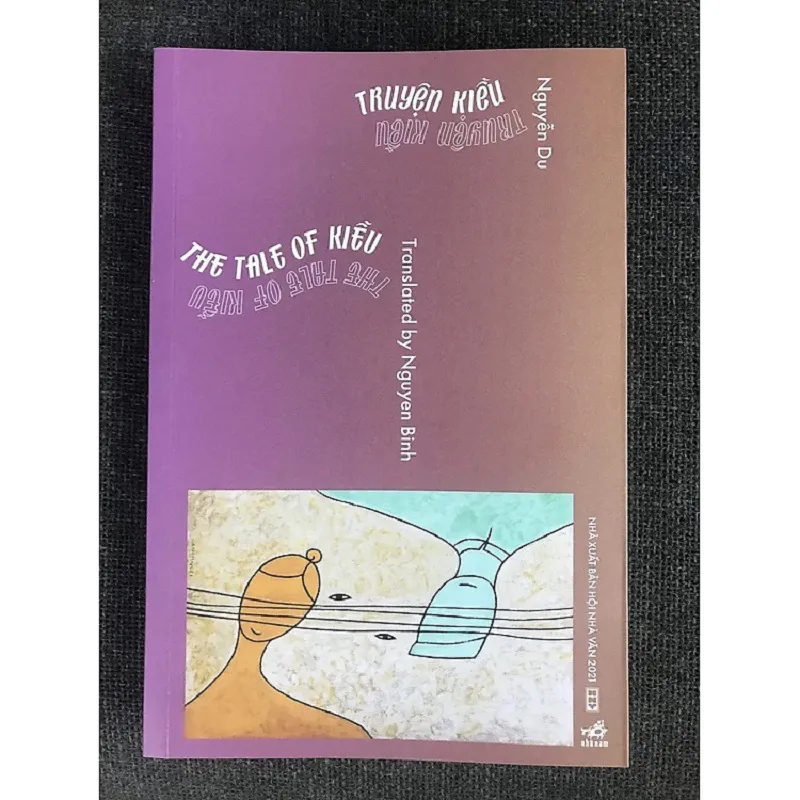
"Through my translation, I hope to open a new window on Vietnamese culture and literature so that people, at least English-speaking people, know that there is another way into Vietnam. It's about emphasizing the very rich culture that molds, shapes, and permeates Vietnamese society even today," he added.
Previously, The Tale of Kieu was translated into English by translators Le Xuan Thuy (1963), Huynh Sanh Thong (1983), Michael Counsell (1994), Vladislav Zhukov (2004), Timothy Allen (2019).
A piece of the poem The Tale of Kieu was translated by Nguyen Binh in 2021 in heroic couplet form of English poetry as below:
“A hundred years alive in Man's demesne,
’Tween Fate and Talent hatred seem to reign.
Of oceans changed to various berry plains,
The sight imbues the heart with cruel pains.
It is not strange that no one’s rich in all,
That rosy cheeks cause envious Heav’n to brawl.”
The Tale of Kieu is an epic poem in Vietnamese written by Nguyen Du (1765-1820), considered the most famous poem and a classic in Vietnamese literature. The original title in Vietnamese is Doan Truong Tan Thanh or “A New Cry From a Broken Heart,” but it is better known as Truyen Kieu or The Tale of Kieu.
The poem was originally written in “Nom” script – the ideographic Vietnamese script widely used between the 15th-19th centuries.
In 3,254 verses, written in luc bat or "six–eight" verses, the poem recounts the life, trials, and tribulations of Thuy Kieu, a beautiful and talented young woman who has to sacrifice herself to save her family.
To save her father and younger brother from prison, she sells herself into marriage with a middle-aged man, not knowing that he is a pimp, and is forced into prostitution. While modern interpretations vary, some post-colonial writers have interpreted it as a critical, allegorical reflection on the rise of the Nguyen dynasty (1802 to 1883).
The work was translated into many languages, including English, French, Chinese, Polish, Russian, Arabic, and Romanian.