Prime Minister orders strong incentives for repatriation of 100 top tech experts
The prime minister emphasized the need for concrete deliverables and visible progress, cautioning against empty declarations and inconsistent implementation.
THE HANOI TIMES — Vietnam is set to launch a special policy package in August to lure 100 top-tier tech experts back home to boost national digital transformation and innovation efforts.
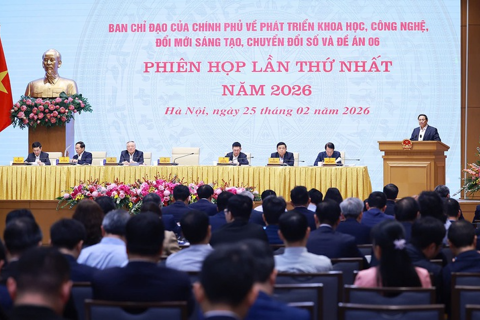
This request was made by Prime Minister Pham Minh Chinh at a meeting of the Government’s Steering Committee on science, technology, innovation, and digital transformation on July 20.

Prime Minister Pham Minh Chinh speaks at a meeting of the Government’s Steering Committee on science, technology, innovation, and digital transformation on July 20. Photos: VGP
The Ministry of Home Affairs has been tasked with drafting the criteria, the recruitment protocol and the incentives for the key experts leading national projects, with submissions due this month.
Meanwhile, the Ministry of Education and Training is responsible for developing a strategic framework for higher education and finalizing plans to reorganize university-affiliated research institutes, to be completed by the third quarter of 2025.
Each ministry, sector and locality must appoint two chief engineers - one specializing in information technology and the other in their core professional field - to assist the Ministries of Public Security, Science and Technology, and technology enterprises in designing and implementing bespoke digital transformation strategies.

VinSmart factory in Hanoi's Hoa Lac Hi-tech Park. Photo: Vingroup
The Ministry of Science and Technology has been required to suggest changes to four important laws: the Digital Transformation Law, the Intellectual Property Law, the High Technology Law, and the Technology Transfer Law. It also has to amend Decree No. 82/2024 on state-funded IT investment to streamline procedures.
The ministry has also been charged with proposing mechanisms to help start-ups commercialize research and with drafting a National Talent Attraction Strategy for 2021–2030 with a vision for 2050, to be completed by September 2025.
Regarding digital infrastructure, the Ministry of Science and Technology will collaborate with the Ministries of Finance and Industry and Trade, local governments, and major enterprises to expand nationwide 5G coverage, promote satellite internet, and address connectivity and electricity shortages in remote areas.
The Ministry of Public Security will draft a national data architecture, a unified data governance framework and a shared national data dictionary.
It will also coordinate the rollout of 116 national and sectoral databases, completing 40 of the 61 public service utilities integrated into the VNeID platform in order to support digital governance and economic development.
From August, the ministry will pilot digital prescription compatibility across hospitals and pharmacies via VNeID, enabling citizens to have their medication delivered to their homes. Full implementation is expected in September.
The ministry will also develop a cloud-based citizen data system integrated with VNeID to enable safe and seamless end-to-end online public services.
At the same time, the Ministry of Construction will lead the development of a National Smart City Strategy in coordination with the Ministry of Science and Technology and six centrally-run cities to put into action this year.
The Ministry of Finance needs to report on the contribution of the digital economy to GDP. The Ministry of Science and Technology is responsible for ensuring that the digital economy accounts for 20% of GDP by the end of 2025.
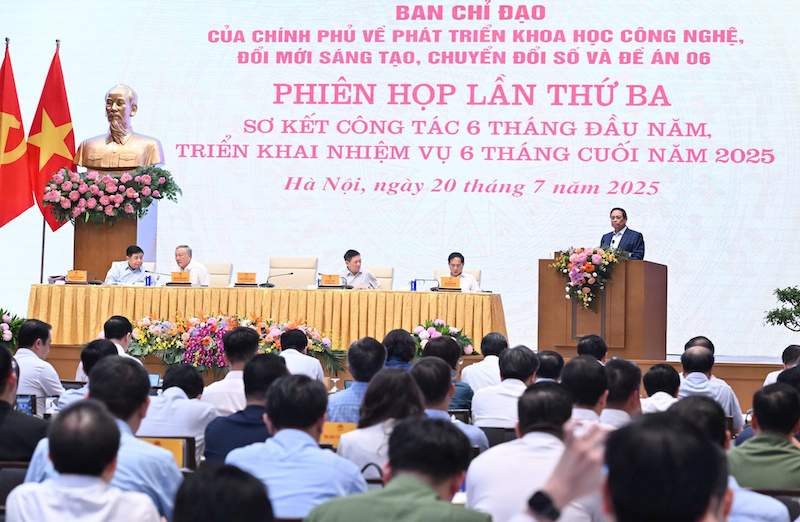
Delegates at the governmental meeting on July 20.
According to reports at the meeting, since the Politburo adopted Resolution No. 57 issued in late 2024, all ministries, sectors and localities have issued action plans on science, technology, innovation, and digital transformation to deliver the national program.
The government has submitted 19 draft laws and five resolutions to the National Assembly, as well as issuing 28 decrees on decentralization and administrative powers between two-tier local governments. It has also identified 50 major obstacles hindering digital transformation at the local level.
Particularly, 5G services have now been deployed nationwide, with over 15,000 stations installed. The establishment of the National Data Center is being fast-tracked, with the institution expected to open on August 19.
Improvements in digital tax and e-invoicing management have boosted tax collection, while e-government is helping local administrations to operate more effectively. Online public services are becoming more proactive and data-driven.