Prime Minister urges actions as salinization begins in Mekong Delta
Salinization in Vietnam’s Mekong Delta is a major environmental concern, driven by saltwater intrusion, reduced Mekong River flow, climate change, and upstream hydropower projects.
The increase of salt concentration in soil in the Mekong Delta has prompted a request from Prime Minister Pham Minh Chinh who asked functional agencies and local authorities to take drastic measures in the country’s rice hub.
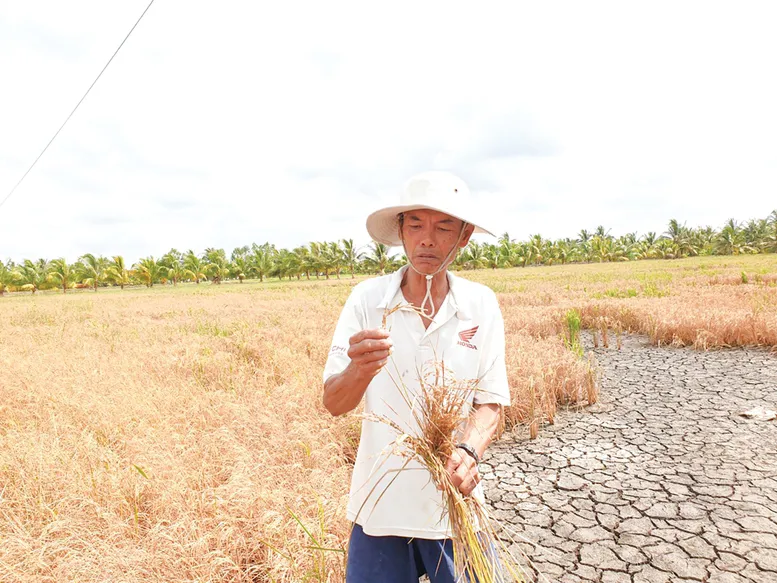
| A field suffers saline water in Tan Son Commune, Tra Cu District, the Mekong Delta province of Tra Vinh, Vietnam. Photo: Baocantho |
As usual, the salinity began in the Mekong Delta in February and will hit the peak from the end of February to April with the saline water entering the fields through estuaries.
In a decree signed on February 17, the prime minister asked involvement of the ministers of Agriculture and Rural Development; Natural Resources and Environment; Construction; Information and Communication; and heads of major cities of Ho Chi Minh City and Cantho, and southern provinces of Tien Giang, Ben Tre, Tra Vinh, Soc Trang, Bac Lieu, Ca Mau, Kien Giang, Hau Giang, Vinh Long, Dong Thap, An Giang, and Long An.
According to Vietnam Television (VTV), the saline water was measured at 1.7g/lilter at Vam Cam in Luong Nghia Commune, Long My District, Hau Giang Province, the place which is 70km away from the sea; at 2.5 g/lilter in Ben Luc District of Long An Province – 67 km from the sea; at 1.8 g/lilter in Soc Trang Province – 59km from the sea; and more than 5g/lilter in Go Quao District of Kien Giang Province.
Between January and February, the salinization is stronger than that in the last year, affecting cultivation. The saltwater instrusion is forecast to take place in March in Tien and Hau Rivers, and at the end of March to the early April in Vam Co and Cai Lon Rivers.
The salt concentration is estimated to hit 4g/lilter with an instrusion of 45km to 60km in Tien and Hau Rivers.
Notable, the salinity is forecast to impact the livelihoods and agriculture in the Mekong Delta provinces of Tien Giang, Ben Tre, Tra Vinh, Soc Trang, Bac Lieu, Hau Giang, Kien Giang, and Ca Mau – the localities with the biggest paddy fields and fruit farming areas in Vietnam.
To mitigate the effects of peak saltwater intrusion in the Mekong Delta and Ho Chi Minh City, the prime minister directs ministries and local authorities to strictly enforce the prime minister’s directive dated Dec 8, 2024 on drought, water shortages, and saltwater intrusion prevention.
The Minister of Natural Resources and Environment is tasked with monitoring conditions and provide timely hydrological forecasts to authorities and media for effective action while the Minister of Agriculture and Rural Development has requested to oversee and support local adaptation efforts, particularly in coastal areas, to protect agriculture.
Provincial and city leaders need to monitor weather and water conditions, implement timely response measures, and ensure sufficient drinking water for residents, hospitals, and schools.
The Minister of Information and Communications and national media will provide timely updates on saltwater intrusion and government response efforts.
Meanwhile, Deputy Prime Minister Tran Hong Ha will supervise the directive’s execution, with the Government Office ensuring compliance and reporting urgent developments.
For long-term response, the government has invested in dozens of saltwater intrusion control sluices and freshwater storage projects in the Mekong Delta.
Of the constructions is Nguyen Tat Thanh sluice in Tien Giang Province, the second largest in the Mekong Delta to control saltwater intrusion, situated approximately 400 meters from the Tien River.
When saltwater intrusion occurs, the sluice is shut to safeguard agriculture and secure the water supply for residents in Tien Giang and Long An provinces. This enclosed system effectively blocks saltwater while preserving freshwater, benefiting over 130,000 hectares of farmland, including economically valuable fruit orchards in both provinces.
In mid-April 2024, the Mekong Delta experienced severe saltwater intrusion. Provinces like Long An, Tien Giang, and Ca Mau declared an emergency. Authorities swiftly implemented response measures to mitigate impacts and restore conditions.
The intrusion was driven by prolonged drought, reduced upstream water flow from the Mekong River, and rising sea levels. Many freshwater sources became contaminated, threatening over 130,000 hectares of crops, including high-value fruit orchards.
Salinization threatens crops, especially in coastal areas where high-value fruit orchards and rice fields are at risk. During the dry season, saltwater can penetrate far inland, disrupting farming and impacting the livelihoods of millions.
Authorities responded by closing saltwater intrusion control sluices, storing freshwater, and implementing emergency measures to safeguard drinking water and irrigation. At the same time, local governments distributed freshwater, advised farmers on crop adaptation, and reinforced dikes.
Saltwater intrusion continues to threaten the Mekong Delta. It requires the need for improved water management, regional cooperation, and sustainable solutions to ensure the long-term resilience of the Mekong Delta.