Prime Minister wants rice quality up to secure second largest exporter title
By shifting focus from low-cost buyers to stable, high-value markets, Vietnam is positioning itself to sustain growth and enhance the global reputation of its rice.
THE HANOI TIMES — Keeping rice quality improved is the priority for Vietnam to offset the downtrend in global prices, boost exports, and reiterate its status as the world's second largest rice exporter.
The points were made in a request that Prime Minister Pham Minh Chinh delivered to the Ministry of Agriculture and Environment on August 18.
The document came after a recent report from the Thai Rice Exporters Association showed that Vietnam overtook Thailand as the world's largest rice exporter in the first half of 2025.
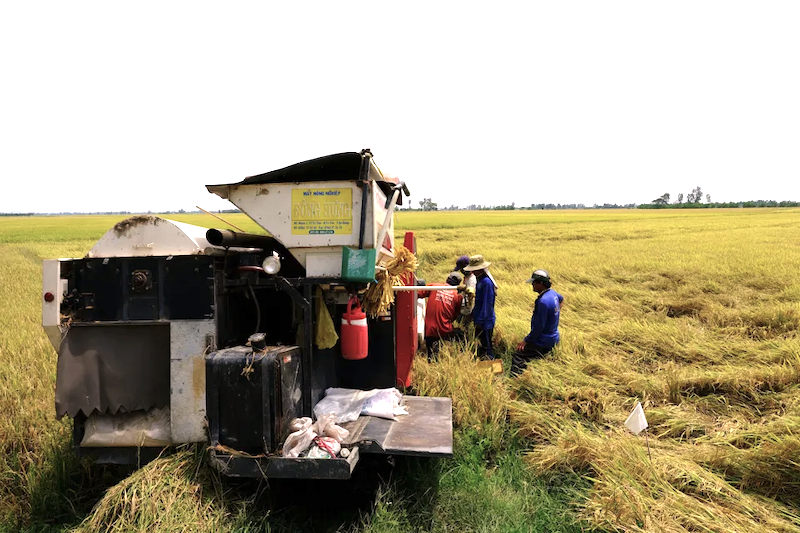
Rice harvesting in the Mekong Delta. Photo: Lam Giang/Kinh te & Do thi Newspaper
The association reported that India's rice exports rose 37% on-year to 11.7 million tons. Vietnam followed with 4.7 million tons, up 3.5% on-year, and Thailand's fell 27% on-year to 3.7 million.
According to the Ministry of Agriculture and Environment, rice exports in January-July from Vietnam rose 3% on-year to 5.5 million tons, but export value dropped 16% on-year to $2.8 billion due to the downward trend of global prices.
To cement its second place, Prime Minister Chinh asked the ministry and its agencies to harness the cultivation of high-quality and organic rice, and develop national brands with a proper traceability system.
One typical program now underway in Vietnam is the one-million-hectare sustainable rice program in the Mekong Delta by 2030, he said.
In that way, he said, Vietnam will make a crucial shift from sheer export volume to selling products of high value to the world, and grow its market competitiveness further.
In the document, the government leader warned of several risks and problems that rice exporters may face.
The bottlenecks include rigid export management policies and technical barriers in strict markets such as the EU and Japan, and falling global prices.
"These pressures push Vietnam to move beyond competing on quantity and price, instead focusing on quality, sustainability, and branding to secure long-term resilience," Prime Minister Chinh said in the document.
According to Do Ha Nam, Chairman of the Vietnam Food Association, rice exports could reach 7.5-8 million tons in 2025.
Vietnam's rice exports are still hindered by a volatile market, especially after India - the largest exporter - decided to offload rice in a large scale to the world and keep prices down, while the Phillippines will suspend rice imports in a 60-day program next month.
Vietnam’s average export price stands at $514 per ton, though lower than recent years, Nam said, adding that it remains higher than competitors.
Despite these headwinds, Vietnam is carving out a distinctive market with premium varieties such as DT, OM, and especially the award-winning ST series.
Specialty rice like ST25 is exported to Europe at over $1,200 per ton, double the price fetched in China.
Vietnam plans to expand fragrant rice exports, seize opportunities in the US market where Thailand and India currently dominate, and push into premium destinations such as the EU, Japan, South Korea, and Singapore with processed products like noodles and vermicelli.
Emerging markets such as Ghana, Côte d’Ivoire, and the UAE are also being prioritized.