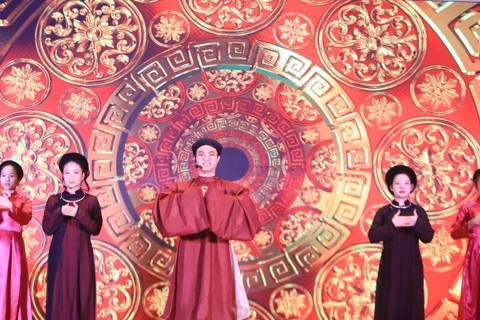
Promoting literature among students through performing arts
Staging literary works is a didactic method that helps to increase students' interest in literature and history.
Do Ngoc Ha, a student at Le Quy Don Secondary School in Hanoi, was thrilled after watching the play Canh dieu lang Vu Dai (The Kite of Vu Dai Village), staged in her school this week.
The play, adapted from the short story Chi Pheo by renowned Vietnamese writer Nam Cao, has helped Ha and other students understand the literary work from a different perspective. "My appreciation of the short story has improved," Ngoc Ha.
The theatricalization of literary works in school has had a positive effect on students like Ngoc Ha. When literary works are adapted to theater, students find it easier to appreciate and love them.
Based on the initial success of the theatricalization of literary works, policies will be worked out to replicate this model.
| A scene in the cheo play Thang Bom. Photo courtesy of Hanoi Cheo Theater |

The project of the theatricalization of famous literary works as a didactic method in Hanoi was approved by the Hanoi Municipal People's Committee in late 2022.
By utilizing the strengths of theatrical art, the project aims to help students develop a deeper appreciation of literature. The project also aims to identify and train potential actors.
A total of 51 plays from 70 student works will be adapted by theaters under the Hanoi Department of Culture, Sports and Tourism. Nearly 2,000 performances will take place in high schools.
The city government requires the plays to be highly educational and suitable for teenagers. In addition, attendance must be free and voluntary.
The project, aimed at stimulating the development of the capital's cultural industry, also focused on spreading the love of literature and performing arts among students.
Breathing new life into the capital's stage
The project has received a strong response from theaters.
The Hanoi Drama Theater is rehearsing the play Spirit of Gymnastics, based on a short story by Nguyen Cong Hoan. The play is written and directed by People's Artist Trung Hieu.
The Hanoi Cheo Theater has monthly staged Canh dieu lang Vu Dai, adapted from Chi Pheo by writer Nam Cao, in schools since April last year.
Meanwhile, the Thang Long Puppet Theater is preparing two fairy tale plays, Tam Cam and Thach Sanh, for students. The Hanoi Cai Luong Theater and the Hanoi Circus and Variety Arts Theater will perform plays based on national literary treasures for the educational program.
| Performance at school as a theatricalization of famous literary works in the general education program in Hanoi. |
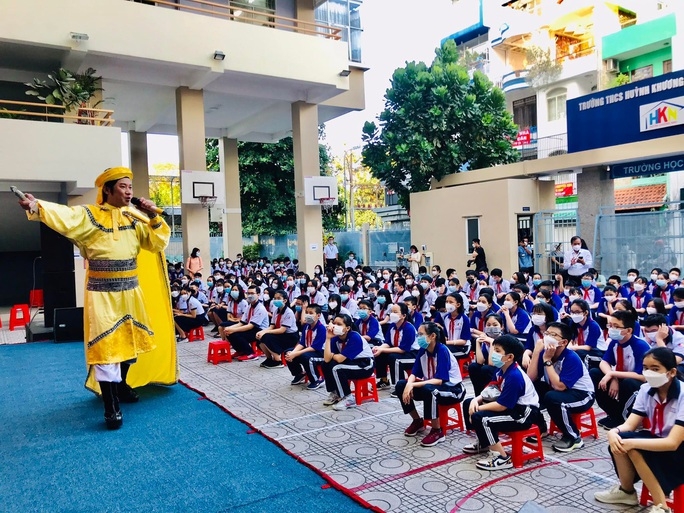
Famous Vietnamese literary works are adapted to theater but with school tweaks. Most of the literary works have been staged with different perspectives from teachers and students.
Trung Hieu, Director of the Hanoi Drama Theater, said the project makes learning literature more interesting for students.
"The activity aims to develop an audience for the capital's theaters and spot new theater talents," Trung Hieu said.
Meanwhile, Deputy Director of the Hanoi Cheo Theater Thu Huyen agreed that introducing traditional theater to young audiences will help preserve the art.
Nguyen Gia Thuy, a student at Dich Vong Secondary School in Cau Giay District, said that watching the play De Men (The Cricket) by Le Ngoc Theater, she felt utterly immersed in the colorful animal world depicted in the play and was able to better visualize the literary characters she had studied.
"I can't wait to see more textbook adaptations like this on stage," she said.
In the past, students in literature classes were merely passive recipients of knowledge from teachers. Still, now, with the theatricalization of literary works, students have a different appreciation of the works than what they are taught in class.
Pham Ha Thanh, a literature teacher at Le Quy Don High School, emphasizes that students are attracted to the theatricalization of literary works because it stimulates their curiosity about the author and their imagination of the context in which the work was created.
"Students are more enthusiastic and interested in literature classes," Thanh said.
There is a widespread belief among literature teachers that theatricalizing literary works contributes to a better understanding of the works. To take this experience to the next level, they suggest the participation of artists from professional theaters.
If this teaching method is replicated, it would improve the quality of literature teaching and learning.