Rare photos of Hanoi architecture revealed
The National Archives Center I will exhibit rare archival documents and photographs of the Grand Palais Hanoi, a significant piece of architecture that is now lost.
In the past, many artisans from all over the country came to settle in Thang Long (now Hanoi) and gradually formed artisan guilds. They were all called Ke Cho.
This name was later used to refer to the entire capital city of Thang Long-Hanoi. The bustling commercial atmosphere of Ke Cho became even more so when Hanoi became the capital of Indochina during the French colonial period.
| Grand Palais Hanoi is under construction in 1901. File Photo |
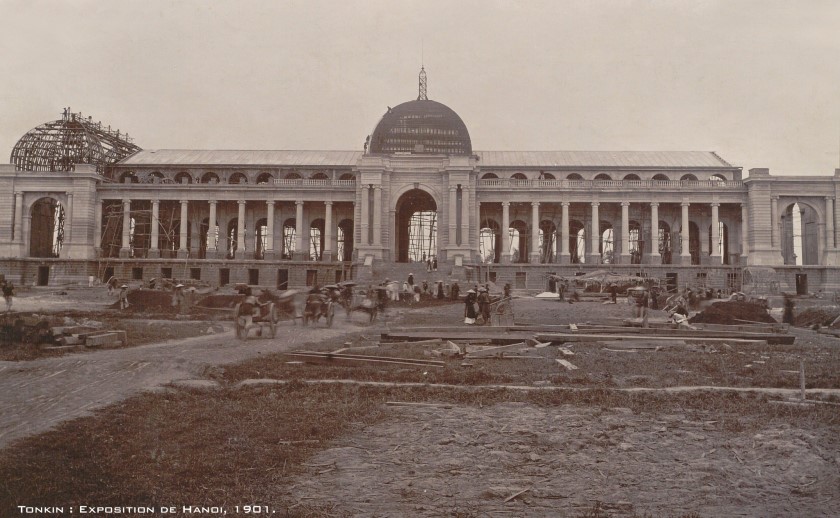
In 1902, the then Governor General of Indochina, Paul Doumer, aimed to organize a large international exhibition in Hanoi, showcasing Tonkin's industrial and agricultural products, as well as the cultural artifacts of Indochina and the Far East. This ambitious project required a spacious venue, leading to the commissioning of architect Adolphe Bussy to design the Grand Palais Hanoi, modeled after the Grand Palais in Paris, France.
Vietnamese people refer to the Grand Palais as the House of Craftsmanship, signifying a place to exhibit handicraft products for comparison of their sophistication and the skills of artisans. This complex covers an area of 17 hectares.
When inaugurated on February 26, 1902, the Grand Palais Hanoi astounded everyone with its scale and design. The road from the main gate to Gambetta Avenue was leveled and paved, surrounded by a magnificent landscape of lush green trees and flags of various countries, including that of the Kingdom of An Nam (now Central Vietnam). The opening ceremony was attended by Governor General Doumer, King Thanh Thai (1879-1954), the royal family, members of the Supreme Council of Indochina, generals, officials, and numerous guests from across Indochina.
The Grand Palais Hanoi is situated on the left side of Gambetta Avenue (now Tran Hung Dao Street, Hoan Kiem District), leading to the central station. The several-kilometer-long street is illuminated by electric lights.
| Grand Palais Hanoi is a beautiful piece of architecture designed by Adolphe Bussy. File Photo |
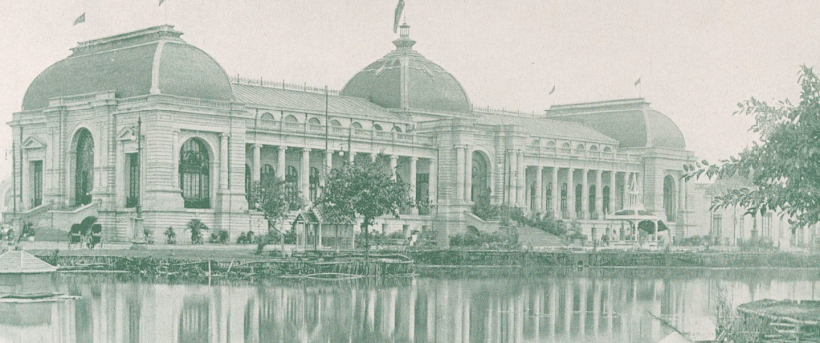
After its completion, a four-month fair was held here from November 1902 to February 1903.
Following the fair, it transformed into the Maurice Long Museum, the first and largest economic museum in Indochina. The space that was once used for exhibitions became an advertising space for companies.
During the Japanese occupation of Vietnam, the Grand Palais Hanoi served as a military base. At the end of World War II, American bombing raids completely leveled the building. The only remnants are two bronze lion statues, currently located in front of the Central Circus on Tran Nhan Tong Street. The site of the old Grand Palais Hanoi is now the Friendship Labor Cultural Palace, established as a venue for organizing cultural and artistic events.
| The Grand Palais, now the Friendship Labor Cultural Palace. File photo |
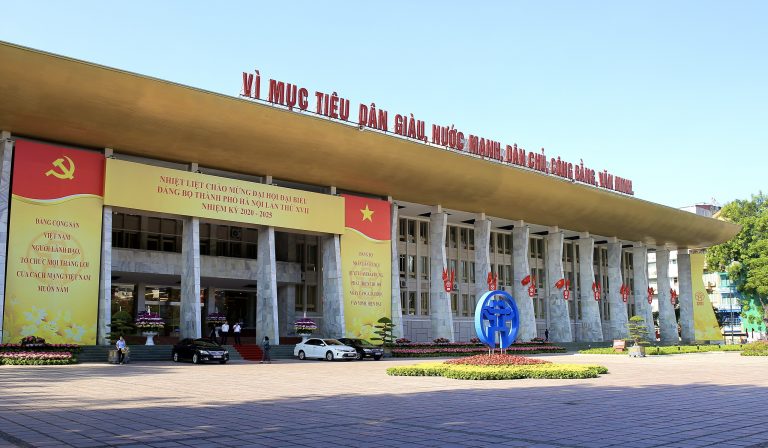
Now, the Grand Palais Hanoi exists only in old photos. Some rare and precious photos and documents of the Grand Palais Hanoi will be displayed at the National Archives Center I in Hanoi.
The exhibition, titled "House of Crafts - Convergence of Quintessence," will open on January 26, showcasing 300 archival documents and photos of the Grand Palais Hanoi and international exhibitions abroad with Vietnamese participation.
Vietnamese exhibits were not only displayed in domestic exhibitions but also in many colonial and world exhibitions in France, the US, and other countries worldwide.
The exhibition of archival documents will outline the space of important national and international exhibitions where Vietnamese elites gathered from the late 19th century to the mid-20th century. The Vietnamese quintessence is not only reflected in the past but also maintained and promoted by generations during the period of global integration.
Through the exhibition, the organizing committee hopes to introduce to the public a rich and valuable source of archival documents about ancient Vietnam through ingenious activities, creating a space to explore historical heritage.
The exhibition will run until June 30 at the National Archives Center I, and admission is free.