Red River cultural space axis to be developed into a heritage road
The Red River will be an important factor in the city's economy, providing water transportation and connectivity to areas on both sides of the river.
The cultural landscape and tourism axis of the Red River will be developed into a heritage road, where festivals will be held and the quintessence of provinces and cities across the country will converge, said Professor Hoang Van Cuong at a recent roundabout conversation held in Hanoi among experts about the river planning.
Professor Cuong, Vice Rector of the National University of Economics, the leading unit of the consulting consortium drafting the Hanoi Plan for 2021-2030 with a vision to 2050, stressed that the Red River project aims to create new cultural spaces, tap the potential of current cultural spaces, and transform cultural heritage for tourism development.
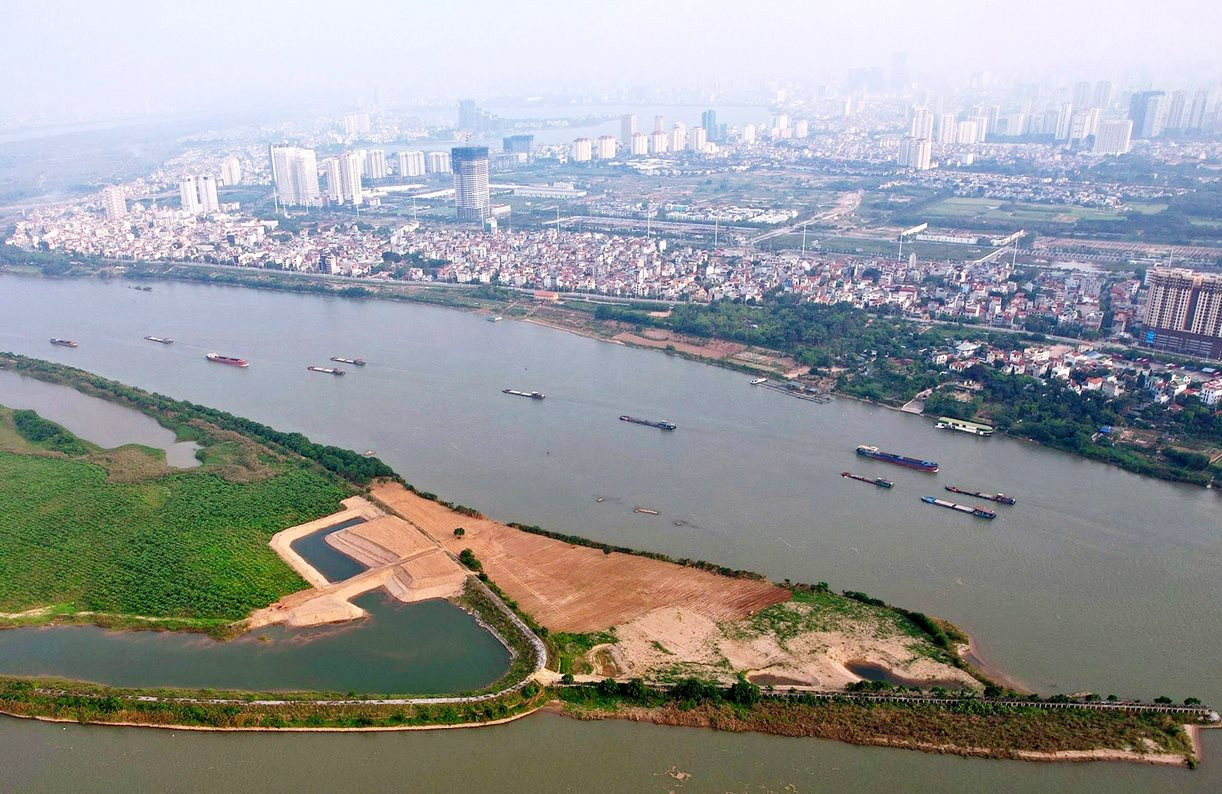
The Red River's islet is planned to be an entertainment park. Photo: Hanoimoi |
“The Red River will serve as a major economic driver for the city, providing water transportation and linking neighborhoods on both sides of the river. Modern commercial and service complexes with unique and impressive architecture will be built along its banks,” Cuong added.
Architect Le Hoang Phuong, Director of the Hanoi Center for Architecture and Planning under the Ministry of Construction, shared the view that in Hanoi's master projects currently under study, the Red River will become a spatial axis for cultural creativity. Therefore, the transformation of the Red River will be a highlight that epitomizes Hanoi's development.
“The planning of the Red River, a landmark of the capital, will take five main directions. The river will become a green corridor, a cultural space and creative arts, for business, trade, modern technology and transit-oriented development (TOD),” Phuong said.
Do Dinh Hong, Director of Hanoi's Department of Culture and Sports, emphasized that a project on creative space and cultural industry center on both sides of the Red River in the period 2024-2026 will be jointly developed by the Ministry of Culture, Sports and Tourism and the Hanoi People's Committee.
"Therefore, the development of the Red River cultural space axis is a step to concretize the above orientation, taking into account that culture will become a new development resource of the capital city," Hong said.
Panorama of the Red River urban subdivision. Photo: The Hanoi Department of Planning and Architecture |
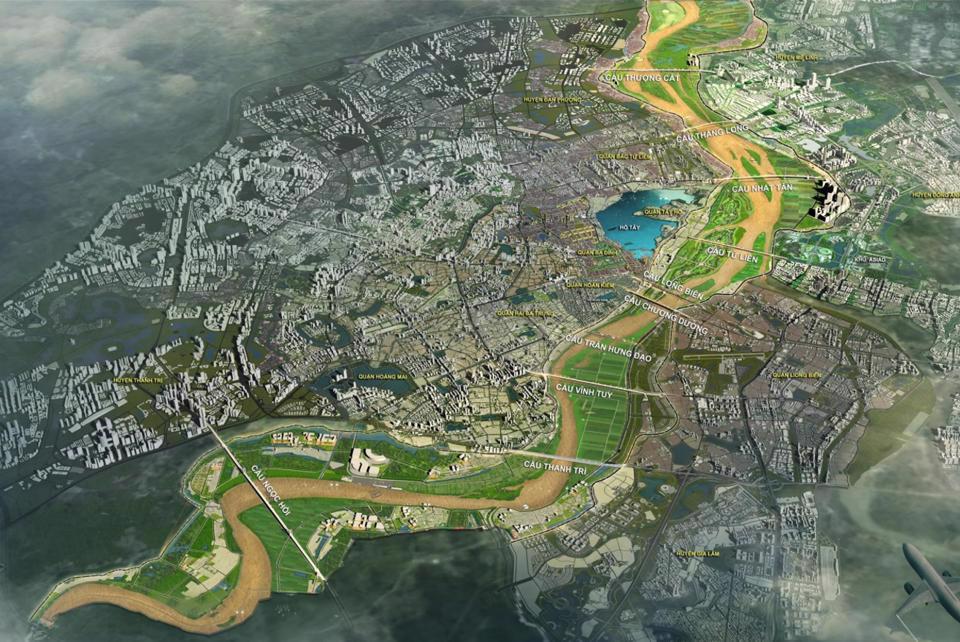
Consulting units have suggested building more bridges to increase connectivity between both sides of the Red River. With input from experts and scholars, the focus will be on building bridges with distinctive architecture.
"The transportation system of the newly developed areas along the Red River must be well connected to the city's main roads and residential areas," Architect Le Hoang Phuong said, expecting these riverfront areas to become centers and important exchange destinations, which will greatly contribute to attracting tourists to Hanoi.
According to Architect Dao Ngoc Nghiem, former Director of the Hanoi Department of Planning and Architecture, building bridges across the Red River creates "connecting circles" to ensure connectivity between areas on the two banks of the Red River.
"There are currently eight bridges spanning the Red River. Each one is built with the unique culture of the thousand-year-old capital in mind. In the near future, the bridges are expected to play an important role in the city's development, shaping Hanoi as a city on both sides of the Red River," Nghiem told The Hanoi Times.
After over 10 years of implementing the Capital Construction Master Plan 2030 with a Vision to 2050, approved by the Prime Minister, the city has completed all urban subdivision planning projects, including urban subdivisions along the Red River.
Aware of the potential of the Red River, on March 25, 2022, the Hanoi People's Committee issued a decision to approve the "Red River Urban Subdivision Planning" project (section from Hong Ha Bridge to Me So Bridge) with an area of nearly 11,000 hectares within the administrative boundaries of 13 districts in the city.