

Red River Landscape Boulevard anchors Hanoi’s next phase of urban growth
Hanoi’s launch of the Red River Landscape Boulevard marks a decisive shift in urban thinking, restoring the historic river to its rightful place at the heart of the capital’s spatial, cultural and economic structure.
THE HANOI TIMES — Hanoi’s recent move to kick-start the Red River Landscape Boulevard restores the historic river to the heart of the capital’s urban structure, according to Bui Hoai Son, a member of the National Assembly’s Committee on Culture and Social Affairs.
With the launch of the US$32.5 billion project last weekend, Hanoi has formally repositioned the Red River as a central urban axis linking infrastructure, landscape and social life, Son told The Hanoi Times.

Rendered design of the Red River Landscape Boulevard project.
“The groundbreaking marks the opening of a new development vision for the city,” he said.
The Red River carries profound significance for Hanoi’s geography, history and cultural identity. For millions of years, it has nourished fertile plains in the northern delta and played a decisive role in King Ly Thai To’s choice of Dai La as the site of Thang Long, the ancient capital of Vietnam and today’s Hanoi.
Son said that for decades, historical circumstances, technical constraints and flood-control demands pushed urban development away from the river, turning large stretches of the riverbanks into technical buffer zones.
This approach, he noted, gradually distanced residents from the river, both in physical space and in the city’s collective consciousness.
“The groundbreaking of the Red River Landscape Boulevard carries historical significance, demonstrating that Hanoi now has the capacity and vision to balance flood safety, effective use of river space and sustainable infrastructure development,” said Son.
Dao Ngoc Nghiem, former chief architect of Hanoi, said the city has spent many years on careful preparation.
Since the early 2000s, domestic and foreign investors have repeatedly proposed riverside development plans, highlighting the Red River’s strong appeal across multiple sectors and disciplines, he said.
Nghiem stressed that flood control and safe water discharge have consistently posed the biggest obstacles to implementation.
The Red River’s complex hydrology, combined with limited upstream flow data, has at times forced Hanoi into reactive flood management instead of proactive planning, he told Tuoi Tre (Youth) Newspaper.
“Lessons from major floods show that water management remains the decisive factor in riverside development,” Nghiem said.
He added that gaps in upstream data continue to limit response capacity, making basin-wide coordination and hydrological data sharing essential for long-term planning.
Reframing the Red River as a living urban space
Beyond technical and infrastructure requirements, experts agree that the Red River Landscape Boulevard calls for a comprehensive and long-term vision for riverside space.
According to Son, wide boulevards and riverside parks should serve a purpose far beyond traffic flow, reshaping the riverfront into a multifunctional urban environment.
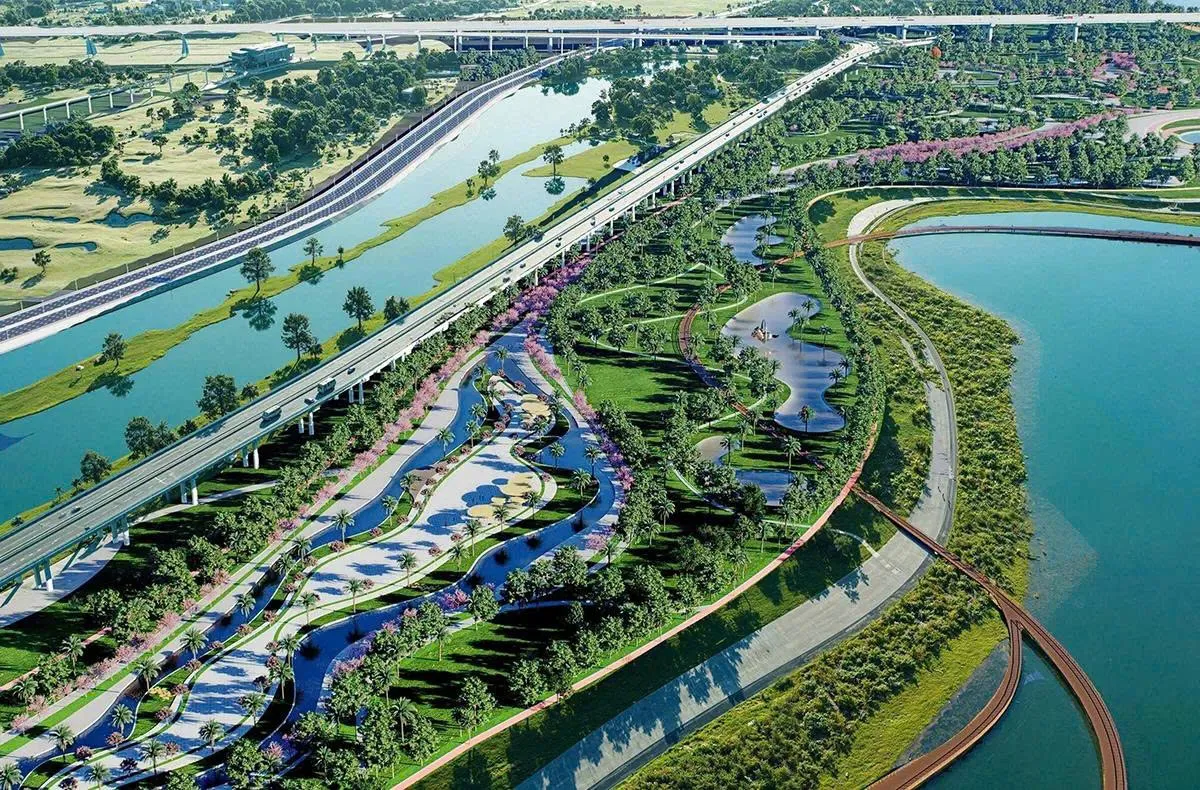
Rendered design of the Red River Landscape Boulevard project.
Under this approach, transport becomes just one layer, alongside ecological restoration, cultural preservation and community life.
As environmental pressure, urban density and quality-of-life concerns intensify, the creation of a central green corridor along the Red River becomes increasingly important, but it must genuinely serve daily urban life.
“A true landscape boulevard should invite people to walk, relax, meet and engage in community cultural activities,” Son said.
He noted that the Red River banks hold deep layers of cultural heritage, from craft villages and ancient settlements to wharves, alluvial plains and historical traces linked to the formation and defense of the Thang Long citadel.
Without sufficient cultural depth in planning, these values risk fading away. A culture-driven approach, by contrast, could turn the riverside into a space where Hanoi tells its thousand-year story through contemporary design.
From an economic perspective, Nguyen Van Dinh, chairman of the Vietnam Association of Realtors, said real estate development often follows infrastructure, but sustainable value does not emerge from every transport corridor.
He said the real strength of the Red River boulevard lies in a well-designed riverside ecosystem where infrastructure integrates seamlessly with housing, services and public amenities.
As the real estate market undergoes restructuring, major projects like the Red River corridor may not trigger short-term price surges, but they can set new benchmarks based on real use value, he said.
As infrastructure gradually takes shape, demand for residential, commercial and service functions will attract long-term capital, steadily replacing speculative investment patterns, Dinh added.
He also said the project’s development space extends beyond Hanoi’s administrative boundaries.
By linking neighboring provinces, the corridor could evolve into a regional axis for urban, industrial and service growth.
Dang Hung Vo, former Deputy Minister of Natural Resources and Environment, said Hanoi currently lacks development corridors capable of driving regional expansion.
“If authorities implement the project in a coordinated way, the Red River boulevard could become a powerful magnet for new investment,” he said.
He cautioned, however, that riverside urban development must avoid excessive hardening of riverbanks, especially as climate change increases risks and places higher demands on dike safety.
Experts also emphasized the role of local residents in the development process.
According to Son, prioritizing on-site resettlement remains vital to sustainability, as large urban projects succeed only when local communities become active participants in transformation rather than being pushed aside.
From a spatial planning perspective, Nghiem added that population distribution will strongly shape development along both riverbanks, especially as the Red River section through Hanoi emerges as a central growth axis.
With nearly 40,000 hectares of riverside land and a population exceeding 10 million, including migrants, the area represents a major resource for housing development.
He stressed that planners must use riverside land in a balanced way, allowing residents to live near the river while commuting to the city center, while at the same time supporting economic growth in riverside wards and communes.
|
Red River Landscape Boulevard The developmet of the Red River Landscape Boulevard kicked off on December 19 in Phu Thuong Ward, Hanoi to mark the beginning of a mega project with an estimated total investment of about VND 855 trillion (US$34.2 billion). According to the project implementation plan, the boulevard covers an area of 11,000 hectares, stretching from Hong Ha Bridge to Me So Bridge and spanning 19 wards and communes across Hanoi. The project includes an approximately 80-kilometer main boulevard, a landscape and recreation park system of about 3,300 hectares, and around 2,100 hectares of cleared land for urban redevelopment and expansion. |







