Red River Zoning plan: Architectural landscape axis for Hanoi
Hanoi - the city with a history of thousand-of-years of development is not only the center of the Red River Delta, the capital of the country, but also a dynamic and competitive city in nation, region, and the world.
Development history has endowed Hanoi with a rich urban heritage, including a diverse system of natural landscapes. Rivers, lakes, and water surface have created a typical characteristic and potential for Hanoi for sustainable development.
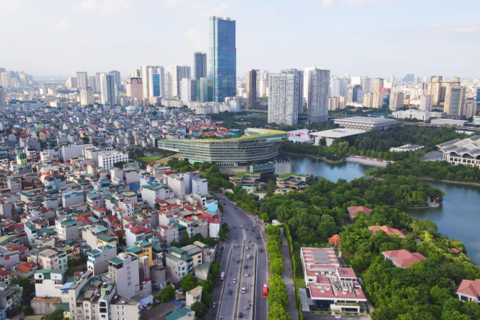
| The zoning plan on both sides of the Red River for socio-economic development of the capital. Photo by: Thanh Hai |

Plans for the Red River’s two side development
"Hanoi: the convergence of water and people" has been the awareness in the development process. Referring to the water, it must mention the Red River as the largest river in the city. The area on the two sides of the Red River today is the historical and cultural space of Hanoi where many people live, becoming the ecological axis connecting the capital with other regions. That awareness is upheld even more today as a motivation for the capital's development.
From the development experiences of the Han River of Seoul (South Korea), the Seine of Paris (France), the Qiantang River of Hangzhou (China), the central axis of the river of Shanghai (China), and the port and waterway system of Manila (Philippines), Vietnamese experts believes that the development of the area on both sides of the Red River is necessary to create a new driving force for the development of the capital city.
The Red River originates from China with a length of 1,226 km in which the final stretch of 600km runs through Vietnam and nearly 40km to Hanoi (before the city’s expansion) with a riparian areas of nearly 11,000 ha on both sides of the river and 118km after the expansion. The riparian area on the river sides has always been paid attention in the city development. Right after the war ended in 1954, the city built a number of riverside housing developments such as An Duong, Phuc Tan… for public officials employees. There are also a number of industrial establishments along the river such as factories and ports.
In 1994, the city implemented a study on detailed planning on both sides of the Red River. Notably, in the Master Plan of Adjustment Project of Hanoi by 2020, it targeted to dredge the river bed and upgrade ports of Khuyen Luong and Pha Den, open more ports of Van Kiep, Thuong Cat,among others, strengthen the dyke system to prevent floods in the city center, and construct riverside roads and some resident areas.
In particular, in 2000 the city authority also had agreed on a planning of Red River riparian areas, attracting local and foreign projects on investment in its development. The city piloted a project to renovate and build 1km along the Red River in Tay Ho district. In 2002, it researched river dyke, tourism route, and residential areas for socio-economic development. Accordingly, the ministries, departments, and universities cooperated to organize many scientific seminars discussing projects for flood drainage and development of culture, tourism, spor.
After Hanoi was expanded in 2008, the riparian area on the two sides of the Red River received more attention, especially in the capital’s construction master plan up to 2030, with a vision to 2050 in which there are a number of regulations related to the area. For example, the area is the axis of the central landscape of the capital, where there will be cultural and entertaining parks to organize important events. It also includes the development of tourism water routes on the Red River, the building of eight new bridges and tunnels across the river, dredging of channels, and construction of new ports and wharves along the Red River, Duong River and Da River for water traffic.
Scientific research projects and studies implemented
From 1994 up to now, there have been 11 domestic and international projects and scientific research on the riparian areas of the Red River. In particular, the cooperation project between Hanoi and Seoul has been well studied, gathering many experts from the two countries. Survey and seminars have been organized to collect public comments, and as well as exhibitions have been open. The research covers a riverside space with a length of 40km with the exploitation land area of 6,200ha.
This project includes building the water traffic, planning for construction of parks on the islets; and renovating riverside urban landscape with 2,400ha including residential area, port, high-tech park, sport centers. The project has a total cost of USD7.1 billion.
It can be seen that the projects are linked to the city's general socio-economic development. However, the implementation is still slow due to shortcomings from the coordination process among ministries and departments of different localities. After the master planning was approved in 2011, Hanoi had a plan to make 35 zoning plans, but so far only 26 projects have been approved. The rest focuses mainly in the central area, including the urban zoning planning project on both sides of the Red River.
It is expected once the project is approved after three years of research with the participation of many experts, it will open a wide window for socio-economic development, residential management, create an attractive destination for both domestic and investors and improve the life quality for Hanoi people.