

Revised Capital Law urged to boost Hanoi’s sustainable growth
The current version of the law lacks specific provisions needed to solve the problems in the management and development of the city.
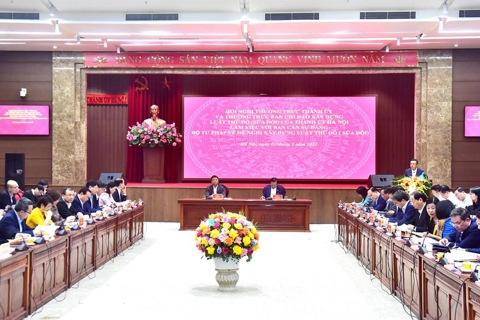
Amending the Capital Law would help Hanoi effectively utilize all available resources, tap potentials and strengths, and ensure sustainable development, experts said at a seminar in Hanoi on March 15.
| Overview of the seminar. Photo: The Hanoi Times |

The Capital Law, which came into effect on July 1, 2013, is an important legal document that outlines the responsibilities, policies, and positions for the construction, development, and preservation of Hanoi's heritage.
Although the specific mechanisms of the Capital Law have brought positive results to Hanoi's growth over the past decade, they have also revealed certain limitations and weaknesses.
Based on the evaluation of the application of the Capital Law and the current requirements for the growth of the capital, local authorities are focusing on revising the Capital Law and proposing new solutions to provide the city with effective and viable mechanisms to promote its sustainable development.
At the seminar, Dr. Duong Thi Thanh Mai, a former expert at the Ministry of Justice, stated that the current Capital Law is still highly relevant to the city's development efforts, but it lacks specific and innovative regulations that are in line with the position and role of the capital, which can create favorable conditions for its rapid and sustainable construction and development.
Mai also argued that some laws enacted after the Capital Law conflict with it and its application guidelines.
Addressing legal bottlenecks
Lawyer Nguyen Hung Quang, Vice President of the Vietnam Society of International Law, believes that urgent urban problems such as traffic congestion, air pollution, and lack of public spaces for children require systematic, synchronized, and sustainable solutions that must be specified in the amended Capital Law.
"The law must include complete regulations on urban planning, management and development, technical infrastructure and transportation in the capital, as well as mechanisms and policies for developing a modern and comprehensive healthcare system and comprehensive social security that will promote the development of satellite urban areas," Quang said.
Quang also called for the gradual relocation of government offices, hospitals, factories, and universities from the central urban area and the development of an interconnected transportation infrastructure system to reduce population density in the central urban area.
Dr. Nguyen Van Cuong, Director of the Institute of Legal Studies (Ministry of Justice), mentioned that many countries had established exceptional institutions for their capital cities, which Hanoi can learn from, such as Seoul, South Korea.
According to Cuong, since 1991, the South Korean Government has granted greater autonomy to Seoul, giving the head of the Seoul Metropolitan Government certain powers normally held by ministers and leaders of ministerial-level agencies.
These special regulations take precedence over those in-laws of general application for the entire country, Cuong said, noting that these specific and outstanding regulations can serve as valuable reference data in developing regulations in the Capital Law.
During the discussion, the guests also emphasized the need to amend the Capital Law to fully utilize all available resources, leverage strengths and potentials, and ensure Hanoi's sustainable and robust development.
They shared the view that Hanoi has a rich cultural heritage spanning over 1,000 years, including numerous tangible and intangible heritage sites, providing economic growth opportunities. The city has unique urban characteristics shaped by centuries of history, making it different from other provinces and cities.
In addition, Hanoi enjoys a vast and beautiful landscape system and a large land bank, which provide favorable conditions and a solid foundation for future urban development. Therefore, it is essential to establish an appropriate legal framework in the Capital Law that is geared toward building a modern, civilized, and developed capital city.
Hanoi's revised Capital Law sets out nine major policy directions, including improving the local government's efficiency, modernization, and professionalism; attracting skilled professionals to support the city's growth; and strengthening Hanoi's financial and budgetary capacity for development.
|
![[Infographic] Hanoi proposes policies for Capital Law amendments](https://cdn-media.hanoitimes.vn/2022/11/08/hanoi1.jpeg?w=480&h=320&q=100)







